

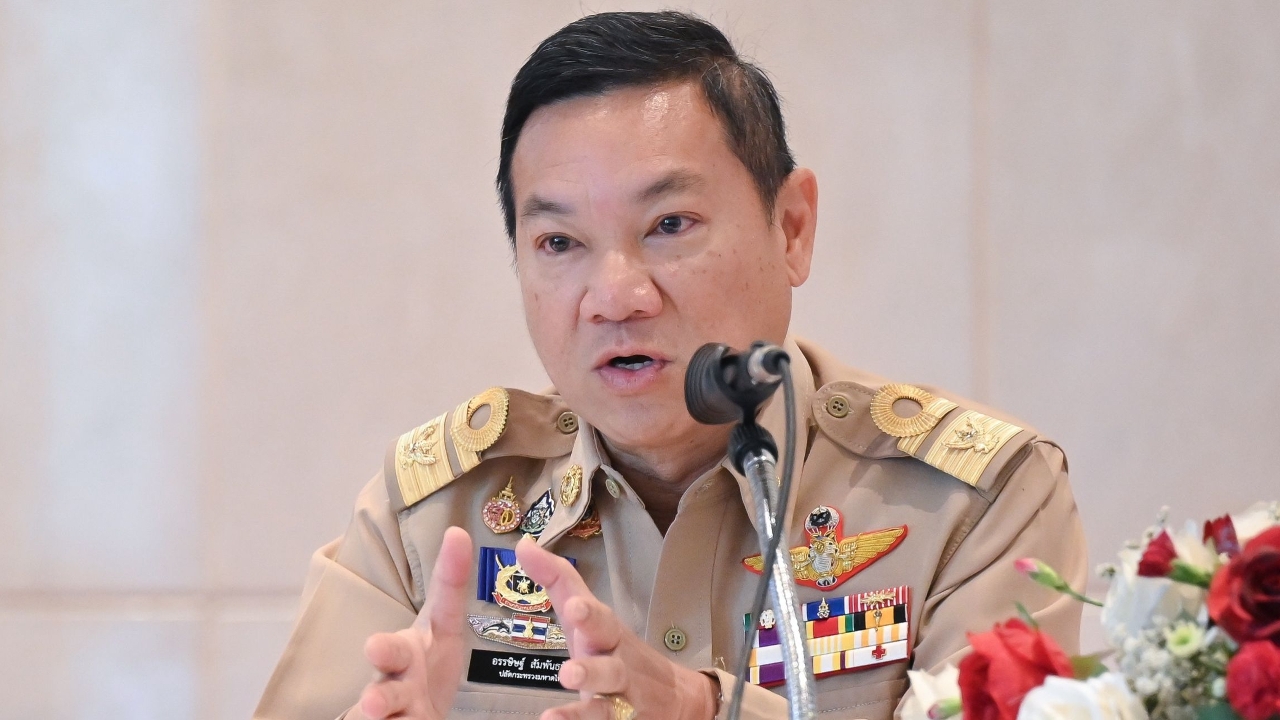
The Permanent Secretary of the Ministry of Interior intensively trained governors of 32 border provinces to advance the Integrated Border Security Center, uniting efforts to address border threats in all dimensions.
At 10:30 AM on 20 Jul 2026 GMT+7, Mr. Arsit Sampantharat, Permanent Secretary of the Ministry of Interior, presided over the opening of a workshop to advance the operations of the Ministry's Integrated Border Security Center (ศบค.ชด.มท.). Attendees included General Natthapong Praokaew, Deputy Chief of Staff of the Royal Thai Armed Forces Headquarters; Mr. Phasakorn Boonyalaksam, Deputy Permanent Secretary of the Ministry of Interior and Head of Internal Security Mission Group; governors and deputy governors of 32 border provinces; Mr. Kerdsak Yasothorn, Deputy Director-General of the Department of Public Works and Town & Country Planning; Mr. Thanawat Phatsadarak, Deputy Director-General of the Department of Lands; Mr. Kukiat Nimniam, Chief Inspector of the Department of Local Administration; Ms. Orauma Worasan, Director of the Foreign Affairs Division, Office of the Permanent Secretary of the Ministry of Interior; the Center's committee members; and representatives of related agencies. The event was held at the Grand Hall 2, Rama Gardens Hotel, Bangkok.
Mr. Arsit stated that Prime Minister Anutin Charnvirakul issued Prime Minister's Office Order No. 212/2569 establishing the Integrated Border Security Center (ศบค.ชด.) on 30 May 2026, appointing the Supreme Commander as director. Subsequently, the Ministry of Interior established its own Integrated Border Security Center (ศบค.ชด.มท.) to monitor, analyze, and assess situations and potential impacts on border security. It also coordinates operations with provincial-level Thai border command centers with neighboring countries and integrates security data with the armed forces to ensure efficient cooperation between provinces as operational units and security agencies in alignment with government policy, aiming to reduce threats and enhance security in the area.
He urged border provinces to utilize the provincial-level Thai border command centers with neighboring countries as serious mechanisms to drive work, especially those bordering Myanmar and Cambodia, which currently face threats such as cybercrime, human trafficking, and drug problems. He called on local agencies to strictly enforce the Border Goods Control Act B.E. 2524 (1981) as well as related Ministry of Defense announcements and orders concerning border goods control.
“Drug issues are a critical national agenda requiring urgent resolution because most drugs are smuggled from abroad. Border provinces serve as frontline checkpoints of utmost importance. District chiefs in border areas must integrate cooperation with security agencies—including military, police, and local leaders—to strictly block and monitor natural routes. I urge governors to accelerate the 'Drug-Free Subdistrict' project to create a domino effect, expanding success from subdistrict to district and provincial levels, ultimately aiming to become provinces free from both drug buyers and sellers, which would be a proud achievement.” Mr. Arsit said.
Regarding other security dimensions, such as addressing transnational crime and cross-border forest fires and haze during the dry season, governors were advised to use good relations with neighboring countries for negotiation and problem-solving and to report progress continuously to senior commanders. Although the southern border provinces have improved, allowing a reduction of declared emergency zones, close monitoring of unrest remains necessary. Officials should regularly check security equipment readiness and involve religious leaders in public communication based on the principles of 'understanding, accessibility, development.' Furthermore, strong personnel should be selected for subdistrict protection units (ชคต.) to respond promptly to situations.
Mr. Arsit further stated that in managing border trade issues, governors, as responsible authorities addressing public grievances, have decisive law enforcement powers. If illegal agricultural imports occur and main agencies cannot resolve the problem, governors may order district chiefs to set up administrative checkpoints ahead of customs stations immediately. Additionally, all provinces should clearly develop border security operation plans for 2023-2027. For areas with refugee shelters for conflict victims currently facing budget cuts from external agencies, relevant agencies should collaborate closely in management. The Ministry of Labor is coordinating with the private sector to consider integrating skilled and linguistically capable refugees into the labor system for mutual benefit.
“I thank all governors for prioritizing and attending this meeting in person. The establishment of the Ministry of Interior’s Integrated Border Security Center (ศบค.ชด.มท.) is a key agenda item the Prime Minister hopes will foster close integration between central and regional agencies to concretely advance security and safety along the country's borders.” Mr. Arsit concluded.