

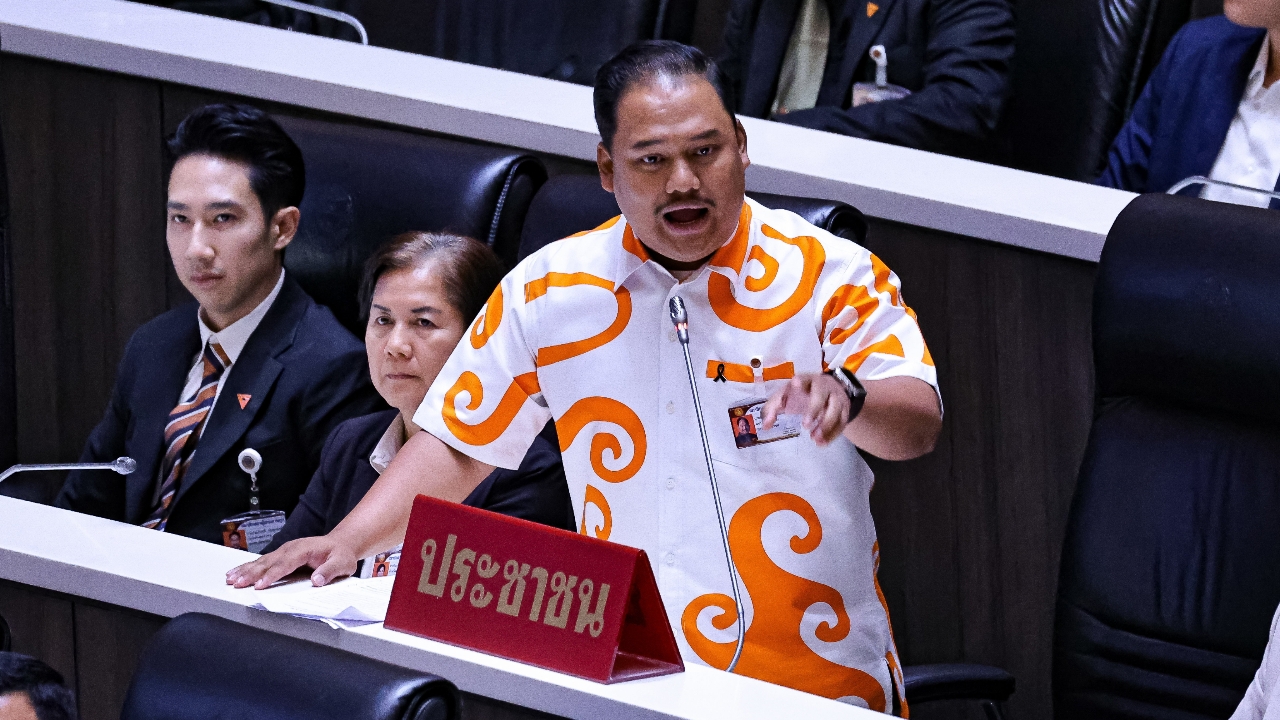
"Kai Natcha" criticized the government for financial shortages, advising stricter control over road construction and repair budgets instead of targeting the poor. He challenged the government to investigate wealthy citizens nationwide first, rather than casting suspicion on the poor, emphasizing that the government’s duty is to care for the people, not to make welfare access more difficult.
21 Jul 2026 GMT+7 Mr. Natcha Boonchaiinsawat, a party-list Member of Parliament for the Party of the People. He criticized the government’s policy implementation regarding the screening of those eligible for welfare cards. Specifically, the recipients of the “State Welfare Card.” He believes the government is demonstrating inefficient budget management by imposing additional conditions and burdens on low-income citizens, instead of addressing the root cause of government spending issues. The government’s current actions clearly reflect signs of "budget depletion and penny-pinching." When funds are lacking, the government chooses to be strict with the poor—those who most deserve state assistance—rather than suspecting them or forcing them to repeatedly prove their eligibility.
“If the government truly wants to be strict with taxpayer money, that strictness should be applied to road construction and repair budgets, rather than cutting benefits for the poor,” he said.
Natcha added that the annual budget for road construction and maintenance is enormous, yet many projects spend money on upgrading roads that are still in good condition, overlaying asphalt over existing roads, recycling road surfaces, or making unnecessary repairs. These are areas where the government should seriously examine cost-effectiveness and transparency to save national funds.
At the same time, Natcha expressed support for the statement by the Committee on Social Welfare for Public Security, which the Party of the People proposed to urge the government to review its screening methods and urgently address structural welfare system problems. He emphasized that the government's role is to make it as easy as possible for people to access rights, not to create complicated obstacles that prevent needy people from receiving assistance.
Regarding verifying low-income eligibility, Natcha proposed that the government change its approach by investigating wealthy individuals first, rather than starting with suspicion toward the poor. “If the government wants to verify and screen people, it should start by checking all wealthy citizens nationwide. Those proven to have income and assets above the threshold should be excluded from welfare, while the rest are people the state must care for. Providing assistance through mechanisms or welfare programs is the government's responsibility.”
He also noted that the state already has databases on taxes, income, assets, and holdings of citizens. If the government wants to screen wealthy people, it should use these data as the main tool instead of forcing low-income people to spend time, money, and endure complicated eligibility processes, especially when many have uncertain incomes and face rising living costs.
He concluded that if the government finds its budget insufficient, it should cut unnecessary or unproductive expenses and projects that do not directly benefit citizens, then use those funds to provide urgent relief and improve the quality of life for suffering people. “The government’s duty is to care for the people, not to make welfare access harder. If it continues to cut benefits for the poor instead of reforming budget spending, public patience will run out, and ultimately, the government will face a crisis of trust from the people.”