

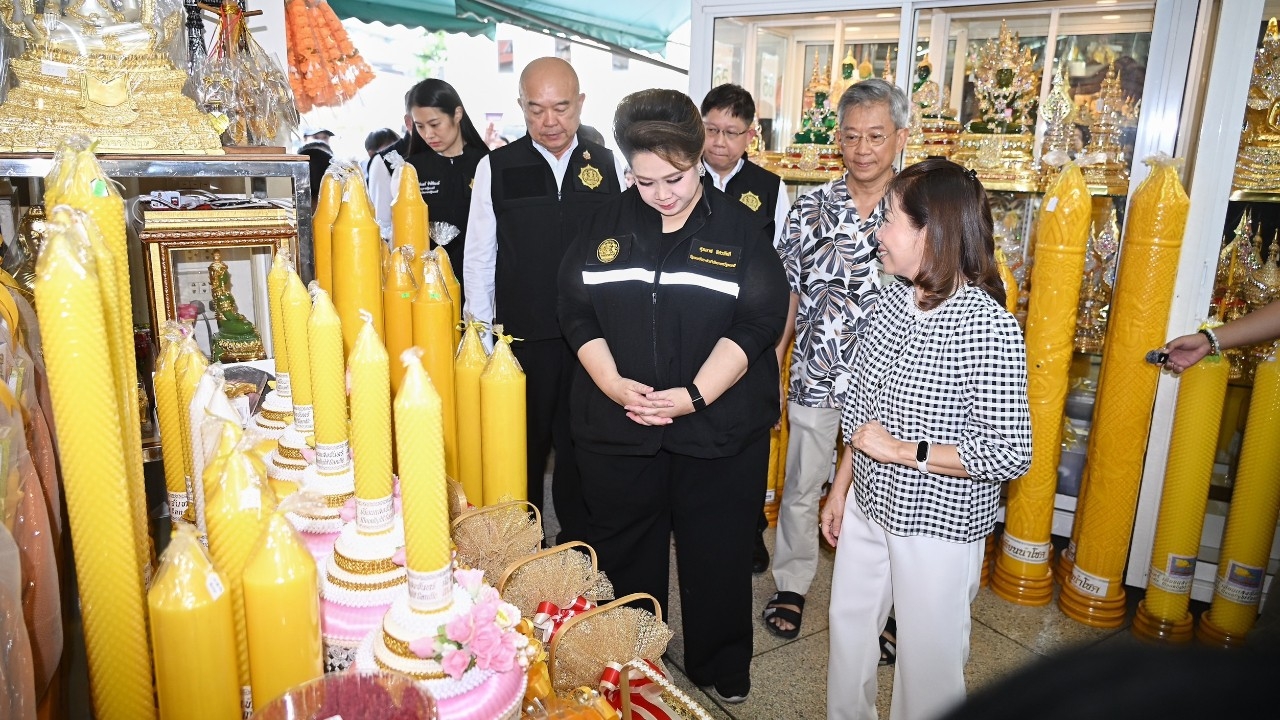
The Office of the Consumer Protection Board (OCPB) is conducting widespread inspections of Buddhist offering product shops in the Sao Chingcha area ahead of the Buddhist Lent Festival. Supamas emphasized that business operators should not exploit devotees.
On 21 July 2026, Ms. Supamas Isarapakdi, Minister attached to the Prime Minister's Office and overseer of the Office of the Consumer Protection Board (OCPB), led a team including Mr. Pradermchai Boonchuaylue, the Minister's advisor; Dr. Patcharin Samsiripong, the Minister's secretary; Mr. Ronarong Poolpipat, Secretary-General of the OCPB; along with representatives from the Department of Internal Trade, the Economic Crime Suppression Division, Phra Nakhon District Office, and the Consumer Organizations Council. They conducted thorough inspections of the production and labeling of Buddhist offering and religious sets in the Sao Chingcha area, Phra Nakhon District, Bangkok, preparing for the upcoming Asalha Puja and Buddhist Lent days (29-30 July).
Ms. Supamas explained that this proactive inspection follows Prime Minister Anutin Charnvirakul's policy to prevent problems before they arise. The OCPB was tasked with checking product labels, while the Department of Internal Trade checked price tags at sales points. She also ordered provincial consumer protection subcommittees across the country to intensify inspections in their areas.
Ms. Supamas stated that although the OCPB has resolved all complaints about poor-quality or misrepresented Buddhist offering sets, the festival season sees a large influx of products. Therefore, vigilance is needed to prevent operators from exploiting devotees by selling substandard goods. Buddhist offering sets are controlled products requiring complete Thai-language labeling, including product details, individual prices, manufacturer name and address, packaging and expiration dates (based on the earliest expiring item), total set price, and warnings if some items might react chemically with others, such as soap or detergent placed near rice or tea leaves.
Regarding legal penalties, the Minister attached to the Prime Minister's Office emphasized that sellers violating labeling laws face up to six months imprisonment or fines up to 100,000 baht, or both. Manufacturers face up to one year imprisonment or fines up to 200,000 baht, or both. She advised consumers to carefully check labels for complete product lists, prices, expiration dates, and manufacturer names before buying Buddhist offering sets, and to purchase from reputable shops. She added, "Charity is not measured by the value of goods but by the sincerity of intention. The government will ensure every donation baht is well spent. When making merit, quality products with clear labels and prices are essential."