

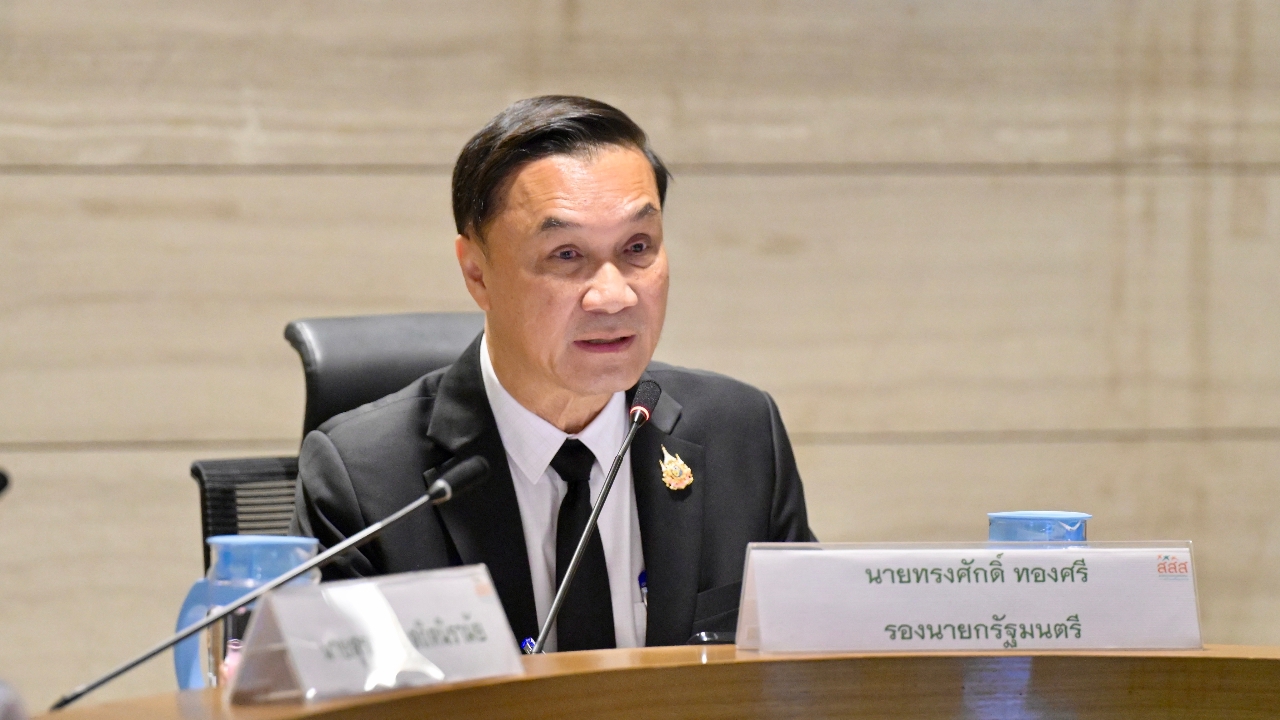
Songsak affirmed that "clean air" is a fundamental right. The government is pushing forward a draft law supporting the Thai Health Promotion Foundation (สสส.) to activate three mechanisms linking government, private sector, and civil society to jointly address the PM2.5 pollution problem.
On 24 July 2026, Mr. Songsak Thongsri, Deputy Prime Minister and Chairman of the Thai Health Promotion Foundation (สสส.) Board, said at the 6/2026 board meeting that the meeting acknowledged สสส.’s strategic work in controlling health risks from fine particulate matter (PM2.5), which threatens health and the national economy, impacting over 38 million people.


There are 12 million patients suffering from air pollution-related diseases, causing economic losses exceeding 2.2 trillion baht. Clean air is a basic health right for Thai people. The government prioritizes the PM2.5 problem and supports the draft Clean Air Management Act currently under parliamentary consideration.
“The Prime Minister has ordered prevention and solutions, especially health care for vulnerable groups, provision of clean air rooms, masks, and campaigns to raise awareness for reducing dust and smoke. This aligns with สสส.’s work focusing on three main mechanisms: 1. developing and linking Big Data innovations for proactive forecasting of dust situations, 2. preparing citizen mechanisms and raising awareness for enforcing the Clean Air Act, and 3. expanding the Breath Council network nationwide to elevate models reducing burning and all sources of PM2.5 dust.”

Meanwhile, Dr. Pongthep Wongwacharaipiboon, manager of สสส., stated that สสส. drives strategies supporting PM2.5 solutions with partner networks through five key operational areas.
1. Creating accurate, up-to-date databases enabling targeted solutions, such as establishing an academic center for clean air promotion, supporting research and data systems for dust management, and developing cross-border cooperation with Laos and Myanmar.
2. Strengthening the public sector by turning those affected into problem managers, for example supporting the establishment of provincial Breath Councils covering 29 provinces and expanding the Dust Fight Classroom project in over 2,000 early childhood development centers nationwide.
3. Driving structural and legal mechanisms, including jointly pushing the draft Clean Air Management Act, preparing for its enforcement, and developing the Burn Check application to manage open-area burning.
4. Raising awareness and encouraging participation in prevention through modern knowledge media accessible to all ages.
5. Connecting government sectors like the Ministry of Agriculture and Cooperatives, private sectors such as the Chamber of Commerce, and civil society to integrate unified local-level actions.