

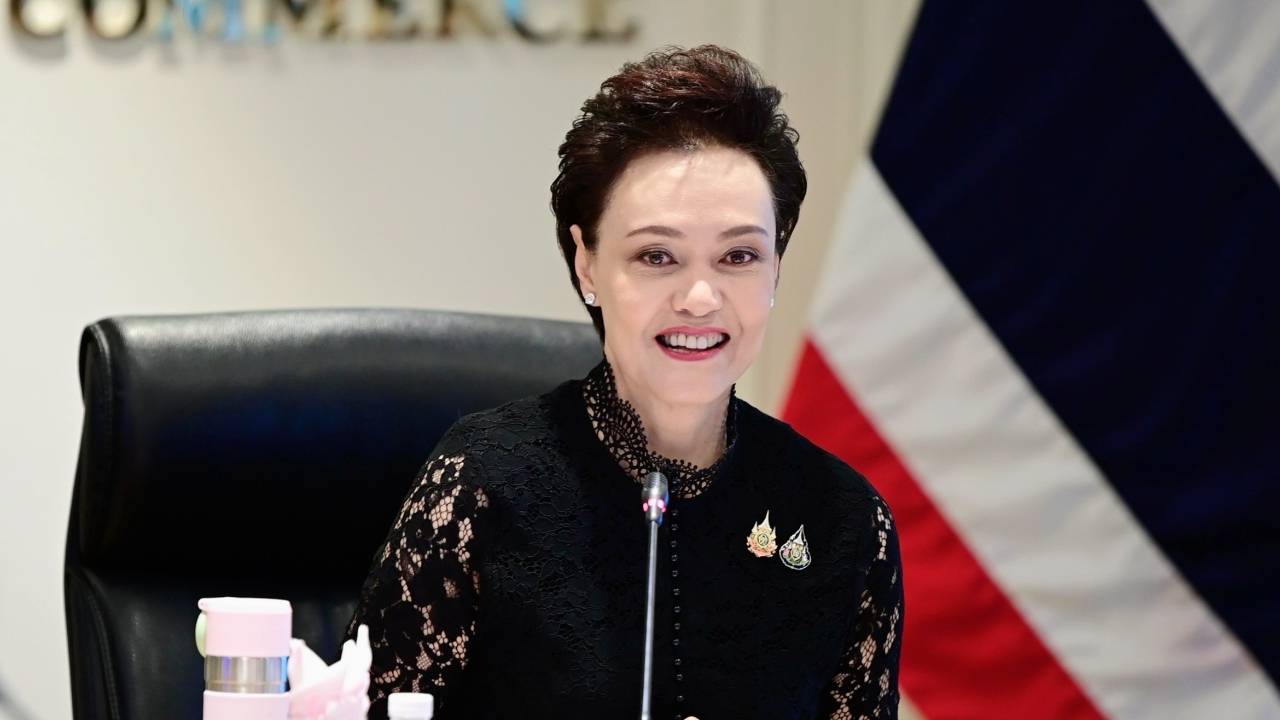
Supapji revealed rapid talks with the U.S. following the announcement of a new 12.5% import tariff on Thai products, emphasizing that the agreement must create balanced benefits. The Ministry of Commerce disclosed that 2,120 Thai product items have been granted exemptions.
24 July 2026 GMT+7 Mrs. Supapji Suthammanphun, Deputy Prime Minister and Minister of Commerce, serving as the head of the Thai delegation in talks with the United States, disclosed details regarding negotiations on the Agreement on Reciprocal Trade (ART) with the U.S. She stated that discussions with the U.S. have been accelerated to reach a mutually beneficial conclusion, aiming to maintain the long-standing good trade relations as long-term economic partners. Thailand's key principle is not just to expedite the conclusion but to ensure the agreement delivers balanced benefits without harming public health, national security, the public interest, or the government's policy-making ability to govern appropriately.
Meanwhile, Ms. Kirida Phaopijit, Assistant Minister of Commerce, addressed the U.S. decision to impose retaliatory tariffs under Section 301 on 60 countries lacking measures prohibiting imports produced by forced labor, at rates of 10% and 12.5%. Thailand and 37 other countries, including Vietnam, the Philippines, and China, face an increased tariff of 12.5% above the usual Most Favored Nation (MFN) rate. She explained that as of today, the U.S. has implemented tariffs under Section 301 for the absence of prohibitive measures against forced labor imports, charging Thai imports 12.5%, a 2.5% increase from the previous 10% under Section 122, which expired today (24 July). However, the U.S. has exempted 2,120 product items, representing more than half the value of Thai exports to the U.S., so Thai goods remain competitive in the U.S. market.
Among the exempted products not subject to the 12.5% tariff are integrated circuits, hard disk drives (HDD), aircraft parts, natural rubber, rubber sheets/blocks, tapioca starch, fresh and processed pineapples, fresh and dried fruits, fresh coconuts and coconut water, and sugar from sugarcane.
However, one issue remains under U.S. investigation under Section 301 involving 16 countries including Thailand, concerning excess production capacity, with the tariff rates yet to be announced. The Ministry of Commerce is closely monitoring this and accelerating discussions with the U.S. to finalize the Agreement on Reciprocal Trade (ART) to maximize benefits for both parties.
Thailand may require more time to negotiate with the United States than some regional countries due to sensitive issues and certain legal constraints domestically that cannot be relaxed, especially regarding the health and safety of the population. However, all relevant Thai sectors—including farmers, producers, consumers, entrepreneurs, exporters, and importers—can trust that Thailand's stance will be based on the country's overall interests, balancing short-term impact reduction with enhancing Thailand's long-term economic competitiveness.
Additionally, the Ministry of Commerce is simultaneously preparing measures to enhance competitiveness and mitigate potential impacts, readying support for businesses and sectors directly affected. Measures include low-interest loans to improve liquidity, tax support for exporters, transportation cost reduction, improved logistics management efficiency, and promoting the use of domestic raw materials and parts to increase value and strengthen Thailand's supply chains.
At the same time, the Ministry is intensifying efforts to enter and expand new markets to diversify trade risks, broaden trade and investment opportunities for Thailand, while maintaining existing customer bases. This approach is not only a short-term fix but aims to restructure Thailand's trade to be more flexible, reduce over-dependence on any single market, and strengthen the competitiveness of Thai entrepreneurs in the long term amid increasing global trade uncertainty.
The U.S. has applied Section 301 of the Trade Act of 1974 to investigate trading partners worldwide, including Thailand, on two main issues: structural excess capacity and the absence of measures banning imports produced by forced labor. The U.S. imposed tariffs replacing the expiring 10% tariff under Section 122, added on top of normal MFN rates, which expired on 24 July 2026.
However, on 23 July 2026 (U.S. local time), the U.S. announced its final decision to impose retaliatory tariffs of 10% and 12.5% regarding the absence of prohibitive measures against forced labor imports. Thailand and 37 other countries, including Vietnam, the Philippines, and China, face an additional 12.5% tariff above MFN rates, with 2,120 Thai products exempted from the 12.5% increase, covering more than half of Thailand's export value to the U.S.