

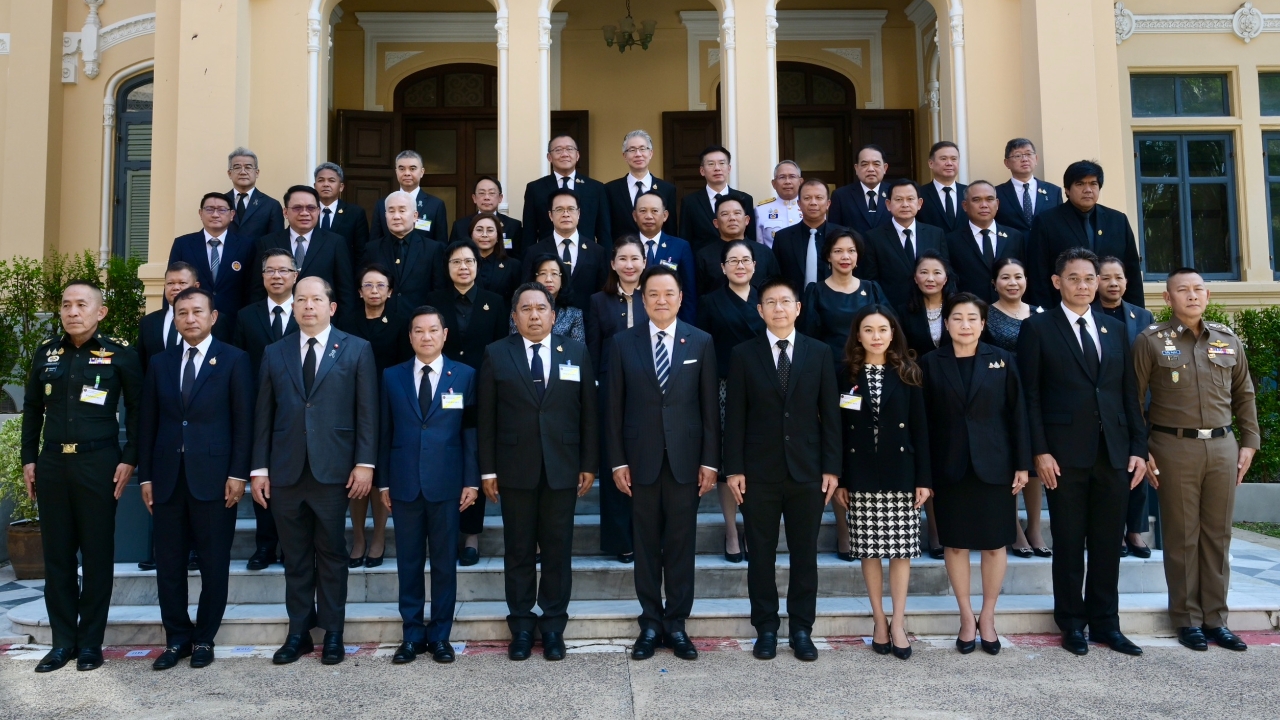
The Prime Minister held a meeting with government heads, ordering all ministries to integrate their work without dividing responsibilities, comparing the Cabinet to a body without party divisions. He instructed the tax negotiation team to be well-prepared with information and warned against allowing negotiation partners to detect weaknesses that could disadvantage Thailand.
At 10:00 a.m. on 24 July 2026, Anutin Charnvirakul, Prime Minister and Minister of Interior, chaired the first meeting of the year 2026 for ministry-level or equivalent government heads at the Paruskavan Palace, National Intelligence Agency, on Ratchadamnoen Nok Road, Dusit District, Bangkok. The meeting was attended by permanent secretaries, military commanders, and heads of all relevant agencies.
The Prime Minister stated that the government has implemented policies across various areas since taking office. He expressed gratitude to all ministries, government heads, and military commanders for their cooperation in driving government work, enabling the country to overcome critical situations.


He noted that initially many viewed the government as a minority and doubted its ability to govern effectively, especially after the dissolution of Parliament agreed with the legislature. However, since assuming office at the end of August last year, the country has faced significant events, including security challenges, incidents causing major national losses, and important royal ceremonies related to Her Majesty Queen Sirikit, the Queen Mother.
“All these events, if the government had not received cooperation and unity from all parties, we would not have been able to manage the situations successfully.”
Additionally, crises such as floods, landslides, and several significant incidents occurred, with cooperation from all agencies. The government not only managed the situations but also used state mechanisms and integrated approaches to resolve problems quickly.

The Prime Minister said that whenever he visits provinces, he does not cling to his titles as Prime Minister or Minister but considers himself a civil servant responsible for caring for the people's welfare.
He thanked all civil servants for maintaining proper conduct during the recent election period, ensuring no side felt advantaged or disadvantaged, and there was no criticism that the government used state mechanisms to benefit politically after dissolving Parliament. He emphasized that he never pressured civil servants to participate in activities overlapping with election campaigning.
The Prime Minister affirmed, “This government is strong, stable, and cohesive.” Although ministers come from various coalition parties, all prioritize their duties over political power retention.
He said those who have worked with him understand that he believes the government's survival depends on its performance, which results from cooperation among government heads. When giving policies to civil servants, he never bypasses the chain of command and is ready to monitor and support all operations to ensure government policies succeed.
He reiterated that although the government must manage many issues, whenever agencies receive policies, all cooperate well, enabling the country to overcome economic and other crises.
Regarding security, the Prime Minister praised police and military officers, stating he often tells security unit leaders that operational units are capable and efficient, never worrying about failing tasks — including crime suppression, prosecutions, investigations, cracking criminal hacker gangs, and drug problem solutions — all coordinated effectively.
On oversight bodies, though the government cannot interfere with the National Anti-Corruption Commission's work, there are cooperation mechanisms between independent agencies and state bodies, demonstrating professionalism, capability, and mutual trust.


The Prime Minister stated the government’s clear stance that any matters related to national security and the people's safety will never prioritize personal interests, political gains, or retaining power over the nation’s and people’s benefit. He believes colleagues have clearly observed this approach.
He added that if everyone had no official roles, they would simply be siblings, citing the Police Commission meeting to select the national police chief, saying, “Please trust the decision because I have called the Police Chief 'father,' 'uncle,' 'brother,' and now must call him 'younger brother.'”
He affirmed Thailand does not invade others, and if relations with Cambodia are restored, they must be on conditions set by Thailand.
The Prime Minister said it is important for Thailand to regain its position on the global stage. International visits are not just for handshakes but for negotiations to attract investment and new opportunities within the country. He noted that Thailand is preparing on many fronts, allowing this government to operate when the country is more ready.
However, although Thailand does not want conflicts with neighbors, it must maintain its dignity and sovereignty.
He said that in talks with neighboring leaders, all sides agree they do not want conflicts. Thailand’s position is clear: it has never invaded others, respects every country’s sovereignty, and desires no conflict. Yet, if Thailand is threatened, exploited, or attacked, it must respond decisively.
Regarding relations with Cambodia, the Prime Minister said the government has already informed that Thailand is ready to restore ties, but negotiations must be based on conditions set by Thailand. Issues that can be discussed without harming national interests are open for talks, but those that disadvantage Thailand will not be accepted as negotiation terms.

He emphasized this within government and private sectors, confident in the security agencies' ability to protect sovereignty and national safety effectively, assuring the public they have no cause for concern.
He urged all agencies to plan investment and development projects, confident that the country is peaceful and secure. He instructed security forces to build public confidence that national sovereignty is stable and people are safe, affirming the government’s ongoing commitment to this.
Regarding civil affairs, the Prime Minister asked all agencies responsible for the economy, society, public health, internal security, and administration to perform their duties fully to facilitate the public. He called for ministries to integrate their work from policy levels, saying, “Do not think that this ministry should only protect its own interests.” He stressed that this Cabinet is not a Cabinet of any single political party but the “Cabinet of Thailand,” which must collaboratively drive the country forward.
He instructed the tax negotiation team not to allow negotiation partners to detect weaknesses that would disadvantage Thailand.
The Prime Minister said that negotiations with foreign countries require cooperation from all ministries, including Commerce, Labor, Finance, Agriculture and Cooperatives, and all related agencies.
He emphasized that the chief negotiator must receive complete information and support from all government sectors, warning that if negotiators return asking for additional data from various ministries, it would greatly disadvantage the country. In informal terms, “the negotiation partner will see through us completely, and we will be at a disadvantage.” He urged full integration from all sectors because those assigned to negotiate represent the government, not their individual ministries.
He urged civil servants, “Do not shift into neutral gear,” emphasizing their duty to serve the public 24 hours a day.
At the end, the Prime Minister said, “As long as I remain Prime Minister, I will keep holding meetings until you get tired,” because he enjoys hearing information, opinions, and suggestions from government heads. He does not just open meetings and let agencies discuss alone, willing to spend several hours if it benefits the country's development.
In closing, he urged all civil servants, “Do not shift into neutral gear because your civil service status ends at midnight on 1 October.” He reiterated that civil servants’ responsibilities extend 24 hours a day, not only during office hours.
