

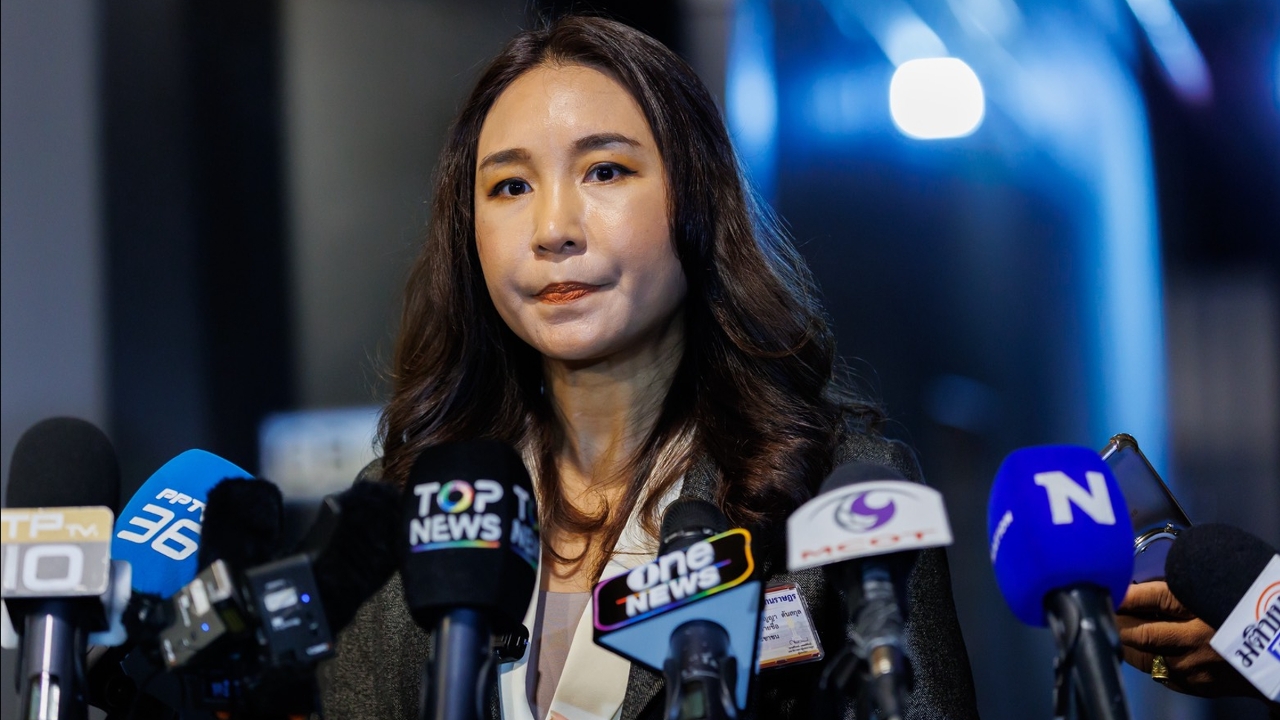
Sirikanya points out that the 2027 budget still has vulnerabilities, finding duplicate Cloud projects and overpriced equipment in several agencies. She highlights concerns over a 6.5-billion-baht solar-powered groundwater project that risks repeating corruption problems.
On 24 Jul 2026 GMT+7 at the Parliament Building, Ms. Sirikanya Tansakul, party-list MP and deputy leader of the People’s Party, spoke to the media about the overall picture and future direction of the draft 2027 fiscal year budget bill, expressing the party’s views after three weeks of consideration in the special committee reviewing the bill.
Ms. Sirikanya said the budget review has been underway for about three weeks. The main chamber has reviewed nearly half of it. This year’s atmosphere is quite lively because the public can follow meetings via live broadcast from the start, increasing social interest in the budget review. Since the government has already cut several agencies’ budgets at the outset, the main chamber’s discussions have focused mainly on policy debates.
However, whereas it was initially expected that the subcommittee might not need to cut many additional budgets, detailed examination this week revealed many projects with abnormally high costs and numerous duplicated budget requests. For example, the Ministry of Digital Economy and Society (DES) received about a 30% increase, mostly for a central government Cloud system worth around 5 billion baht, aimed at consolidating data storage from various agencies centrally.
But a detailed review found many agencies still request budgets to purchase or rent separate Cloud services, causing duplication. The subcommittee has therefore required agencies requesting such budgets to present certification from the DES confirming no overlap with the central Cloud system and that the central system cannot meet their needs.
Ms. Sirikanya further noted problems in agencies serving the public, such as the Ministry of Social Development and Human Security (MSDHS). Welfare budgets meant for the public have been reduced, yet administrative budgets have increased. For example, the Department of Empowerment of Persons with Disabilities has a project to establish a Data Center with procurement items priced excessively—fire doors about 200,000 baht, backup power units at 800,000 baht, and office chairs at 15,000 baht each. These items need scrutiny and possible reduction.
“Although the subcommittee has only started detailed reviews for one week, many irregularities have been found, reflecting that even though the government claims significant budget cuts, many overpriced items remain at the project level,” she said. Ms. Sirikanya added,
Regarding the central budget of 12 billion baht, it was among the first sections the committee reviewed. Additional factual information has been received, but it will be reconsidered after all budget sections have been reviewed. Some government faction committee members agree that if duplication is confirmed, budget reductions are possible. Thus, the final outcome must be closely monitored.
As for the Ministry of Interior, although the Department of Public Works and Town & Country Planning has had some budget cuts, concerns remain that the remaining projects distribute work to top-tier contractors while leaving room for lower-tier contractors to advance. This should be examined for irregularities.
Ms. Sirikanya observed that several agencies generate off-budget income yet still request additional state budget support. A clear example is the senior executive courses of the Ministry of Interior, which train around 200–300 people annually, charging about 200,000 baht per participant, generating tens of millions baht yearly, but still seek further state budget.
This issue was raised in previous fiscal years. Many courses have high costs, but many trainees do not receive promotions before retirement, making the budget use inefficient and effectively transferring funds between agencies through these courses.
Ms. Sirikanya also discussed the Ministry of Interior government center construction project, describing it as a delayed binding budget project from the start. The delays stemmed from contractors bidding far below average prices and failing to deliver on schedule, as explained previously by the Permanent Secretary of the Ministry. Recently, liquidity problems of the project supervisor company have further delayed progress.
Originally scheduled for completion in 2026, the project is currently about one-third complete. Even with a one-year extension, completion on time is unlikely. Consequently, agencies still using old buildings must request additional budgets for renovations during the wait, causing redundant expenses.
Regarding approval of about 6.5 billion baht in the central budget for a solar-powered groundwater project to address drought, Ms. Sirikanya said that despite limited budgets and government reallocations for essential expenses, such a large project’s approval is concerning. It risks repeating the 2025 water management project issues, which the National Anti-Corruption Commission (NACC) identified as corruption risks, leading to government cancellation of some projects later.
The draft Terms of Reference (TOR) are currently open for public comment. She invited experts to help review whether specifications or conditions favor any private party, as the project involves groundwater systems, solar cells, electrical equipment, and inverters, making it complex.
Ms. Sirikanya concluded that the country’s budget is limited while the government faces many obligations, including the Klong Dan case, the Orange Line mass transit project, and other citizen aid measures. She questioned why the government chose to allocate over 6.5 billion baht of the central budget to this project when the Royal Irrigation Department recently had its budget cut by about 7 billion baht, highlighting inconsistencies in budget prioritization this year.