

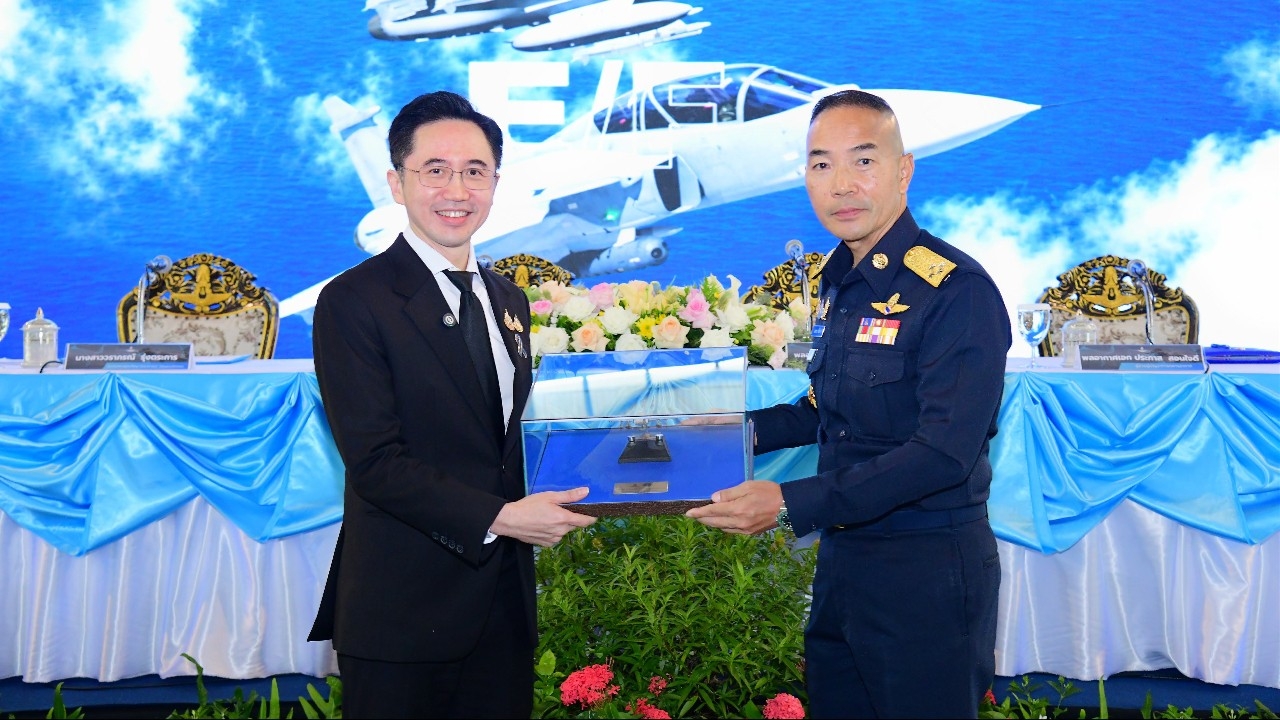
The Air Force announced the success of its Offset Policy in attracting world-class technology to develop the country's defense industry. Yotsanan emphasized the Defence Offset deal between the Air Force and Sweden, turning the budget for purchasing fighter jets into job creation opportunities.
On 24 Jul 2026 GMT+7, the Air Force, together with the Ministry of Higher Education, Science, Research and Innovation (MHESI), announced progress on acquiring 12 Gripen E/F fighter jets. They highlighted the Defense Offset Policy, which converts defense procurement budgets into societal benefits, including nine master's scholarships at leading Swedish universities and technology transfer of the Link T tactical data link system, promoting military security alongside sustainable technological and economic development for the country.
Air Chief Marshal Seksan Kanchitthaworn, Commander-in-Chief of the Air Force, stated that due to the necessity of replacing the nearly 40-year-old F-16 fleet, the Air Force procured 12 Gripen E/F jets. This was done using the Defense Offset Policy aligned with international standards set by the Ministry of Defense and the 2025 White Paper guidelines. The procurement negotiations included conditions requiring Saab, the manufacturer, to provide compensatory benefits to Thailand. These conditions were reviewed and approved by the Comptroller General's Department, Ministry of Foreign Affairs, Office of the Attorney General, and the Cabinet on 19 August 2025 GMT+7.
Deputy Prime Minister and Minister of Higher Education, Science, Research and Innovation, Yotsanan Wongsawat, said that national security is a fundamental foundation inseparable from economic prosperity. Promoting the Offset Policy is a key strategy to transform Thailand's role from merely a buyer of defense equipment to a creator, thereby reducing dependence on foreign technology during crises and establishing sustainable security based on self-reliance.
This success extends beyond just delivering defense equipment; it involves securing technology exchange benefits (both direct and indirect offsets), especially building collaborative networks with global academic institutions and private sectors such as KTH and Lund universities in Sweden, as well as Saab, which specializes in advanced engineering and defense innovation.
In the initial phase, nine Thai researchers and personnel were sent to study and conduct research in three future technology fields:
1. Cybersecurity and Artificial Intelligence (AI)
2. Space and Aerospace Technology
3. Food Technology and Molecular Biology (agricultural technology and molecular biology)
Yotsanan added that studying is only part of the philosophy of learning. It is uncertain whether the technologies learned today will remain, but the pursuit of new knowledge daily is certain. Having friends, the ability to communicate globally, and understanding shared sovereignty are vital. Technology transfer is crucial. Earlier, there was discussion about transferring various tactical technologies, which Thailand can receive but must localize to fit Thai contexts. This ensures Thailand’s agenda aligns with global trends without being driven by others’ agendas.
“The journey of these nine researchers working abroad in foreign labs is like being the country's 'forwards,' not a one-man show but a team effort to learn and adapt technologies to Thailand’s context (localize) so that Thailand’s development agenda aligns with and leads global trends,” he said.
Yotsanan affirmed that the Ministry of Higher Education, Science, Research and Innovation is ready to support the Air Force and related agencies in all aspects of science and innovation to ensure effective technology transfer, while jointly protecting sovereignty and fostering strong national development.


