

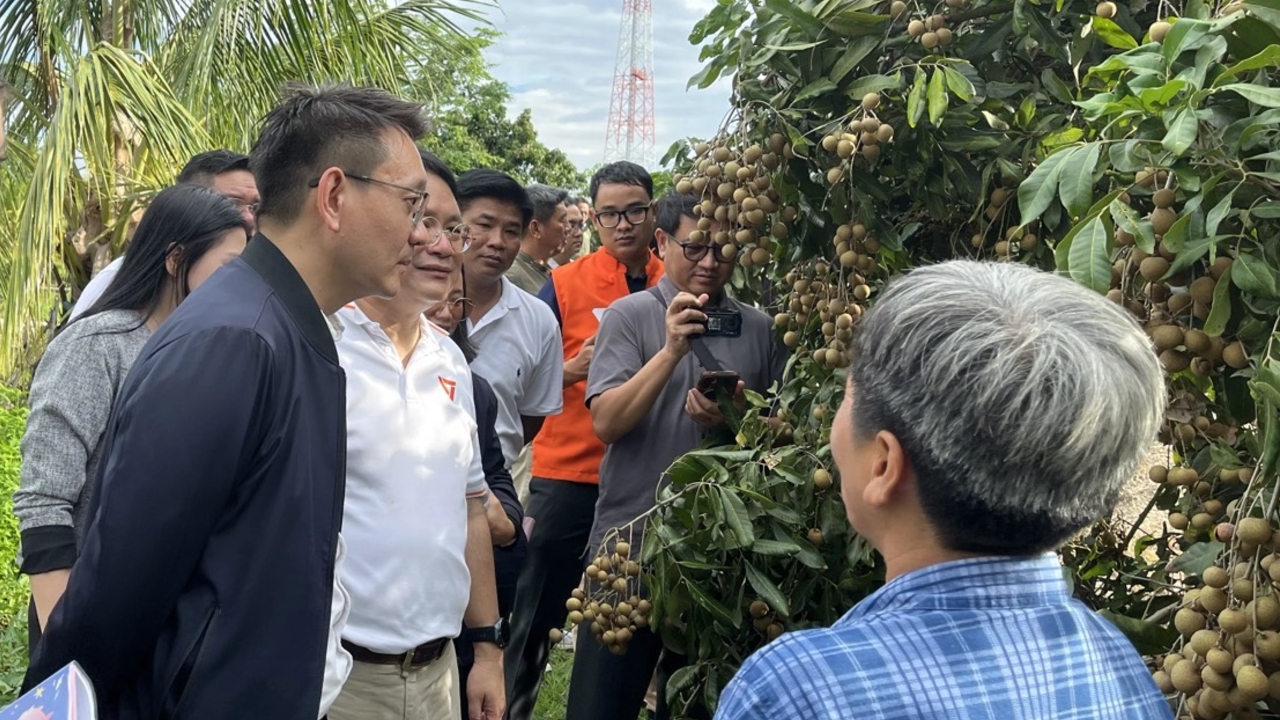
Veerayut led the Economic Development Committee team of the parliament to monitor the longan situation in Chiang Mai and Lamphun, pointing out that the entire supply chain must be addressed, from fertilizing methods to negotiations at the Chinese border checkpoints.
On 25 July 2026, Veerayut Kanchuchat, Chairman of the Economic Development Committee of the House of Representatives and party-list MP and Deputy Leader of the People's Party, revealed after the committee’s field visit to monitor the production, sales, and export issues of longan in Chiang Mai and Lamphun provinces. The visit, conducted from 23 to 24 July, aimed to understand the situation and propose systematic solutions.
Veerayut stated that this field visit is part of the work of the subcommittee studying the export supply chain for regional economic growth. The Economic Development Committee established this to better understand the supply chain of Thai agricultural products, covering production, processing, transportation, and export. Currently, it is longan season, and longan serves as an agricultural product that well reflects the broader problems facing Thailand’s agricultural sector.
The subcommittee was formed because Thailand’s agricultural sector still lacks comprehensive knowledge in managing systematic supply chains, including both official data and real-world information. Moreover, the sector faces increasingly strict non-tariff measures as trade barriers.

After hearing from farmers, entrepreneurs, and responsible government agencies, Veerayut reflected that one issue with northern longan stems from domestic factors such as aging trees yielding lower productivity, rising costs of fertilizer and pruning, labor shortages during harvest season, and unequal price bargaining power between farmers and middlemen or traders.
These domestic factors affect production quality, but regarding price, the main buyer—China—sets the direction, holding over 70% of the longan export market. This season, China uses sulfur residue testing as a key filter. Traditionally, Thai producers treat longan with sulfur dioxide to extend shelf life, but from August 2025, China raised safety standards to 50 ppm total in both flesh and peel, causing nearly all Thai longan to fail entry into China.
"The situation with longan overlaps with other agricultural products that cannot be resolved by interventions at a single point, such as pruning, creating large farms, or targeted policies like purchase guarantees or online sales support. It is necessary to address the entire supply chain—from cultivation, fertilization, product standard control, to clearer negotiations with trading partners," he said.
The subcommittee on supply chain studies covers agricultural products at both general and individual product levels, including changing international trade dynamics. It plans to present findings and recommendations to the public around the end of the fiscal year, approximately in September.
