

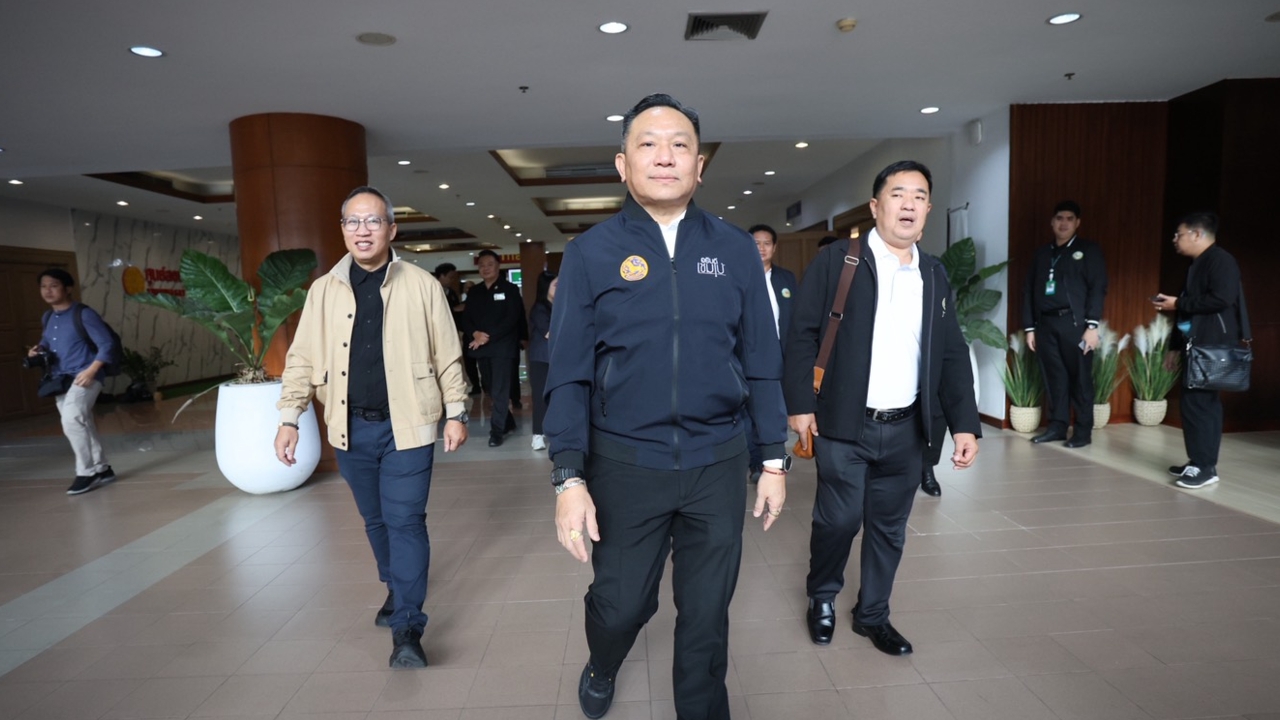
The Deputy Permanent Secretary of the Ministry of Interior visited Thammasat University to inspect the local civil service exam site, emphasizing that candidates should not be deceived into paying bribes. Those caught will be dismissed immediately. After the exam, scores will be broadcast live for examinees to review, compare, and file objections if needed.
At 08:00 on 26 Jul 2026 at the Thammasat University Convention Center in Pathum Thani province, Mr. Nirat Pongsitthithaworn, Deputy Permanent Secretary of the Ministry of Interior, inspected the exam site for recruiting local government officials to managerial positions. He was accompanied by Mr. Udomwet Towsatja, Director of the Thammasat Exam Center, and exam supervisors to check the smooth operation and exam scoring system. There were 37,359 applicants in total. The exam was divided by local government types: Provincial Administrative Organization (PAO) with 2,747 applicants for 753 vacancies; Municipalities with 17,657 applicants for 8,151 vacancies; Subdistrict Administrative Organizations (SAO) with 16,894 applicants for 8,593 vacancies; and Pattaya City with 61 applicants for 46 vacancies. Overall, 37,359 candidates competed for 17,543 available positions.
Mr. Nirat said that exams occur every year, and candidates should not fall for scams demanding money. If caught using dishonest means, especially if already a local government official, they will be immediately dismissed, which is not worth it. He urged those who have secretly agreed to pay bribes to return the money and take the exam honestly, as no wrongdoing will then be recorded. He assured that the exam organizers and university would conduct the exam and scoring professionally without outside interference, committing to transparency in line with the Prime Minister’s policy. He pledged to do his best to ensure fairness.

Asked about reports of attempts to influence the exam process, Mr. Nirat said they do not naively believe such attempts don’t exist, but efforts are in place to prevent them. Warnings have been issued, even described as threats, supported by laws and oversight from agencies including the police, Anti-Corruption Organization, Office of the Auditor-General, National Anti-Corruption Commission, as well as civil society and private sectors monitoring. This oversight should make wrongdoing more difficult. When pressed if such attempts exist, he acknowledged they likely do but remain undisclosed. The key message is for candidates not to engage with such schemes.
Regarding discrepancies in candidate numbers and names, Mr. Nirat explained, "That relates to recruitment exams, but ultimately, the numbers will align with explanations. We do not base results on predetermined numbers but on factual exam outcomes. Any irregularities or fraud will be addressed accordingly. We rely on facts rather than fixed quotas to ensure fairness and avoid conflicts with actual results."

On mismatched figures, Mr. Nirat added that the department will verify scores and address any score adjustments below standard thresholds using actual scoring criteria. Investigation of corruption is the responsibility of relevant agencies, with the Anti-Corruption Organization conducting inquiries as needed.
Mr. Udomwet Towsatja, Director of the Thammasat Exam Center, added that after 16:30, when the exam concludes and answer sheets are collected, Thammasat will release exam questions and create official answer keys. They will review objection petitions related to the exam by around 16:00. The process will be broadcast so candidates and reporters can observe, as scores are not confidential. Results are expected to be announced by evening, with answer sheets and keys made available the next day for candidates to print and compare. This transparent system is intended to serve as a model for civil service exams.


Photo: Ekkalak Mainoi