

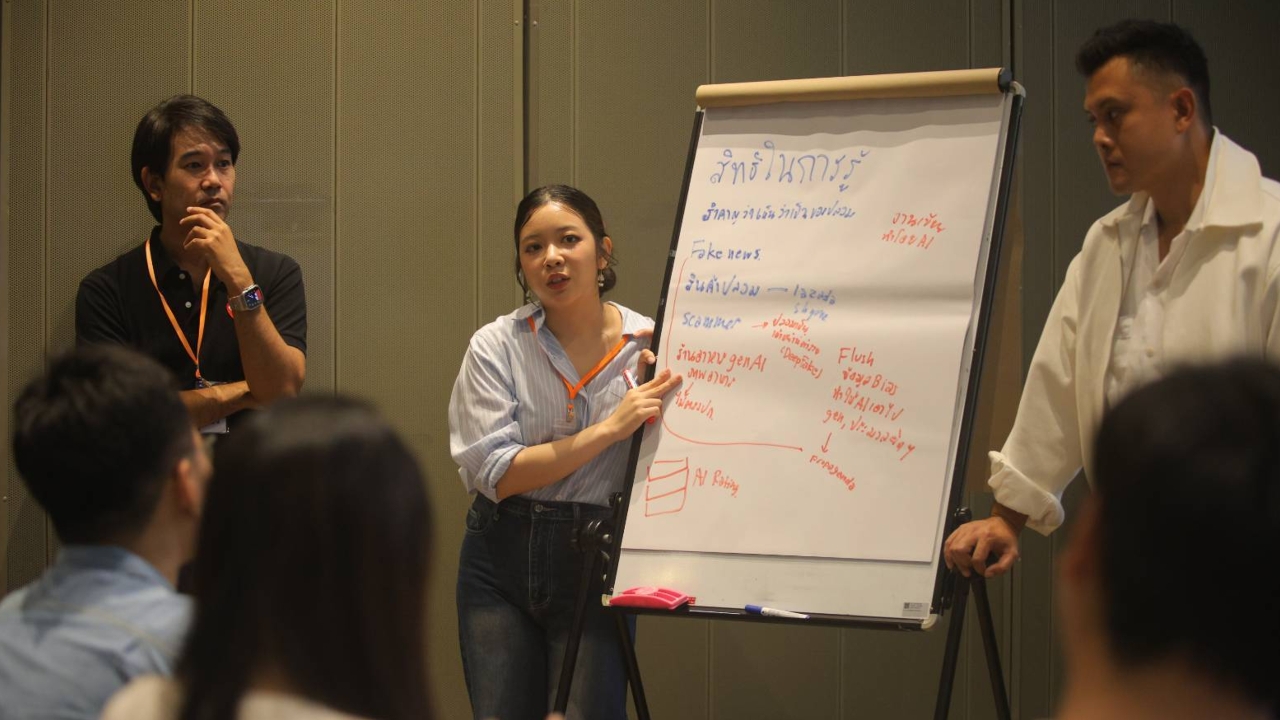
The People's Party held a seminar to gather input on promoting AI legislation, highlighting three key pillars to protect the rights of creative workers, and plans to propose to parliament the establishment of a subcommittee for study.
On 26 July 2026 at Glowfish, 2nd floor, buildingSathorn ThaniBangkok, the Culture and Creative Economy wing of the People's Party held a seminar titled “PROMPT THE FUTURE” to hear and exchange views with a network of artists, illustrators, musicians, writers, designers, and creative workers on the People's Party's draft Artificial Intelligence Act for creative people. This marks a significant step in shaping the future direction of Thailand's creative sector. Attending People's Party MPs included Phuriwat Jaisamran, MP for Bangkok's 12th district; Naphat Jittapinan-Kanta, MP for Bangkok's 24th district; Sahasawat Khumkhong, MP for Chonburi's 7th district; and Kantapon Duangamphon, MP for Bangkok's 6th district.

At the event, the draft law's approach was revealed, focusing on creating a fair ecosystem that balances technological advancement with the protection of human creators' rights, structured around three main pillars:
1. Human in the Loop: The principle that technology must not replace human ethics. In important decision-making processes that affect values or rights, a human must always oversee and verify to maintain ethical standards and protect the rights of those involved.
2. Opt-out Rights: The principle that creative workers must have the power to protect their own works. Owners have the right to refuse consent for AI systems to use their works, data sources, or intellectual property to train AI unless explicit written permission is given or fair and appropriate compensation is provided.
3. AI Declaration: The principle that consumers and society have the right to know the origin of works. Any work created or partially created by AI must be clearly labeled, and AI platforms or developers must disclose the sources of the datasets used for AI training to ensure transparency and traceability.
The Culture wing of the People's Party will incorporate proposals and feedback from creative sector workers into the draft law. Additionally, the party plans to push for the establishment of a subcommittee to systematically study related legal amendments, ensuring that this AI Act and other relevant regulations respond effectively to evolving technology and genuinely protect Thailand's creative workers.


