

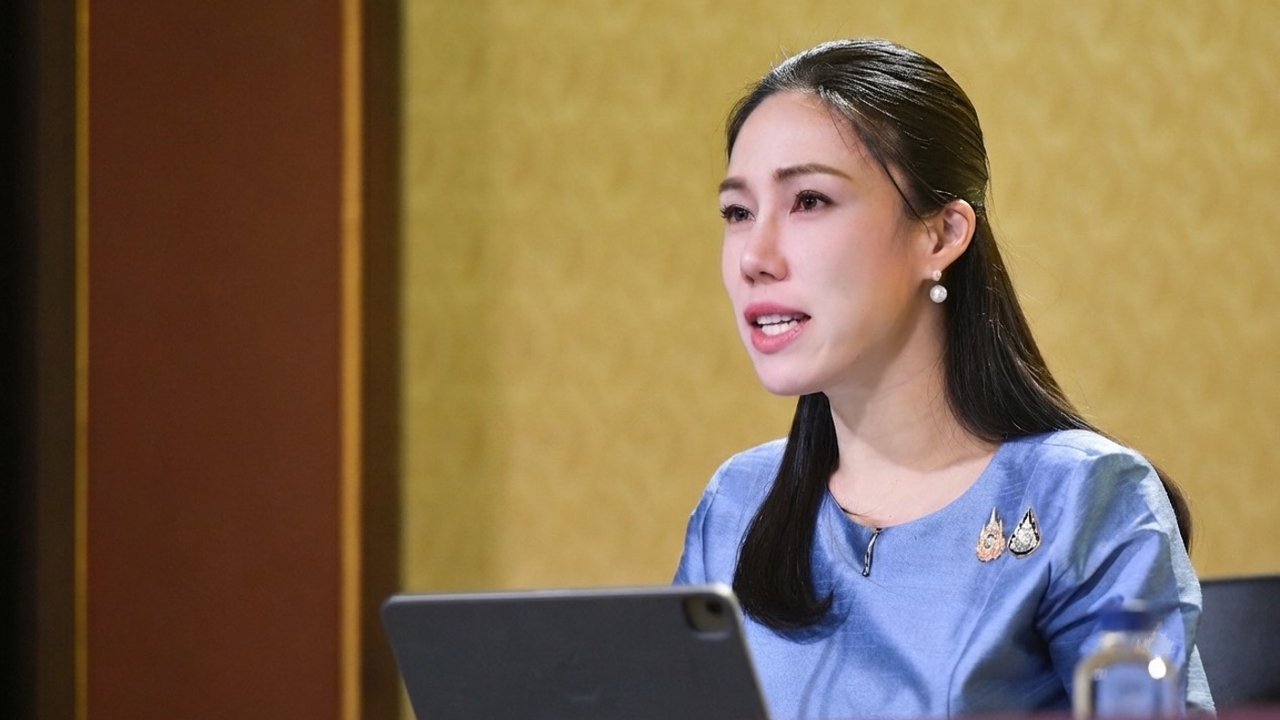
Sasikarn supports Pakorn's bureaucratic reform proposal to establish a Land Court to resolve state-public disputes clearly, swiftly, and fairly, helping the government efficiently act against encroachers of state land.
On 29 Jul 2026 GMT+7, Ms. Sasikarn Wattanajan, deputy spokesperson of the United Thai Nation Party and former deputy spokesperson for the Prime Minister's Office, praised and supported Deputy Prime Minister for Legal Affairs Pakorn Nilprapunt's push for bureaucratic reform. This initiative addresses root problems to enhance government efficiency and reduce redundancies.
She also proposed that the government consider establishing a specialized Land Court as a key mechanism to resolve disputes between the state and the public more clearly, rapidly, and fairly.
Ms. Sasikarn stated that many citizens currently face land disputes involving long-term agricultural or residential use but are notified that their land lies within reserved forest or national park areas. Even with official documents such as title deeds, Nor Sor 3, or Por Bor Tor 5, government agencies interpret these differently. There are also issues with overlapping boundaries between citizens' land titles and state land.
Meanwhile, land cases must proceed through ordinary courts, causing lengthy rights verification processes. Some disputes last several years or even decades, partly due to the complexity of multiple laws such as the Forest Act B.E. 2484 (1941), National Reserved Forest Act B.E. 2507 (1964), National Park Act B.E. 2562 (2019), and Land Development Act B.E. 2551 (2008).
The Land Court concept would be a specialized court handling cases related to agricultural land, housing, and disputes between the state and citizens, differing from the current system where such cases go to ordinary courts. It would use an inquisitorial system, with the court actively seeking facts rather than leaving citizens to fight cases alone.
The proposed model allows both citizens and government agencies to file directly with the court, whose panel would include professional judges, government experts, and civil society experts to ensure that legal and factual perspectives from the field are considered.
The Land Court would help accelerate rights verification, reduce overlapping land issues, decrease case backlogs, increase fairness for bona fide citizens, and enable the government to effectively handle encroachers on state land.
This proposal can be implemented within the government's existing annual budget framework, focusing on improving system efficiency.
"Land issues are not just about documents but concern the homes and livelihoods of Thai people. Promoting the Land Court alongside bureaucratic reform will be another crucial mechanism to lessen the burden on citizens and build trust in the justice system," said Ms. Sasikarn. Ms. Sasikarn added.