

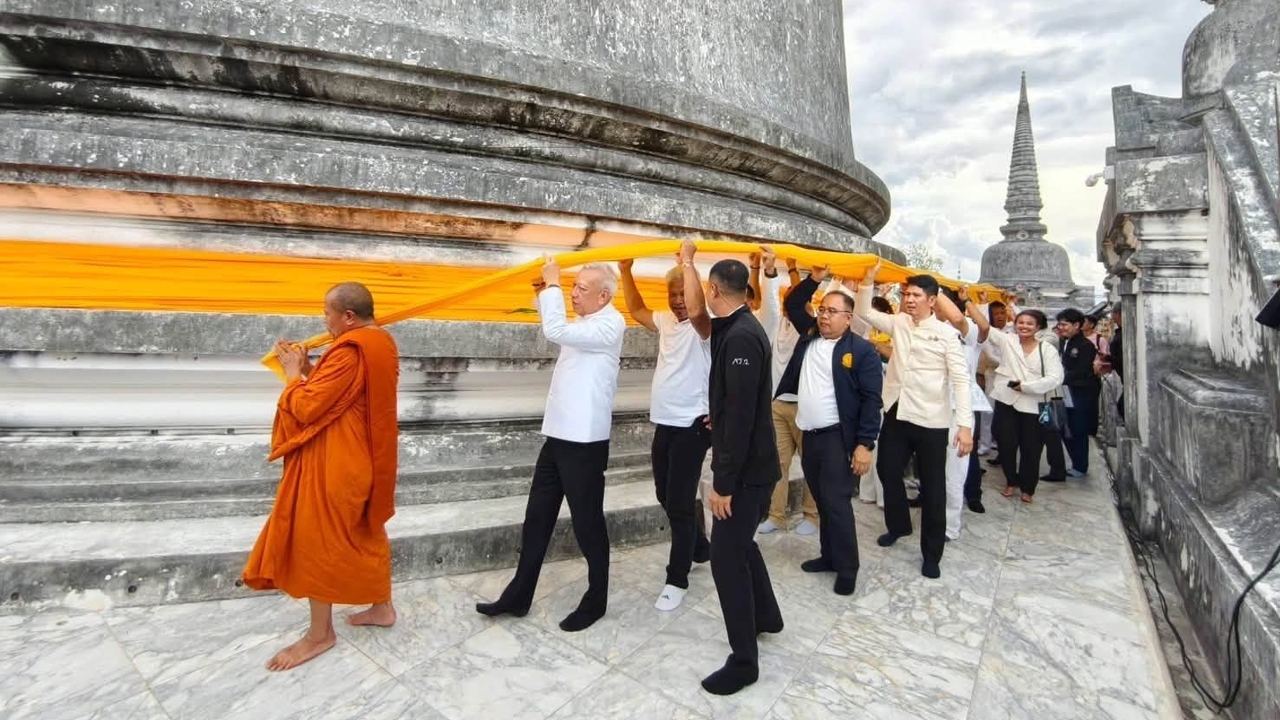
Phiphat congratulates Wat Phra Mahathat on its registration as the first UNESCO World Heritage site in Southern Thailand, highlighting the integrated road, rail, and air network connecting the "Path of Faith" to welcome tourists worldwide.
At 3:00 p.m. on 31 July 2026, Mr. Phiphat Ratchakitprakarn, Deputy Prime Minister and Minister of Transport, joined in congratulating the inclusion of "Wat Phra Mahathat Woramahawihan, Nakhon Si Thammarat Province" as a cultural World Heritage site. The decision was made at the 48th session of the World Heritage Committee held in Busan, Republic of Korea, on 25 July 2026. This marks Thailand's ninth World Heritage site, its sixth cultural site, and the first in the southern region.
Mr. Phiphat stated that the registration of Wat Phra Mahathat Woramahawihan as a World Heritage site is a significant achievement for Thailand and a source of pride for the people of Nakhon Si Thammarat and southern Thailand. This success results from the collaboration among the monastic community, government, academia, private sector, local communities, and citizens who have jointly preserved, continued, and promoted the temple's value to international recognition.
Wat Phra Mahathat Woramahawihan has been a major Buddhist center in the region since the 8th century CE, reflecting the exchange and blending of religious, artistic, and architectural influences from Brahmanism-Hinduism, Mahayana Buddhism, and Theravada Buddhism. It has developed a unique identity for Nakhon Si Thammarat and influenced various areas in Southeast Asia. The temple is also linked to living traditions, including the robe-offering procession to the stupa, local legends and chronicles, and the traditional Nora dance performance.
Mr. Phiphat said that being designated a World Heritage site will open opportunities for Nakhon Si Thammarat to elevate itself as an international center for religious, historical, and cultural tourism. It will enable connections from Wat Phra Mahathat to the old city, cultural learning sites, local communities, and key tourist attractions within the province and the southern regional cluster. This will encourage longer stays, distribute income to small businesses, shops, accommodations, transport services, community products, and youth returning to their hometowns for employment.
Regarding transportation readiness, the Ministry of Transport will utilize the existing networks alongside future development projects to increase travel options to Nakhon Si Thammarat, making access more convenient, safe, and better connected.
For road travel, the Ministry of Transport, through the Department of Rural Roads, has opened the highway branch connecting Highway 4103 to Phutthabhum Road, about 4 kilometers long with four lanes. This reduces congestion and links travel to Wat Phra Mahathat and major tourist sites in the city center under the concept of the "Path of Faith."
In air travel, Nakhon Si Thammarat Airport has a new passenger terminal capable of accommodating approximately 1,600 passengers per hour or 4 million annually. It is ready to handle increased tourist volumes and provide connections to the city center.
For rail travel, direct train service to Nakhon Si Thammarat is currently available. Meanwhile, the Ministry of Transport is promoting the second phase of the southern double-track railway to improve travel efficiency and connect important tourist cities in the south.
Mr. Phiphat added that the Ministry of Transport is ready to coordinate with Nakhon Si Thammarat Province, local administrative organizations, and relevant agencies to develop management plans for travel within and around the World Heritage area. This includes traffic systems, parking, directional signage, safe walkways, public transport, and connections from the airport, train station, and bus terminal to the city center, especially during major festivals and periods of high visitation to the Phra Borommathat Chedi.

