

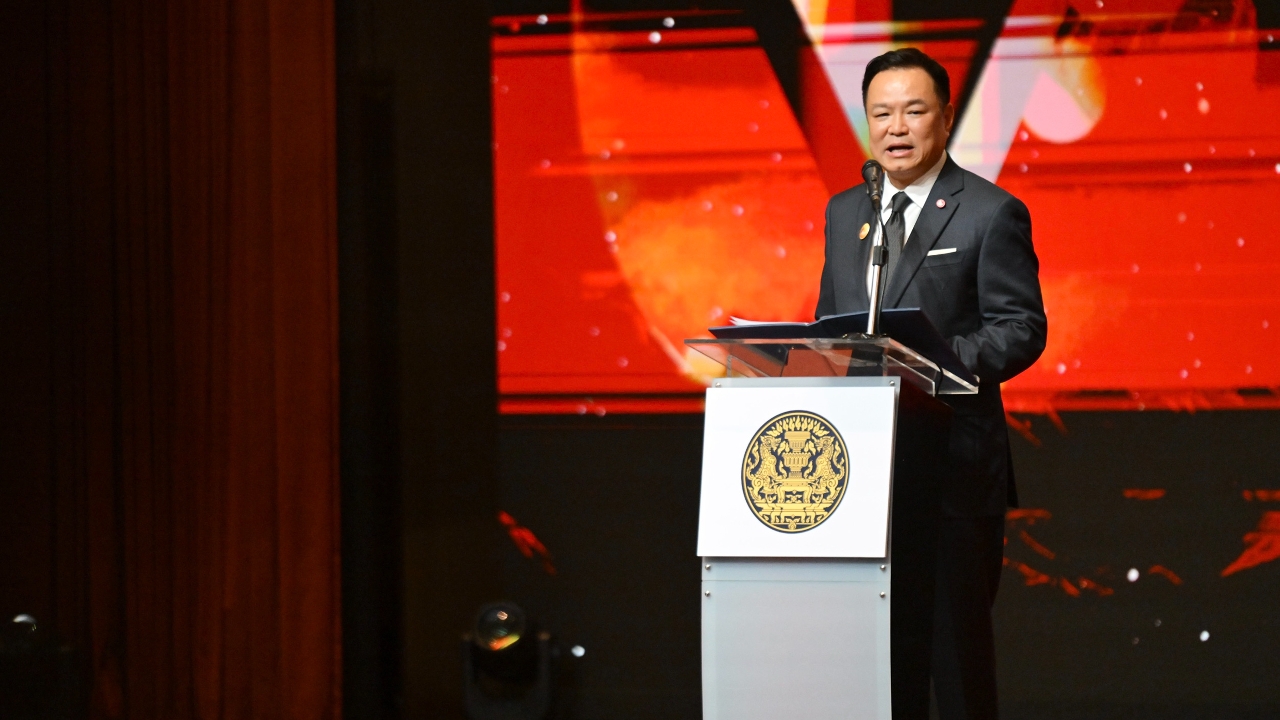
Anutin highlights political engineering to navigate the disorderly global crisis, advancing public administration reform, human resource development, and R&D support. He sets the 4P framework to embrace the AI trend and promote a decentralized economy, mobilizing the power of Thai people to strengthen the nation sustainably and powerfully.
At 7:00 p.m. on 31 July 2026, at the Faculty of Engineering auditorium, Chulalongkorn University, Prime Minister and Minister of Interior Anutin Charnvirakul delivered a keynote speech titled “Overcoming Crisis, Facing the New World Order” during The Intania Forum: Surviving Under the New World Order symposium.
Anutin said that today’s world may not be a New World Order but a New World Disorder—an unstructured world without set formulas that changes too rapidly for old thinking methods. The government must prepare the country to face uncertainty by focusing on flexibility, self-reliance, and decision-making based on real data.
Thailand’s growth has so far relied on globalization, manufacturing bases, exports, and tourism, but urgent focus is needed on research and development (R&D). The new technological era brings many countries closer to starting points, so if Thailand invests wisely, it is not too late to upgrade its own industries.
Anutin stated that Thailand cannot avoid adopting modern technologies, especially AI, but all must follow the 4P principles: Prevention to mitigate impacts; Prosper to create wealth; Potential to enhance national capability; and Protection to prevent technology from harming humans, society, and nature.
“The government is seeking the Critical Path Method (CPM) for Thailand to prioritize where limited resources should be used first, minimizing time and inputs while maximizing returns. It also aims to build resilience to guide the country toward a steady state—a stable, secure, and sustainable position,” Anutin said.
Anutin explained that the government’s key goals cover the economy, security, society, and disaster response. Some areas require bold budget investments, such as flood prevention systems. Previously, Thailand paid about 50 billion baht annually for flood relief; investing earlier in infrastructure can greatly reduce long-term damage.
He emphasized that while Thailand’s economy remains strong, the major challenge is how to distribute wealth more evenly, not concentrating it in certain areas. Thailand should not have Bangkok as the only metropolis but must develop new economic cities with transportation systems that connect production, industry, jobs, and income.
Anutin said the country’s most important resource is its people. Technology can be bought, but people must learn faster, adapt better, and have lifelong development opportunities. The government will mobilize Thai people to "power up the nation" through education, new skills, and opportunities for Thais to become creators, not just users of technology.
The prime minister added that the government will seriously support Thai innovation—from universities, startups, and industries to defense R&D. If Thailand can produce these technologies, the state must help create markets and real applications so that R&D goes beyond the lab and becomes a new economic driver.
Another key task is reforming public administration to make government work more agile, transparent, and accountable. This includes reducing unnecessary procedures, using technology to enhance efficiency, and adjusting personnel to fit missions—not just making government smaller but smarter and more capable of accelerating business progress.
The prime minister also said the government is reorganizing the state welfare card system to provide assistance directly to those truly in need, while creating opportunities for working-age people to return sustainably to the economy with jobs and income, rather than relying solely on welfare.
“The government is stable and determined to work for the country. Although the new world is disorderly, Thailand must not be directionless. The government will use its engineering mindset to find solutions, its business acumen to seek opportunities, and the strength of all Thai people to sustain the country’s stable, sustainable growth and self-determined future,” Anutin said. Anutin concluded.
