

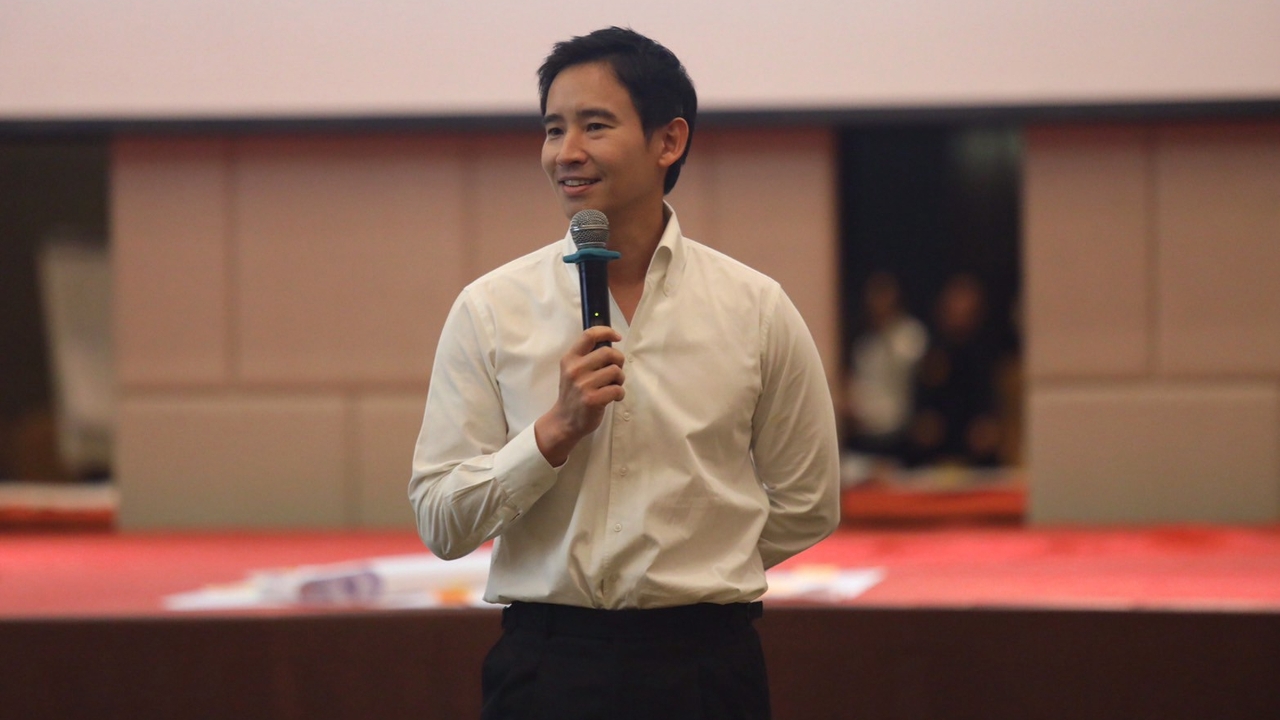
Pita Limjaroenrat joined the Palang Pracharat Party seminar, urging, "You can be tired and discouraged, but never retreat." He warned of a turbulent world and stressed that party MPs must think one step ahead of the government. Meanwhile, Weerayut Kanchuchat highlighted the mission to build an Alternative Thailand.
On 2 Aug 2026 GMT+7, at the Maple Hotel, Palang Pracharat Party held a seminar for its MPs and network members. The event involved discussions about challenges, work processes, and the formulation of the party's future strategies and direction.
During the seminar, Pita Limjaroenrat, former leader of the Move Forward Party, who had just returned from the United States, accepted an invitation to deliver a keynote speech to the Palang Pracharat MPs. He shared experiences from meetings with politicians and young people in various countries during his university teaching work. Pita stated that Palang Pracharat is internationally recognized and regarded as a model for a new generation political party. Young people in countries such as Indonesia, Malaysia, the Philippines, Chile, and Colombia expressed a desire to see political parties like Palang Pracharat in their own nations.
The former Move Forward Party leader acknowledged that party members might feel tired or discouraged by the political situation but urged them to focus on the party's achievements, including gaining MPs in several areas, expanding its work base in Bangkok, and having the first female Bangkok council president in Thailand. He emphasized that everyone can be tired and discouraged, but retreat is not an option. He encouraged confidence that when the political moment arrives, the party must be ready to turn opportunities into victories. The party must build a sufficiently large ladle to draw as much water as possible when the situation is favorable.
Pita added that Palang Pracharat MPs and members should monitor important international issues, noting the world faces a Pincer Crisis—pressure from two sides: geopolitical tensions impacting living costs and the decline of domestic politics causing governments worldwide to be ineffective in problem-solving. This presents both challenges and opportunities for the opposition party to propose an Alternative Thailand.

Assessing the second half of this year, significant global events will continue, including the Chinese Communist Party leaders' meeting, the United Nations assembly, the meeting between Xi Jinping and Donald Trump, elections in Israel and Brazil, the US midterm elections, and the G20 summit. All will inevitably affect Thailand's economy, living costs, and policy implementation. There are also likely impacts from climate change, such as El Niño risks, floods, wildfires, and heatwaves, directly affecting the population. Palang Pracharat MPs must prepare policy proposals in advance to enable the party to offer solutions before the government.
In closing his keynote, Pita emphasized the utmost importance of party unity. He urged members to trust each other, work as a team, and adhere to the principle "Your problem is my problem" to collectively advance Palang Pracharat as a visionary party and a future alternative for the country.
“Our goal is to be a visionary party that shows Thailand has more options beyond just the blue color. When people give us multiplied support and turn out to vote in large numbers, we have the chance to win, come to power, and together change the Thailand we all love.” Pita said.

Afterwards, Weerayut Kanchuchat, deputy leader of Palang Pracharat Party, opened the seminar on strategy. The main content reviewed the development of Thai politics over time to understand the power structures the party faces and questioned the party's role in the coming decade.
Weerayut stated that Thailand’s political history each decade reflects struggles between different power groups. In the 1990s, political power began shifting from the military toward the parliamentary system and networks of local politicians. Although accompanied by violence and intense political competition, this process advanced. In the 2000s, the rise of the Thai Rak Thai Party and Thaksin Shinawatra’s government connected national politics with grassroots citizens through public policies, especially universal healthcare, reducing reliance on patronage and traditional vote-buying.
The electoral success and policies directly reaching the people made the government a rival to traditional power networks, even if initially it did not intend direct confrontation. In the 2010s, Thai politics entered a period of attempted reconciliation among factions, eventually leading to a coup and the formation of the so-called “Prayut regime,” which encompasses not only military power but also large business groups influencing the economy and policymaking.
Weerayut continued that in the 2020s, Future Forward, Move Forward, and Palang Pracharat parties emerged as political forces challenging these power structures and gradually became key opponents of conservative groups and local political networks. As Thailand approaches the 2030s, Palang Pracharat members are not mere observers but active participants shaping the country's political future.
The “blue regime” does not refer to a single political party but is a blend of elite networks, patronage systems, bureaucracy, and technocrats legitimizing governance. While elite networks and technocrats may differ in ideas and methods, they coexist within one power structure. However, this combination can lead to policymaking lacking political decisiveness and technical continuity, limiting government effectiveness in crisis response.
Weerayut added that parties growing from coalition roles and adept at managing local networks may face limitations as leading governments. National governance requires vision and the ability to integrate policies beyond ministry control or resource distribution. If this management style continues, bureaucratic efficiency may decline while Thai businesses face fiercer foreign competition amid fiscal constraints, household debt, and industrial slowdowns, increasing pressures on the population in many dimensions.
Nonetheless, dissatisfaction with the government or existing power structures does not automatically translate into votes for Palang Pracharat, as citizens have alternatives such as adapting within patronage systems, participating in gray or informal economies, migrating, or turning to extra-systemic powers. Palang Pracharat is only one of several choices. The party’s crucial task is not just to criticize opponents but to help citizens see the connection between problems and political structures, while building confidence that the party has a real chance to win and govern.
Weerayut further said that a party trusted by the public must be a source of hope, the top alternative, and demonstrate a viable Alternative Thailand—not just ideological or long-term visions. Palang Pracharat’s next mission in building state power and legitimacy involves winning the battle of ideas, the political battle, and building a strong mass party.
Winning the battle of ideas means helping citizens understand structural causes of problems and believe Thailand has other options. Winning politically requires grassroots work, expanding alliances for change, and broadening support bases. Building a mass party will be the key mechanism connecting these two missions.
“Every Palang Pracharat member is contributing to writing the next chapter of Thai political history. The outcome in the 2030s will depend on the party’s ability to transform public dissatisfaction into hope, trust, and political power leading to national change.” Weerayut said.

