

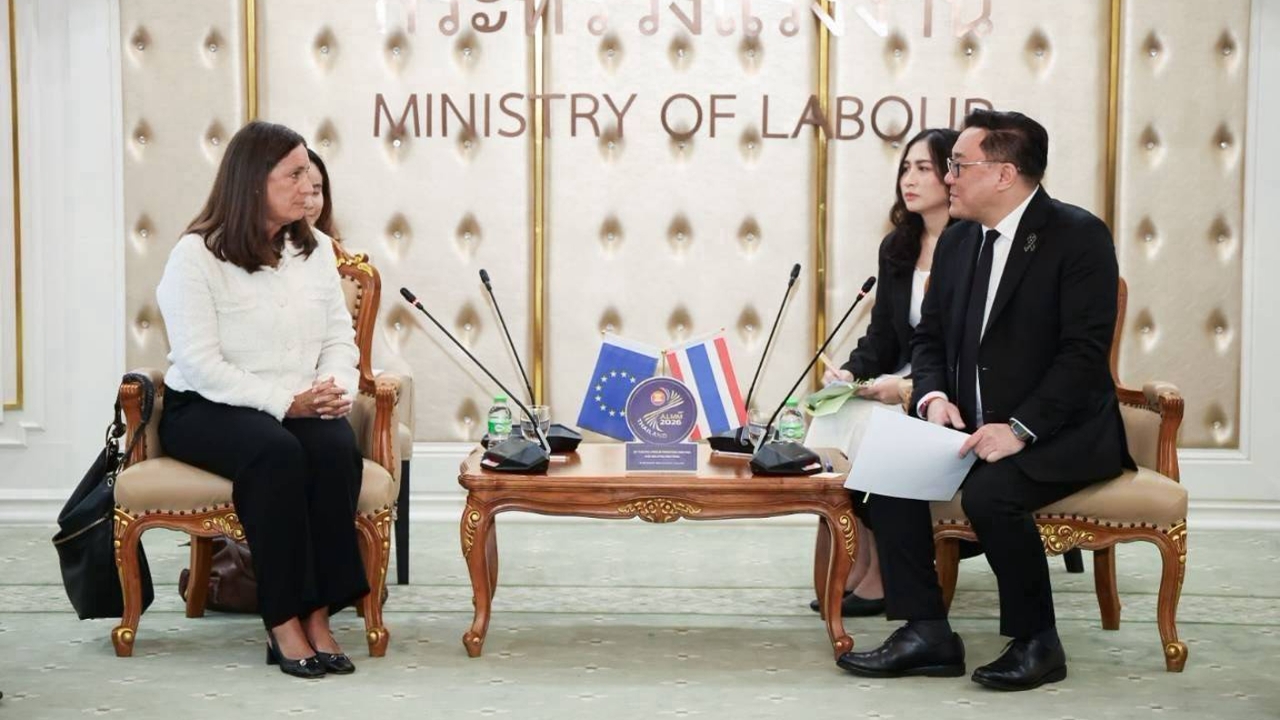
Chulaphan discussed with the EU Ambassador, highlighting Thailand's model achievements in combating IUU Fishing and aiming to raise fishing labor standards to international levels, while fostering sustainable cooperation.
At 10:30 a.m. on 3 Aug 2026 GMT+7, Mr. Chulaphan Amornwiwat, Minister of Labour, welcomed H.E. Mrs. Luisa Ragher, the European Union Ambassador to Thailand, along with EU delegation members, to congratulate her on her new appointment. They exchanged updates on progress and cooperation strategies concerning Illegal, Unreported, and Unregulated (IUU) Fishing and the protection of labor rights in the fishing sector. Also present were Police Lieutenant Colonel Wannapong Kotcharak, Permanent Secretary of the Ministry of Labour; Mr. Somchai Morakotsriwan, Director-General of the Department of Employment; Mr. Saksilp Tulathorn, Deputy Director-General of the Department of Labour Protection and Welfare; Mrs. Niyada Seniemanomai, Deputy Secretary-General of the Social Security Office; Mr. Sakdinat Sonthisak-yothin, Assistant Permanent Secretary of the Ministry of Labour; and Ms. Thidarat Yingcharoen, Advisor to the Minister of Labour. The meeting took place in the Jatumongkol Room, 6th floor, Ministry of Labour building.
Mr. Chulaphan stated that the Ministry of Labour prioritizes the issue of IUU Fishing, regarding it as a matter of the rights and dignity of all workers on fishing vessels. Thailand has continuously and strictly enforced labor protection through the Port In Port Out Control Center (PIPO) and frontline fishing vessel inspection points (FIP) across 21 coastal provinces, operating as a "multi-disciplinary team" in cooperation with relevant agencies. Additionally, language coordinators (English, Burmese, and Khmer interpreters) have been employed to ensure effective, transparent, and accurate labor screening interviews. As a result of these earnest efforts, the number of fishing vessels violating the law has markedly dropped from 544 in fiscal year 2018 to only 7 in fiscal year 2026, with all cases subject to strict legal prosecution. Moreover, Thailand places strong emphasis on labor protection at sea and rigorous inspections of seafood processing facilities within the supply chain.
Mr. Chulaphan added that Thailand does not view the lifting of the EU yellow card in 2019 as an endpoint, but rather as a starting benchmark to elevate Thai fishing labor standards to internationally recognized and exemplary levels. He expressed gratitude to the European Union for its ongoing support, including backing the Ship to Shore Rights South East Asia project in collaboration with the International Labour Organization (ILO), and for supporting Thailand’s accession to the Organisation for Economic Co-operation and Development (OECD).
Beyond the fishing labor issues and ILO Convention No. 188, Thailand remains committed to advancing ratification of other ILO conventions such as Convention C155 concerning occupational safety and health. Thailand is also developing standard operating procedures (SOPs) for preliminary screening to prevent forced labor and human trafficking related to labor exploitation, alongside the development of the A-LAT (Anti-Labour Trafficking) information technology system for case management. The Thai side welcomes technical recommendations and support from the European Union to further align Thai labor standards with international norms.
On this occasion, the Minister of Labour invited the EU Ambassador and delegation to participate in the 29th ASEAN Labour Ministers’ Meeting (29th ALMM), which Thailand will host in Bangkok from 23 to 28 August 2026. The minister also presented a souvenir—a crafted peacock image made from palm leaves—created by insured workers undergoing training at the Workers’ Rehabilitation Center of the Social Security Office, to the EU Ambassador to Thailand.