

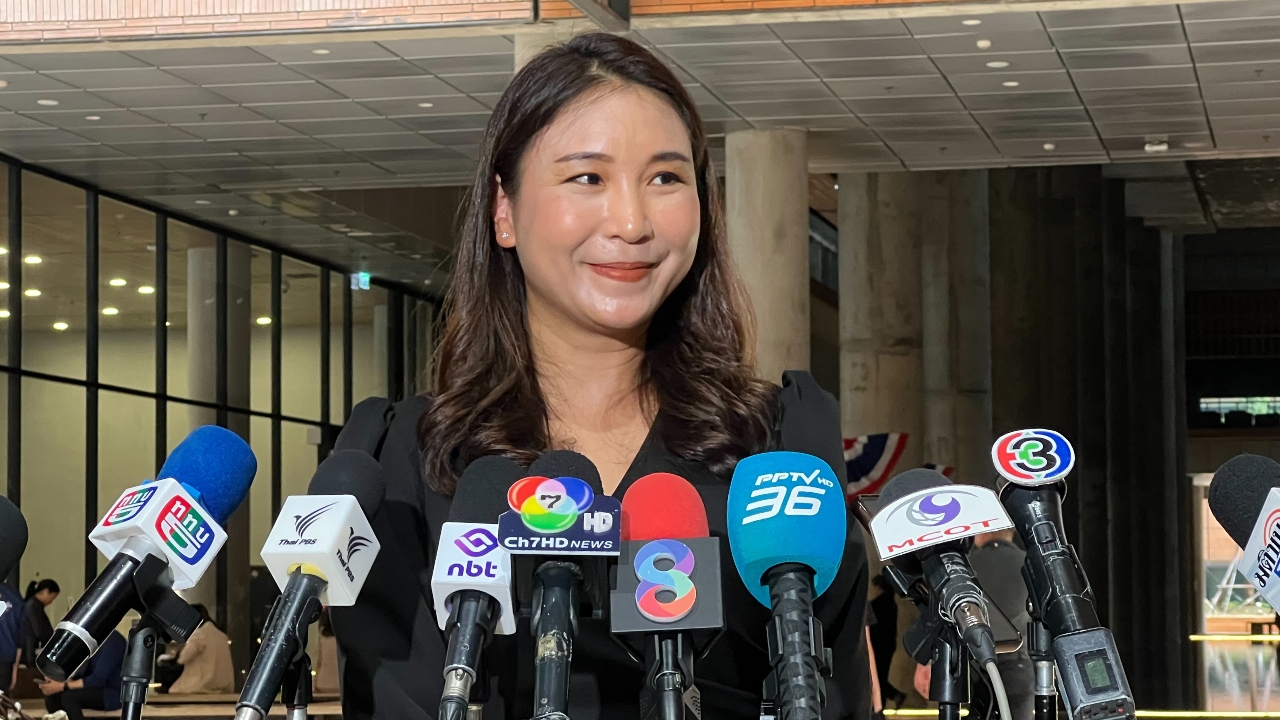
Sirikanya revealed that the Budget Committee for fiscal year 70 has passed the halfway point, with the People's Party subcommittee having cut several items already. She noted that new road construction budget requests are mainly concentrated in the lower Isan region.
On 3 August 2026 at the Parliament, Ms. Sirikanya Tansakul, party-list MP and deputy leader of the People's Party, spoke about the progress of deliberations on the draft budget bill for fiscal year 2570 (2027 CE). She said the process is now over halfway through and currently under review by the budget subcommittees, where more detailed scrutiny is taking place. The main committee sessions focus on policy exchange without detailed examination of each item. This week, the People's Party's subcommittee will announce which items have been cut and which remain. Previous disclosures have drawn public interest, such as cuts to the Data Center budget for the Department of Empowerment of Persons with Disabilities and highway department requests related to cybersecurity protection, which were higher than many other agencies, even those holding more public data. Other cuts included overpriced agricultural drones and cloud services that multiple agencies competed to purchase, despite the Ministry of Digital Economy already receiving a large budget for a central cloud system. These issues will be gradually revealed to the public by the subcommittee.
Ms. Sirikanya stated that every budget item is contentious, but many subcommittees do not only examine the individual items; they also propose suggestions for improving budget development. For instance, the Land and Construction subcommittee requested that the Ministry of Transport or the Department of Highways provide maps showing where new road projects are planned. They found that new road construction is heavily concentrated in the lower Isan region. The subcommittee plans to disclose all details to show that their review goes beyond merely considering items—they also provide recommendations, which the Department of Highways has responded to, enabling better budget deliberation.
Additionally, there are recommendations concerning quotation documents reviewed by the Equipment subcommittee, which has encountered numerous issues. Ultimately, quotation documents must meet standards; otherwise, they may lack signatures, include copied text, or come from companies lacking the capacity to carry out projects. Such suppliers often submit bids resulting in equipment that is substandard and overpriced. These recommendations aim to improve budget preparation and review processes.
Asked about worrisome reports from the subcommittees, Ms. Sirikanya said a positive aspect is that new subcommittee members tend to be particularly enthusiastic and attentive. For example, the Equipment subcommittee, including former People's Party party-list candidate Mr. Thirachat Kotrakul, employed AI to record every debated item, identifying issues such as inflated prices, companies with no relevant expertise—like real estate firms bidding on IT projects—and specification locking. These findings have been summarized after only two weeks of review, revealing significant problems. Therefore, the Equipment subcommittee is one to watch closely.
When asked if any subcommittees have proposed budget cuts, Ms. Sirikanya said the subcommittees regularly report and summarize daily how much budget has been cut. However, the volume of issues does not always align with the amount cut. Also, the People's Party subcommittee lacks sufficient representation and consistently loses votes. They report which items they wish to cut but cannot, and which have been cut across all seven subcommittees. The process will continue, and projects that raise suspicion may still be cut during main committee deliberations, even after subcommittee reviews conclude.
Ms. Sirikanya added that in the first reading, there is generally little focus on reducing the budget drastically, as many items had already been significantly cut during the 2569 (2026 CE) budget discussions, such as nearly halving government building expenditures and reducing road budgets by about 30%. This initially gave some reassurance about the 2570 budget. However, in the second and third readings, more detailed scrutiny and debate are necessary to seek further reductions. Ultimately, the overall effectiveness of the subcommittees and main committee work will be assessed to decide in the third reading whether to approve the 2570 budget after thorough deliberation.