

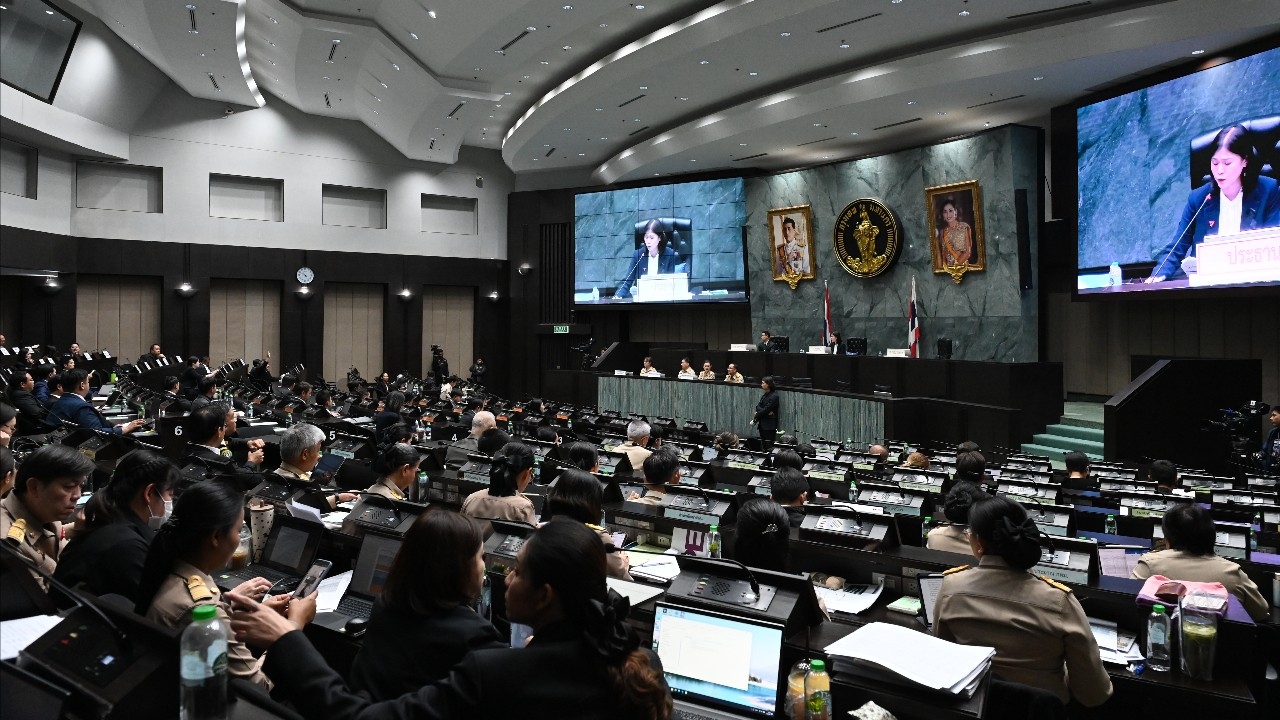
The Bangkok Metropolitan Council debated the 2027 budget totaling 93.9 billion baht. Governor Chadchart emphasized transparency and value, allocating 6 billion baht to pay off Green Line debts while advancing citywide development.
On 3 August 2026 at the Bangkok Metropolitan Council meeting room, Irawat Pattana Building, Bangkok City Hall (Din Daeng), during the 3rd ordinary session of the council presided over by Ms. Pattaraporn Kengrungreungchai, Chairperson of the Bangkok Metropolitan Council, the draft Bangkok Metropolitan regulation on the 2027 fiscal year expenditure budget was considered in the first reading.
Governor Chadchart Sitthiphan presented the draft regulation's principles, which set the 2027 budget at 93,918,922,000 baht. The budget prioritizes transparency, value, equitable development, and simultaneously addresses citizens' issues while laying foundations for long-term urban development. It comprises 93 billion baht in regular revenue expenditure and 918.922 million baht in commercial expenditure. He noted that the upcoming fiscal year will continue to face challenges from the global economy, international conflicts, disasters, and climate change impacts.
Bangkok also bears significant obligations to pay for operations and maintenance of the Green Line extensions 1 and 2, including interest on loans for the Bearing-Samut Prakan section, totaling 6.044 billion baht payable to the Ministry of Finance. This leaves 86.956 billion baht for city management and citizen problem-solving. The budget maintains fiscal discipline with balanced accounts, accelerates disbursements to stimulate the economy, and incorporates technology to enhance management efficiency.
As of 6 July 2026, Bangkok had total deposits of 62,134.71 million baht, while outstanding debt commitments from 227 projects stood at 67,043.45 million baht. Revenue for 2027 is projected at 94,170.49 million baht, a 1.10% increase over the previous year. Government subsidies amounting to 28,953.01 million baht are pending parliamentary approval.
The budget is approximately allocated across nine urban development strategies as follows: Efficient Transportation 15,719 million baht; Safety 4,126 million baht; Transparency 159 million baht; Environment 5,440 million baht; Health 2,536 million baht; Education 2,513 million baht; Economy 195 million baht; Society 1,115 million baht; and Management 845 million baht.
Additionally, a proactive budget of 6,661 million baht targets micro-level infrastructure at the community level to improve roads, alleys, sidewalks, parks, lighting, drainage systems, canal dredging, schools, and child development centers. Overall infrastructure development receives a budget of over 25,674.18 million baht.

Mr. Kantapong Deechaiya, council member for Taling Chan district, commented that the Medical and Public Health offices' budgets remain personnel-heavy while investment spending has decreased. He suggested reviewing TORs for medical equipment procurement to align with actual needs and increasing budgets for health promotion and disease prevention. He also called for expanded roles for community health volunteers, more physiotherapists, home visit teams, and ensuring access to rights for the elderly, bedridden patients, and disabled persons.
Mr. Wiput Sriwaurai, council member for Bang Rak district, discussed the 507.51 million baht digital learning project with portable computers, highlighting indicators for students' digital and AI skills, teachers' technology use, and academic outcomes. He raised concerns over the 151% increase in the Traffic and Transport Office budget but limited investment funds, urging targeted spending on road safety using accident data to guide CCTV and safety equipment installation. He also addressed waste management, pipe cleaning, and flood management, stressing the need for integrated systems.

Deputy Governor Wisanu Traipsomphon clarified that hospital and health center construction and renovation budgets over 1 billion baht fall under the Public Works Office. The traffic budget increase mainly covers Green Line train operations and interest. Risk points improvements and CCTV installations rely on accident data and police and municipal officer inputs, though budget constraints remain.
Deputy Governor Associate Professor Tawida Kamolwetch explained that the Promotion and Prevention (PP) budget is capped at 325 million baht annually but faces regulatory limitations. The National Health Security Office is revising rules, expected to take effect from 1 October 2026.
Deputy Governor Sannon Wangsangbun noted that reductions in education budgets stem from government subsidies, which range from approximately 11,000 to 14,000 million baht annually. For 2027, 234 school improvement projects totaling 617 million baht will be implemented through district offices across Bangkok.
Council member Noppawit Wongaree of Lak Si district stated that although Bangkok's budget has increased yearly, especially in public works, drainage, and traffic, sustainable urban solutions remain elusive. He pointed out delays in construction projects, repeated road excavations, and budget overruns. He proposed real-time project tracking systems and underground utility mapping to support digital city development (Digital Twins). He also questioned the inconsistent installation of adaptive traffic signal systems and urged the administration to reconsider the 2027 budget allocation.

Council member Mathuros Bent of Saphan Sung district opposed budget cuts for two education projects: over 6 million baht to renovate the Khlong Bang Lao Child Development Center and over 19 million baht to rebuild teacher housing at Somphot Krung Anuson School (200 Years). She regarded these as necessary long-term investments for education quality improvement and called for reviewing related regulations to enable legal replacement building construction.
Council member Akkarachai Kanthamala of Dusit district stated that CCTV cameras are key safety infrastructure and essential evidence in justice processes. The 2027 budget allocates over 727 million baht for CCTV, including funds for installing 922 new cameras. However, he noted a lack of details on camera types and that installation costs are twice the market price.
Council member Narongsak Muangsiri of Bang Bon district expressed concern over wastewater treatment and water quality management budgets. He said citizens and farmers still face unsuitable water quality for agriculture, with most funds used for repairing embankments and pumps. He proposed the Drainage Office invest in innovations to tangibly improve water quality.
Deputy Governor Wisanu explained that Bangkok maintains an underground utility database linked with the Electricity and Waterworks Authorities. Efforts are underway to update data and develop legally mandated project tracking systems. Requests for smart traffic signal budgets have been submitted, but adaptations per area are required. Bus shelter installations face space constraints. He agreed with proposals to enhance CCTV efficiency.
Council member Sannon reiterated that teacher housing projects in Saphan Sung district and Khlong Bang Lao child center remain in budget requests but are delayed due to damaged asset reporting procedures. He pledged to expedite follow-up to push these projects forward.
Council member Adisorn Ruklaksi of Don Mueang district questioned the adequacy of flood management budgets, especially for community-level drainage or “microcirculation.” He also raised concerns about standards for pipe cleaning and grease trap systems in shops and expressed disappointment over budget reductions in this area.
Council member Kittipong Ruayfuphan of Thung Khru district proposed that Bangkok establish a blacklist of contractors who abandon or delay projects to enhance budget efficiency. He also suggested allocating funds for new manhole covers in narrow alleys and pointed out that the 2027 draft budget lacks canal dredging funds compared to previous years, requesting the administration to clarify reasons.
Council member Siram Prakaikit of Sathorn district discussed the increasingly complex drug problem in Bangkok, with younger users and easier drug access. Users and dealers often overlap, while treatment and rehabilitation facilities remain insufficient. He proposed Bangkok integrate efforts with the Narcotics Control Board and related agencies, use risk area data to allocate budgets accordingly, develop screening systems connecting treatment with vocational training, and establish multi-sectoral monitoring mechanisms.
Council member Pongsakorn Rattanaruangwattana of Bang Kapi district urged the administration to expedite budget allocation for constructing the Suksan 26 Community Center building, worth 7.05 million baht, damaged by an earthquake. He emphasized this as an investment in community safety and children's future. He also called for prompt road repairs in Theptawi community, currently under survey by the Public Works Office, to improve residents' quality of life.
Council member Piyawan Choraka of Suan Luang district requested the city allocate funds to build reinforced concrete embankments along the Phra Khanong canal in gaps within the project area. She noted this location is a critical water intake point, with damaged canal-side bridges causing accidents and flooding problems in On Nut 39 alley. She emphasized the project's necessity for long-term safety and flood mitigation for residents.
Council member Somchai Wesarattrakool of Sai Mai district questioned Bangkok's revenue estimates, particularly miscellaneous income, which he viewed as set below potential. He criticized the BMA Tax system for limitations, including lack of data linkage with the Land Department, Interior Ministry, and civil registry, as well as issues with notifications, installment payments, and land use recording. He urged system improvements to reduce impacts on citizens and district office operations.
Deputy Governor Wisanu explained that the 2027 drainage budget decreased because 24 flood risk points were addressed in 2026, reducing risk areas this year. Pipe cleaning remains a key policy, with frequency set by area: densely populated communities twice a year, main roads annually, and general residential areas every two years to enhance drainage efficiency and reduce flooding.
Deputy Governor Tawida clarified that drug prevention work is funded from multiple sources, including government subsidies and the National Health Security Office. Each year, district offices run an average of 4–5 drug prevention projects. She noted that over the past four years, at-risk children... (text incomplete).
