

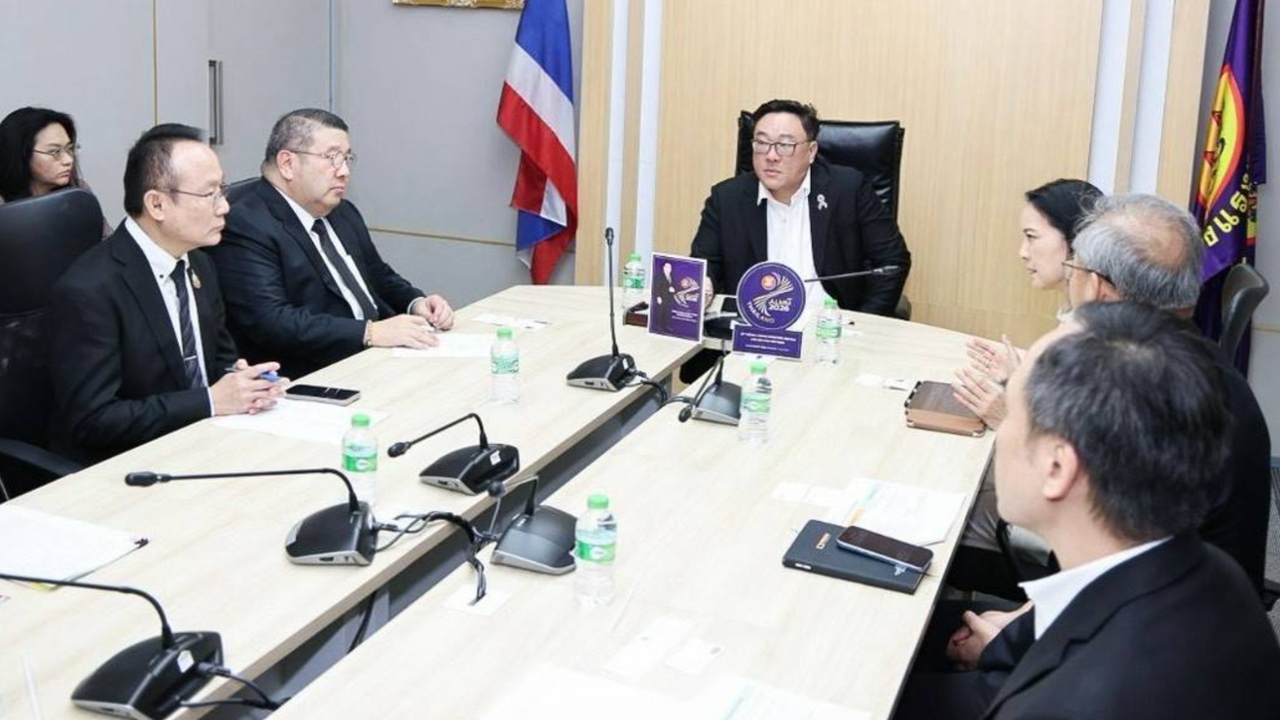
Labor Minister Julapan Amornwiwat met with the Thai Construction Industry Association to urgently and sustainably resolve the shortage of foreign labor, presenting five measures to address the crisis at the Thai-Cambodian border and the unrest in Myanmar.
At 09:30 on 4 Aug 2026 GMT+7, Mr. Julapan Amornwiwat, Minister of Labor, welcomed Ms. Lisa Ngamtrakulpanit, President of the Thai Construction Industry Association under Royal Patronage, and her delegation on the occasion of their visit to present information and discuss approaches to solve the labor shortage caused by the situation along the Thai-Cambodian border and internal unrest in Myanmar. Also attending the meeting at the Ministry of Labor building were Police Lieutenant Colonel Wannapong Kotcharak, Permanent Secretary of the Ministry of Labor; Mr. Somchai Morakotsriwan, Director-General of the Department of Employment; Mr. Surachart Tiangthong, Secretary to the Minister of Labor; Ms. Yanika Tiangthong, assigned from the Prime Minister's Office to the Ministry of Labor; and Ms. Thidarat Yingcharoen, advisor to the Minister of Labor.
During the discussion, both sides exchanged information and policy recommendations to urgently alleviate the labor shortage, agreeing on five key proposals and operational guidelines as follows:
1. Extending residence and work permits for Myanmar MOU foreign workers who have completed the 4-year term. The Department of Employment held a technical meeting with Myanmar authorities on 23 July 2026, agreeing in principle to waive the 30-day waiting period for Myanmar MOU workers whose 4-year terms expire between 1 January and 31 December 2026, allowing them to continue temporary residence and work. Details are being finalized to submit to the Committee on Foreign Workers Management Policy (CFWMP) and the Cabinet for approval.
2. Managing undocumented foreign workers (amnesty for four nationalities). The Ministry of Labor, through the CFWMP—which includes security agencies such as the Ministry of Interior, National Security Council, National Intelligence Agency, Royal Thai Army, and the Thai Chamber of Commerce—is considering leniency allowing workers from Cambodia, Laos, Myanmar, and Vietnam whose permits have expired to legally stay and work temporarily (not exceeding two years per extension), balancing economic, social, and national security factors.
3. Facilitating and maintaining channels for new Myanmar worker imports. Since land border checkpoints remain closed due to conflict along the border, Myanmar MOU workers must still enter mainly by air. Although Thailand proposed opening land checkpoints to reduce employer and employee costs, Myanmar authorities require continued air entry for security reasons.

4. Streamlining and upgrading the digital work permit system (e-Work Permit). The Ministry of Labor has developed a full electronic e-Work Permit outsourcing service to accept applications, issue permits, notify arrivals/departures, and make permit changes, enhancing speed, transparency, and reducing paperwork—especially allowing employer changes without personal biometric visits to service centers. Visa and social security issues will be coordinated with relevant agencies.
5. Long-term proactive measures and sourcing labor from new countries (Sri Lanka). Beyond the Cabinet resolution on 14 July 2026 extending work permits for workers from Laos, Myanmar, and Vietnam until 11 Dec 2027, the Ministry is preparing to pilot importing Sri Lankan workers. The Department of Employment has finalized a draft agreement pending review by the Department of Treaties and Legal Affairs, Ministry of Foreign Affairs, and Cabinet before signing international cooperation agreements.
. In conclusion, Mr. Julapan emphasized that the Ministry of Labor recognizes the vital role of the construction industry as a pillar of national infrastructure development and is ready to cooperate with the private sector to accelerate measures addressing the labor shortage in a concrete and sustainable manner. .
