

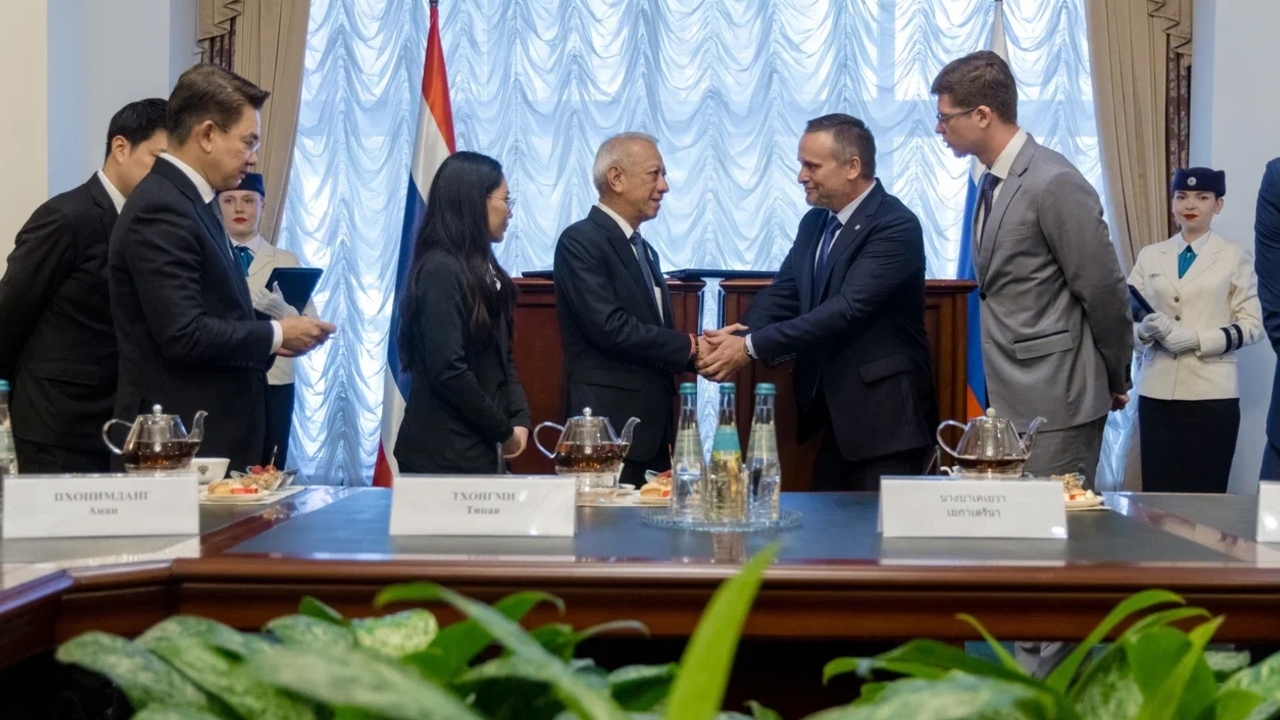
"Phiphat" flew to Moscow and secured a cooperation agreement covering seven areas, harnessing smart transport and driverless vehicle technology to lay the foundation for security enhancement in transportation.
On 3 Aug 2026 at 14:00 local time, Mr. Phiphat Ratchakitprakarn, Deputy Prime Minister and Minister of Transport, led a senior executive delegation including Mr. Chayatham Promsorn, Permanent Secretary of the Ministry of Transport; Mr. Sorapong Phaithoornpong, Director-General of the Department of Land Transport; Mr. Anan Phonimdaeng, Governor of the State Railway of Thailand; and Mr. Sasivat Wongsinwasdi, Thai Ambassador to the Russian Federation. They held discussions and signed a memorandum of understanding on transport cooperation with H.E. Mr. Andrey Sergeevich Nikitin, Minister of Transport of the Russian Federation, at the Ministry of Transport of the Russian Federation.
This signing is part of strengthening diplomatic relations between Thailand and Russia, which will mark their 130th anniversary in 2027. It also builds on government-level cooperation following the visit to Russia by Prime Minister Mr. Anutin Charnvirakul in June 2026. Mr. Phiphat revealed that the main goal of this trip is to open doors to global knowledge and technology to develop Thailand's transportation system, especially rail systems, smart transport, automation technology, water transport, aviation, and human resource capacity building for Thai personnel.
"Transportation technology is evolving rapidly. Thailand must be open, learn, and select the best international practices to adapt to our context, with the main goal of making travel more convenient and safer for the public, reducing transport costs, and enhancing competitiveness internationally," Mr. Phiphat said.
The seven strategic cooperation frameworks include infrastructure development; collaboration on rail, road, maritime, and aviation projects; multimodal transport connecting freight and passengers to improve efficiency and reduce logistics time and costs; human resource development through professional training to elevate Thai experts ready to support new transport technologies; academic and research cooperation including research exchange and joint study of modern transport knowledge; satellite technology for transport, using positioning and satellites to enhance management efficiency and safety; and security and safety cooperation through standards exchange to improve travel and transport safety. Additionally, Thailand will promote its role in global transport networks through ESCAP, APEC, ASEAN, and ASEM forums.
During discussions, the Russian side presented advancements in Smart Transport and Unmanned Technology, which Russia applies in railway systems, subways, trams, maritime transport, and the development of legislation supporting driverless vehicles and automated trucks on freight routes. Russia is also ready to support specialized educational institutions to train and promote joint research, enabling Thailand not only to be a "technology user" but to develop personnel who can independently manage these technologies long-term.
Mr. Chayatham Promsorn, Permanent Secretary of the Ministry of Transport, added that the ministry will expedite development in four high-potential sectors: air transport, water transport, rail systems, and smart transport. They will exchange technical data and consider adapting these under Thailand’s safety standards and laws. He affirmed that the Ministry of Transport is open to cooperation with all countries, prioritizing the benefits of the nation and its people.