

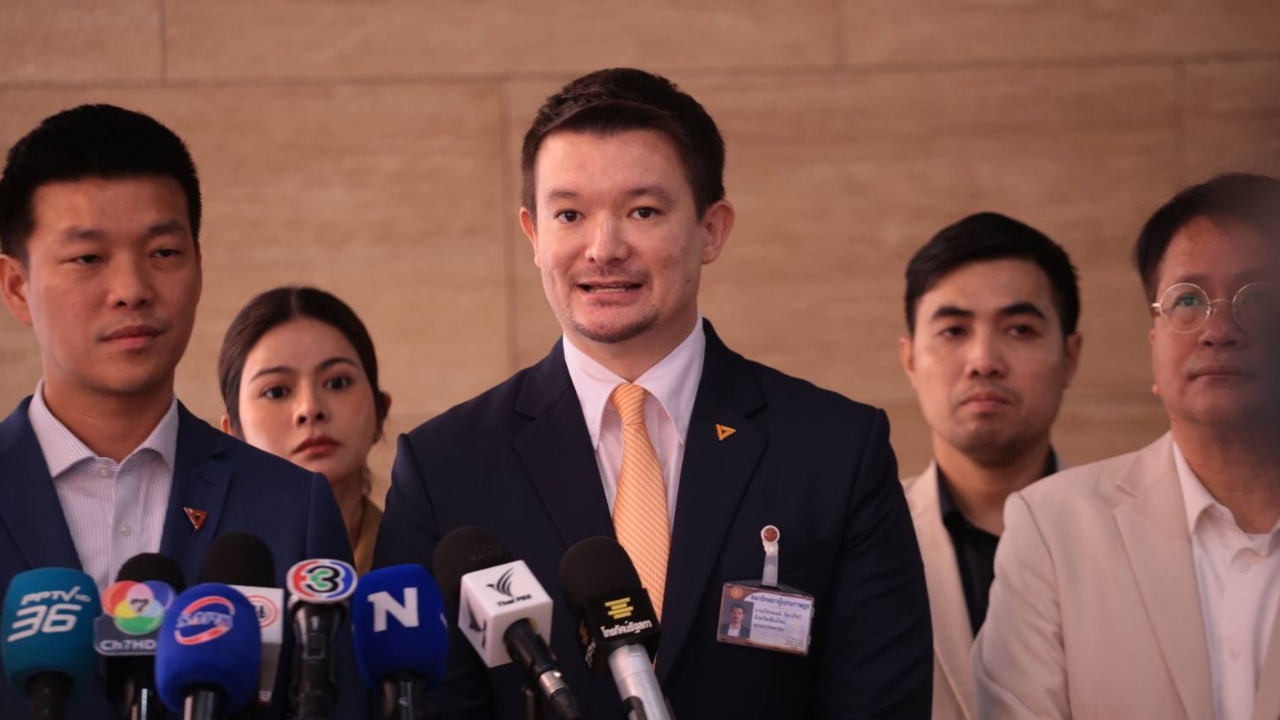
Pattharaphong, MP from the People’s Party, unveiled a website to monitor water pollution caused by mining in neighboring countries, emphasizing that it was created without spending a single baht. He invited the government to use the data to negotiate with neighbors to address the root causes.
On 4 August 2026, Pattharaphong Leelaphat, MP for Chiang Mai’s 8th district from the People’s Party and chairman of the subcommittee on transboundary water pollution, launched the website.https://waterpollution.disaster-mp.org/The website allows the public to access information about water pollution from various mines in neighboring countries.
This website compiles data from government and private agencies into one system, enabling the public to see the overall picture of pollution issues in rivers such as the Kok, Sai, Ruak, Mekong, Salween, and Kra Buri. It provides details on toxic substance test results in water and sediment, agricultural product contamination, mining site coordinates in neighboring countries, satellite images, and animated maps explaining the flow paths of the relevant rivers.
Pattharaphong plans to further develop the system when more complete data is available, including water and sediment test results from the Kra Buri River, fish testing results, and import-export statistics of minerals at various Thai checkpoints.
He also revealed that the website was created without any government budget, as he personally developed the transboundary water pollution monitoring system based on data gathered by the subcommittee. He only paid a few hundred baht for the website domain.
He added that since the government has not systematically integrated information on water pollution from foreign mines, he is willing to manage all the existing data in a single system. This allows the public to truly understand the problem of river pollution from neighboring countries’ mines—where the problem originates, how it damages local water sources, and to monitor how far the transboundary water pollution has spread.
“I hope the government will use this information to negotiate with neighboring countries to solve the problem for the affected local communities effectively. It’s not enough to just measure pollution; the mining operations that cause the problem must be addressed directly.”