

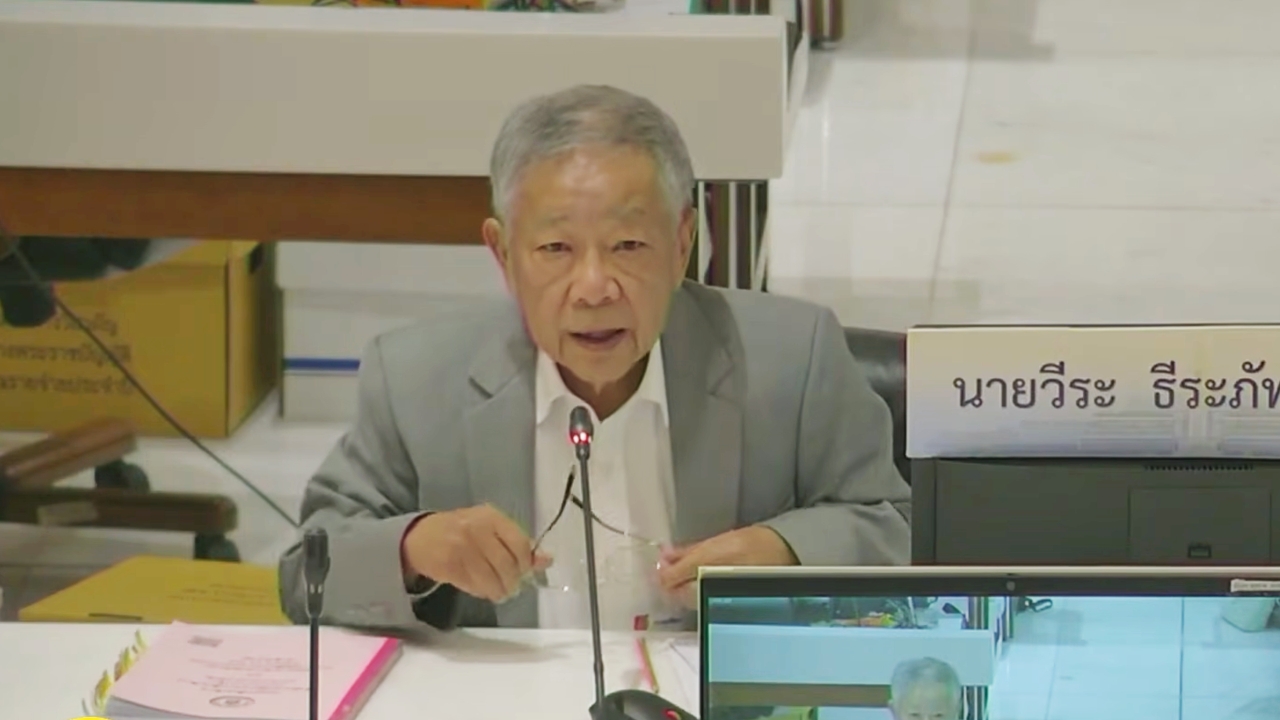
Mr. Weera emphasized in the 2027 budget committee meeting for the Ministry of Education that there is no need for verbal responses but rather to provide explanations in writing. He suggested establishing model vocational schools so that parents need not worry about their children falling into trouble. He criticized the ministry for unclear activities and expressed anger at someone sitting beside the permanent secretary who was laughing mockingly.
On 4 August 2026, the special committee reviewing the 2027 fiscal year budget bill of the House of Representatives reached Section 24, covering the Ministry of Education's budget. At 12:41 p.m., Mr. Weera Theeraphatranon, as a committee member, raised observations and questions, requesting only partial answers without the need for intense scrutiny. He noted that the ministry's budget is approximately 360 billion baht, one of the few ministries receiving increased funding. He viewed this as a limitation since much of the budget goes to the Office of the Basic Education Commission (OBEC), which received 276 billion baht—an increase of 6 billion baht, exceeding the ministry’s average growth. The ministry’s budget rose by about 1.3%, while OBEC’s increased by 2.23%, understandable given it oversees nationwide education.
However, a closer look reveals most of the budget is for teachers’ salaries. Some committee members calculated ratios, claiming one teacher per 12 students, a figure he deemed inaccurate because many teachers do not actually teach. He asked the permanent secretary of education if any assessment has been done on how many students each teaching teacher truly handles, noting that fewer students per teacher is better, while more indicates poor conditions due to lack of attention.
While giving examples from his own school days 60 years ago and noting he is older than everyone present, Mr. Weera turned toward the ministry officials waiting to respond and asked, “Why are you laughing? Are you older than me? Who is the person sitting next to the permanent secretary? I am speaking seriously and do not intend to disrespect anyone, but your mocking laughter makes me angry.”
Mr. Weera continued, stating that the real issues concern both teaching personnel and management systems. He considered these problems unsolvable and therefore did not propose specific additions or cuts, seeing them as minor details. He focused on the Office of the Permanent Secretary, the Department of Learning Promotion, the Office of the Vocational Education Commission, the Office of the Basic Education Commission, and the Equitable Education Fund (EEF).
Starting with the Department of Learning Promotion, he requested data on how many people registered for courses, noting that, to his knowledge—possibly incorrect—the number of actual learners differs from those registered for budget purposes. He asked that answers be submitted in writing. He mentioned issues related to welfare card eligibility involving over 100,000 people, whose participation is unclear. The rest concerns teaching management developed from non-formal education and equivalency exams, which he personally is too old to pursue.
Regarding the Office of the Vocational Education Commission, he criticized its failure, especially in high school-level vocational education, which is crucial. After Grade 9, students choose either vocational or academic tracks, with university graduation varying accordingly.
“What worries me and other parents is that I want my children and grandchildren to study vocational education because, in Germany, it is highly valued. However, students attending vocational schools face issues like fighting, which deters parents from sending their children there. I do not understand what culture or circumstances have caused this,” he said.
He proposed establishing at least one school free from such problems—like the Chulachomklao Royal Military Academy—a serious institution modeled after China’s system, so parents would not fear sending their children to vocational education and risk them becoming wayward, sometimes fatally. “Why not fix this problem instead of doing unclear things? Whether government vocational colleges or private ones, the problems persist. We should create a model school or training institute, a boarding school with about 500 students. We teach what they lack, hire good teachers, and stop fragmenting efforts. This is my straightforward suggestion.”
He then asked the permanent secretary two questions: First, where are the off-budget funds? If none exist, say so; if they do, where are they? He requested information on fees and how much off-budget money is collected and possibly misused, so the committee can verify figures. Second, how many funds and revolving funds exist within the Ministry? How much accumulated money remains in accounts or assets? He requested detailed financial statements and lists of all funds in writing.
He commented that the Equitable Education Fund is a heavy financial burden, receiving allocations of 7.483 billion baht in 2026 and 7.688 billion baht in 2027. While aware of its uses, he questioned its existence as evidence of the Ministry’s systemic failure. The more money the fund gets, the more it indicates failure. Though he has not studied abroad, he suggested teaching children just three key subjects: 1) Mathematics—basic arithmetic, no calculus needed; 2) Language—many countries struggle with students who speak and listen well but cannot write, sometimes with illegible handwriting; 3) General knowledge—easily accessible nowadays. Teachers may not be as smart as AI anymore.
“I believe the core of education is simple: think and do, think well and do well. The rest involves professional specialization, pursuing advanced degrees, personal interest, and career advancement. Humans do not need much—having money and a good family suffices,” he said.
He concluded by saying that if anyone cannot or does not want to answer his questions, that is acceptable. If documents cannot be provided, that is also fine, but he urged some effort. He reiterated that no verbal answers or time should be spent responding to him.