

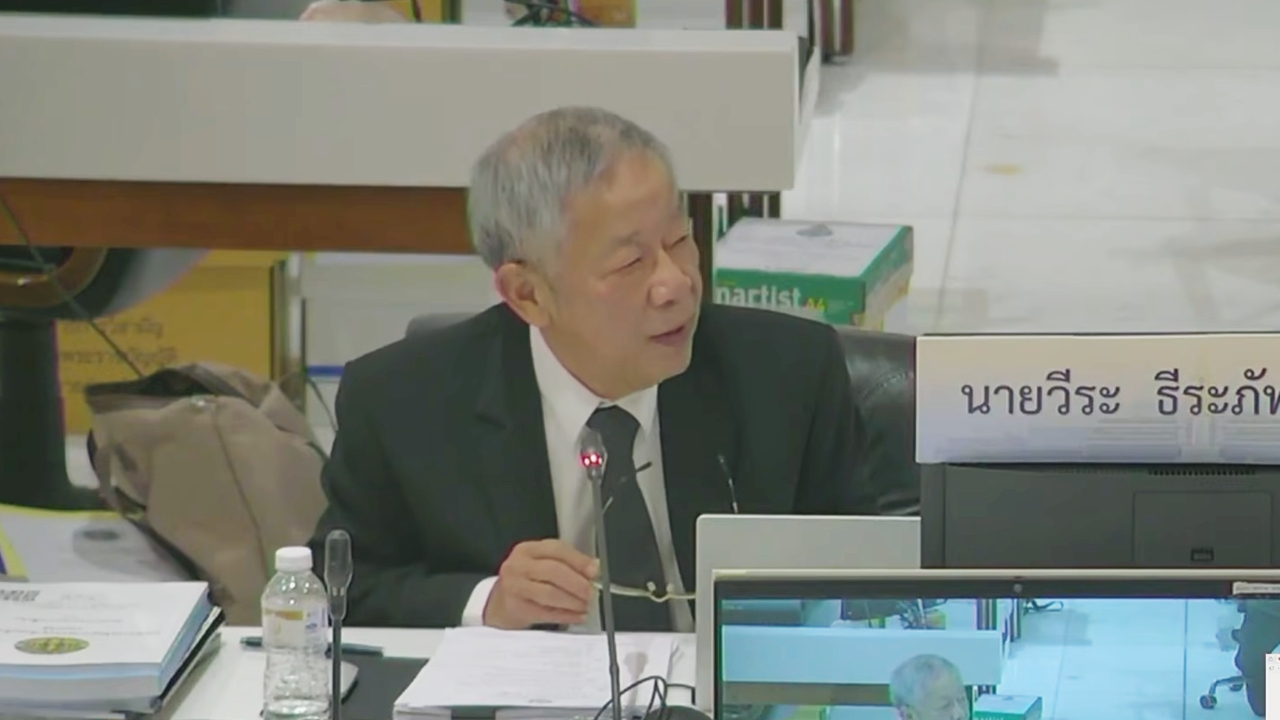
During the Ministry of Natural Resources and Environment budget discussion, Mr. Veera severely criticized the poor quality of national park accommodations, expressing anger and saying even cricket hotels are better. He suggested launching pilot projects for private sector investment, believing revenue collection could be higher. He also hinted that corruption underpins the system, sustaining it as a "feeding mechanism." The ministry's budget was being examined in detail.
On 5 August 2026, starting in the morning, the Special Committee on the Budget Bill for fiscal year 2027 held its 21st session at the House of Representatives to consider Section 17 of the bill. This concerned the Ministry of Natural Resources and Environment. (Abbreviated as MoNRE) During the session, Mr. Veera Theerapatranon, in his capacity as a committee member, said that after reviewing the overall proposed budget documents, there was confusion. The ministry requested a regular annual budget of 38.625 billion baht, with an additional 1.96 billion baht in extra-budgetary funds.
However, in the red booklet, Budget Document No. 3, Issue 6 for the Ministry of Natural Resources and Environment, some figures differed by nearly 300 million baht. There might be later amendments, as the regular budget had increased from the original 36.148 billion baht, and the extra-budgetary funds from 1.634 billion baht. He requested clarification on any significant changes since the numbers did not match the submitted documents.
Mr. Veera further revealed that for fiscal year 2027, the ministry had an estimated extra-budgetary fund carryover at the start of the year of 4.266 billion baht, though the fiscal year was not yet complete. He estimated that by the beginning of fiscal year 2027, the remaining extra-budgetary funds would be about 2.919 billion baht after some expenditures.
“Viewed this way, the ministry is commendable for managing a significant amount of extra-budgetary funds and integrating them into the budget to operate fully. I consider this ministry among the top in managing the balance between extra-budgetary and regular funds. I urge maintaining this record, as given our financial status, monitoring remaining extra-budgetary funds is necessary.”
Having large extra-budgetary funds is not unusual and likely relates to fees for water and land park access, rentals, accommodations, and other revenues. In 2026, extra-budgetary revenues amounted to 2.488 billion baht (still incomplete), with an estimate of 2.470 billion baht for 2027. There was also about 1.1 billion baht from revolving funds not yet fully audited. Overall, the ministry has considerable revolving funds, though they will be spent. He said if explanations about these funds' origins were unclear, he would inquire directly.
“What I want to say, and leave as a suggestion, is whether it could become a policy. Personally, as someone who enjoys traveling and frequently visits parks, the quality of park accommodations, such as at the Similan Islands four years ago, was extremely poor. For example, lights were turned off at 8 PM, and the bed I stayed on was a metal frame requiring a blanket to lie on. I also saw staff housing that was better than the paid visitor accommodations. I can't recall if it was Similan or Surin National Park, but I spent one night there. Maybe things have changed since, but other places I've visited didn't have such severe issues. Water supply was insufficient, no hot water, no internet—only staff areas had it. I was willing to pay 5,000 baht per night but expected decent quality.”
Mr. Veera continued that while some park accommodations are decent, he asked if better management of visitor lodging is possible. If the budget is insufficient or constrained, could public-private partnerships (PPP) be used to improve? Some national parks are stunning but their accommodations do not match the quality of the environment. He mentioned a park in Sukhothai Province infested with animals and insects, possibly due to lack of funds. He suggested asking the Permanent Secretary or relevant officials if a pilot PPP project could be initiated, where private investors build and manage accommodations while park staff remain. Alternatively, new facilities could be built without disturbing existing ones. Otherwise, visitors will leave unimpressed. Price is less important than service quality. He planned to revisit Similan or Surin Islands National Parks in Phang Nga Province by late this year or early next year.
He also mentioned Tarutao Island in Satun Province, suggesting accommodations there should be developed. Although the ministry might have security concerns due to proximity to Malaysia, he understood these but said the island was impressive, comparing it to Alcatraz Island in San Francisco Bay, California, USA. He recommended developing it similarly. Although access to Tarutao is difficult, the experience is memorable.
At 15:26, Mr. Veera spoke about the Zoological Park Organization under royal patronage. He shared positive personal experiences from a recent visit to Khao Kheow Zoo, which had greatly improved over the past decade. However, he noted the access road was complicated, narrow, and dangerous, suggesting a more direct entrance road to avoid winding village roads. Inside, the zoo was good, and he looked forward to the completion of the new zoo in Khlong Hok, Pathum Thani Province, which would replace the former Dusit Zoo as Bangkok's main zoo. He hoped it would become a popular tourist destination for Bangkok residents. Regarding its budget request of over 2 billion baht, he saw it as a continuation of zoo development and urged improvements in parking and shading for visitors.
Regarding the Forest Industry Organization (FIO), Mr. Veera said its roots date back to King Rama V's reign when forestry was established. Although activity later declined, FIO remains the most skilled in teak forestry—planting, care, harvesting, and processing. It also handles seized timber properly. However, he regretted that FIO should be self-sufficient without requesting over 100 million baht annually. Based on financial reports, it seemed feasible but perhaps there are obstacles. He understood these requests are annual due to long-term work and suggested better coordination with the Royal Forest Department, which also runs a good nursery center.
He then mentioned the Botanical Garden Organization, familiar with the site in Phu Khae Subdistrict, Chalerm Phrakiat District, Saraburi Province, but less so elsewhere. He visited the Mae Rim site in Chiang Mai Province infrequently but praised their excellent work. He wished there were more such gardens and lamented their absence in Bangkok, suggesting the capital could seek knowledge from them. He had no criticisms of state enterprises, even if their budgets exceed 100 million baht, stating others ask for more and often underperform. These organizations operate economically and effectively. He skipped commenting on two other public organizations due to lack of knowledge.
For the Royal Forest Department and the Department of National Parks, Wildlife and Plant Conservation, which were formerly one agency, Mr. Veera praised the forest nursery centers as excellent but encouraged expanding production. He noted that during dry seasons, seeds collected from the forest are grown free of charge but suggested charging nominal fees (one or two baht per seedling) instead of free distribution, as current staff often juggle multiple roles. He appreciated the nursery centers and mentioned personally obtaining 200-300 seedlings to plant at his countryside home.
Before discussing the Department of National Parks, Wildlife and Plant Conservation, the largest and most budgeted department (about one-third of the ministry's budget), Mr. Veera noted it manages substantial extra-budgetary funds. The current director-general was nearing retirement, so he saw little point in appealing to him but urged his successor to listen. In 2025 and early 2026, the department received 11.746 billion baht, 100 times the FIO's budget, though this year it slightly decreased to 10.284 billion baht. It also received 1.583 billion baht in extra-budgetary funds, which was generous. Yet, this generosity should be examined alongside revenue. The department earned 2.332 billion baht in 2025 from sales and services, managing finances well with income exceeding expenses.
“However, I fear the recorded income of 2.3 billion baht is significantly understated. Based on visitor and accommodation numbers, actual revenue should be higher. There is also the issue of ticket sales; staff reportedly reject E-Ticket systems and prefer paper tickets. I ask whether E-Ticketing is fully implemented yet. If not, it should be, to prevent revenue leakage. Developing this requires minimal investment.”
He sincerely asked whether accommodations in parks—marine and forest—could be improved with basic amenities. Recently visiting Erawan National Park in Kanchanaburi Province, he noted nearby hotels had many conveniences, but park accommodations caused fear due to poor conditions. He shared photos of the shabby park lodging, saying it did not match the status of world-class parks like Similan. He was disheartened. Staff explained lack of budget, insufficient personnel, and limited facilities—water supply was poor, salty, and rationed; no electricity was available. Compared to Myanmar's islands, where well-equipped tents are common, Thailand's situation was embarrassing. He questioned why others could do it but Thailand could not.
The department claimed laws prevent private sector involvement, but he urged creative thinking about PPP models, such as Build-Transfer-Operate (BTO), allowing private investment in quality infrastructure with reliable utilities like water, electricity, and internet. This would ensure enjoyable visits.
“This should be considered both for marine and land parks, starting now. I might not live to see it completed, but if you don’t start today, don’t talk about tourism. Such substandard amenities make travel unattractive. I am middle class, not wealthy, and I wouldn’t want to stay under these conditions. Honestly, even provincial cricket hotels are better. I get angry just saying this. Now you must think seriously about what to do.”
He also called on the government to establish a pilot project, amend laws if needed, and not worry about reducing civil servants' powers in managing these areas, even if it affects their interests. Discussions with marine tour companies would reveal that official revenue figures are understated. Where the government reports collecting 2 billion baht, he claimed he could collect 5 billion baht. While revenue loss is unfortunate, he understood the situation.
“If there were no corruption, this country would collapse. I understand corruption sustains the system; it is a shadow economy. Without it, we couldn’t survive. I speak frankly as I am old and do not want to leave problems behind. You must consider what to do about this. Otherwise, we will continue in this messy state indefinitely.”
Mr. Veera concluded that if he knew the current director-general was still in office, he would speak more strongly, but for now, he kept his remarks brief and urged the incoming director-general to take heed.