

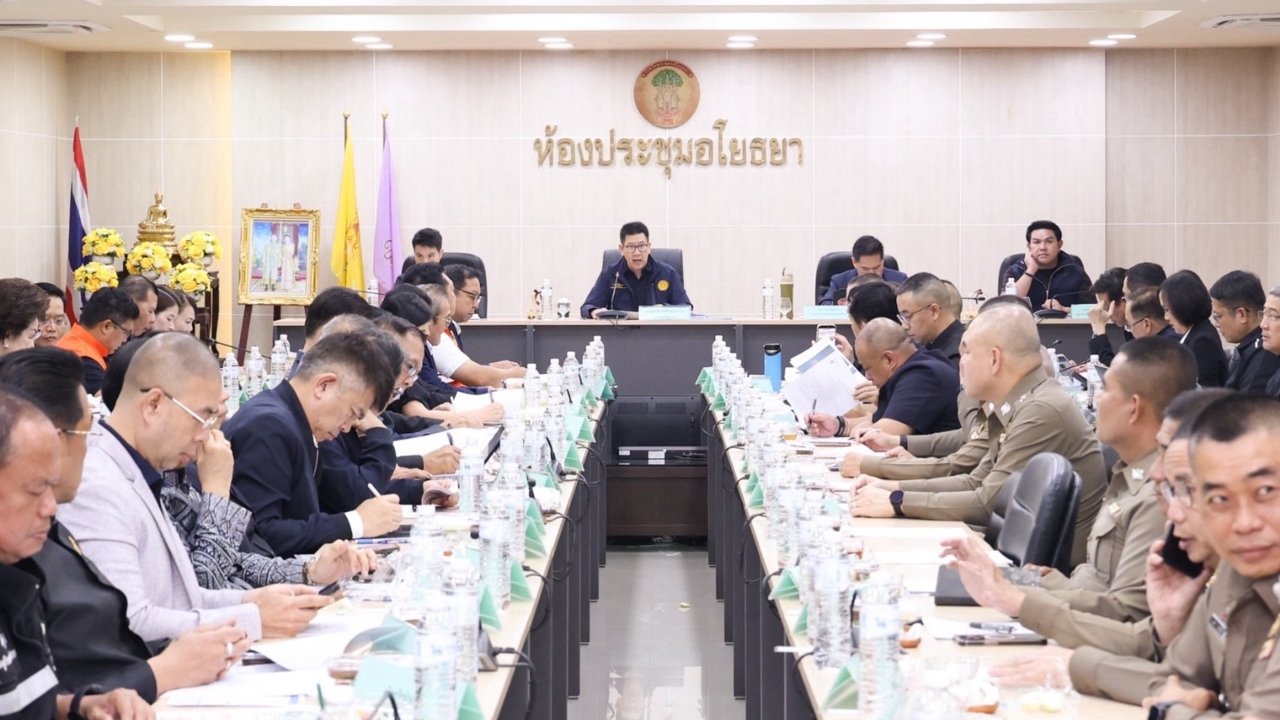
Ekniti chaired a meeting to address flooding and drought issues in central Thailand. Warawut expressed concern that El Niño could cause water shortages, proposed prioritizing reservoir water storage, recommended Royal Rainmaking operations, and supported alternating wet and dry rice cultivation.
On 9 August 2026, at the Ayothaya meeting room, Phra Nakhon Si Ayutthaya Provincial Hall. Deputy Prime Minister and Finance Minister Ekniti Nitithanprapas. Presided over the first 2026 meeting of the Central Region Flood and Drought Prevention and Mitigation Committee, convened under Prime Minister's Office Order No. 275/2026 appointing the regional flood and drought prevention committee. Present were Minister of Industry Warawut Silpa-archa, Minister of Tourism and Sports Surasak Pancharoenworakul, Minister attached to the Prime Minister’s Office Pradorn Prissanantakul, National Disaster Warning Council Vice-Chairman Seri Supharatikit, and other relevant agencies.
The meeting acknowledged Prime Minister's Office Order No. 275/2026 and discussed preparations for preventing and addressing flood and drought problems in central Thailand, based on the Ministry of Interior’s urgent letter dated 7 August 2026.


Ekniti said that Prime Minister and Interior Minister Anutin Charnvirakul appointed deputy prime ministers responsible for flood and drought prevention in each region. Today's meeting was for the central region committee, aiming to raise the level of coordinated response and ensure unified action. Current forecasts show Thailand facing El Niño, which will intensify next year, causing severe drought and erratic weather affecting people and businesses. Planning and preparation are essential for timely response when events occur.
Seri summarized the current situation, trends, and forecasts regarding water and drought conditions. The National Water Resources Office reported on flood and drought management in the central region, while the Geo-Informatics and Space Technology Development Agency presented on using geospatial technology to address these issues. The meeting also discussed flood prevention in Phra Nakhon Si Ayutthaya Province, drought prevention in Prachuap Khiri Khan Province, and support from the Department of Disaster Prevention and Mitigation, Ministry of Defense, and Ministry of Public Health.


At one point, Warawut suggested the importance of storing water in advance because after November and December, rainfall stops. If a super El Niño occurs as predicted, water shortages may arise. He urged the public to conserve water now as only a few months remain. Currently, reservoir levels remain low at the end of the rainy season, but humidity still exists, so he proposed employing Royal Rainmaking operations to help alleviate drought.
Warawut further explained that the alternating wet and dry rice cultivation technique poses challenges, requiring coordinated water management among all parties. However, this method can save nearly 50% water and reduce fuel use for pumping by about half. Coordination among agencies must improve, and ideally this method should be applied to large rice fields to be effective. Several provinces have already adopted this approach.
He acknowledged the challenge of educating farmers, but emphasized the necessity of modernizing rice cultivation. Without change, future super El Niño events will continue to strain water use. Adapting cultivation methods will save water and energy, and importantly, farmers can benefit by selling carbon credits and obtaining better rice prices. He called on the Ministry of Agriculture and Cooperatives to support the promotion of alternating wet and dry rice planting.


