

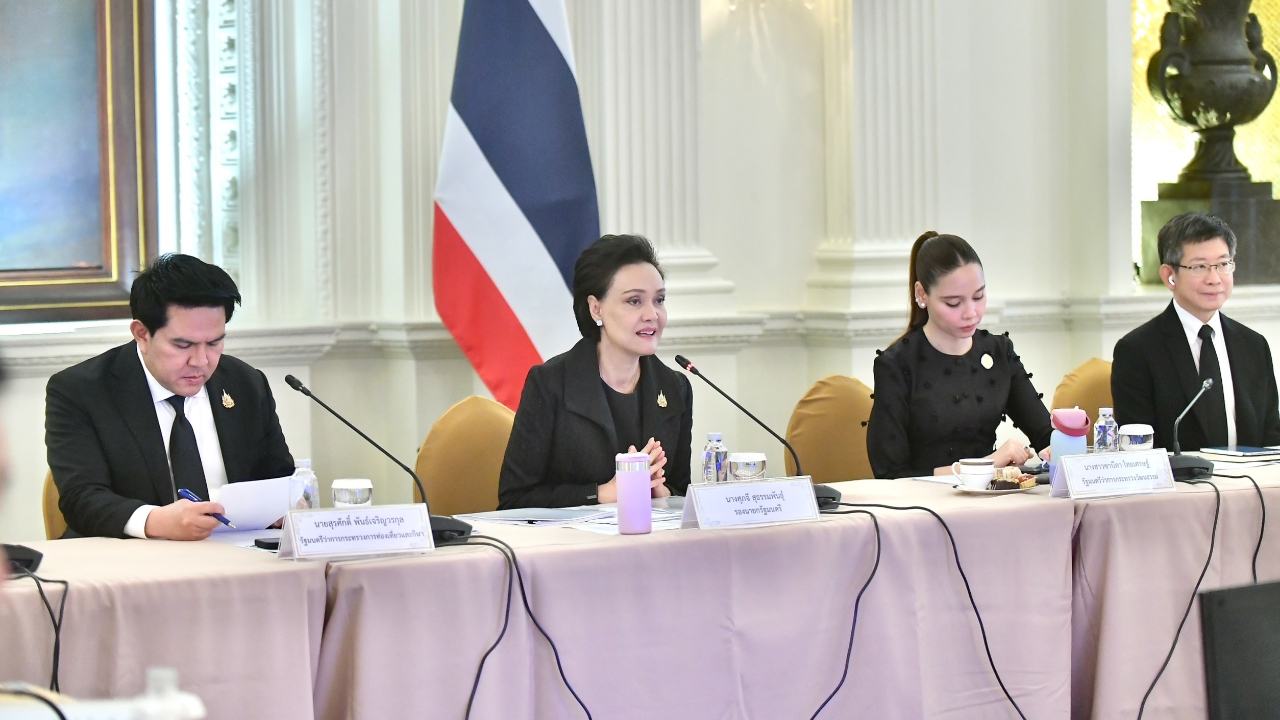
Supachai has set up four working groups to drive the government's economic board, speeding up deregulation with a 6-12 month framework to resolve immediate issues and establish a competitive foundation for trade, services, agriculture, SMEs, and community economies over the long term.
At 12:30 p.m. on 10 August 2026 at the Government House, Mrs. Supachai Sutthumpan, Deputy Prime Minister and Minister of Commerce, along with her team, held a press conference on the results of the first meeting of the Subcommittee on Trade Development, Tourism, and Community Economy for 2026. She stated that this subcommittee has started to implement the economic structure according to the government's second group policy on trade and services.
Mrs. Supachai said that this subcommittee was tasked with five areas: quality tourism and wellness, creative economy, agriculture, retail and wholesale trade, and international trade. However, their work will not be limited to previous frameworks because today's economic challenges require both short-term solutions and long-term structural planning simultaneously.

Therefore, today's meeting established four working groups to ensure clear achievements rather than merely adding committees without real driving forces. These groups focus on the creative economy and Visitor Economy; agricultural products and food security; community economy and SMEs; and international trade.
Mrs. Supachai explained that the Visitor Economy concept is broader than traditional tourism, covering all inbound travelers including tourists, students, business contacts, and potential investors. The goal is to increase economic value from these visits by connecting culture, experiences, services, secondary cities, and the creative economy.
Regarding the community economy and SMEs, the focus is to elevate them from retail and wholesale issues to becoming a core part of the national economy. Since SMEs and communities account for about 35% of the country's total income, it is essential to boost their competitiveness while ensuring fair competition so that small entrepreneurs are not left behind.

Mr. Weerasak Kowsurat, chairman of the working group on the creative economy and Visitor Economy, said the group will conduct weekly field visits to discuss with various sectors in order to identify four to five urgent issues to address within the first 6-12 months, covering both opportunity creation and obstacle removal.
Key obstacles include disguised or nominee operators who leverage advantages to suppress Thai businesses, and domestic regulations that hinder Thai entrepreneurs themselves. Thus, unnecessary rules must be removed to allow Thai businesses to compete faster in global markets.
Mr. Kobsak Putrakul stated that the agricultural sector must shift from traditional production to modern, high-value agriculture by considering the entire chain from upstream production, midstream processing, to downstream marketing, especially during periods of oversupply.
As for SMEs, the entire ecosystem needs adjustment—from business entry, licensing, expansion, to entering global markets. The numerous licensing requirements, such as for hotels or restaurants, create cost burdens that must be urgently resolved.
Ms. Sabida Thaiset, Minister of Culture, said the Ministry of Culture will collaborate to drive the creative economy and Visitor Economy by leveraging cultural assets, traditions, arts, and local identities to create new experiences and concretely increase community income.
On international trade, the meeting agreed that the global context is changing rapidly, with trade increasingly linked to geopolitics and new rules. Therefore, FTAs must be used to open new markets, maintain existing ones, and rebalance trade by increasing SME roles in export structures.
Mrs. Supachai added that the government will link this work with other economic committees, especially that of Mr. Akniti Nititanprapas, to rebalance investment promotion, reduce import dependence, and increase the use of raw materials, labor, and Thai entrepreneurs within production chains.
Overall, the first meeting marked a systematic start to the government's economic board operations, moving from major policy tasks to specific working groups with a 6-12 month framework to solve immediate problems, remove constraints, and build a competitive foundation for trade, services, agriculture, SMEs, and community economies over the long term.