

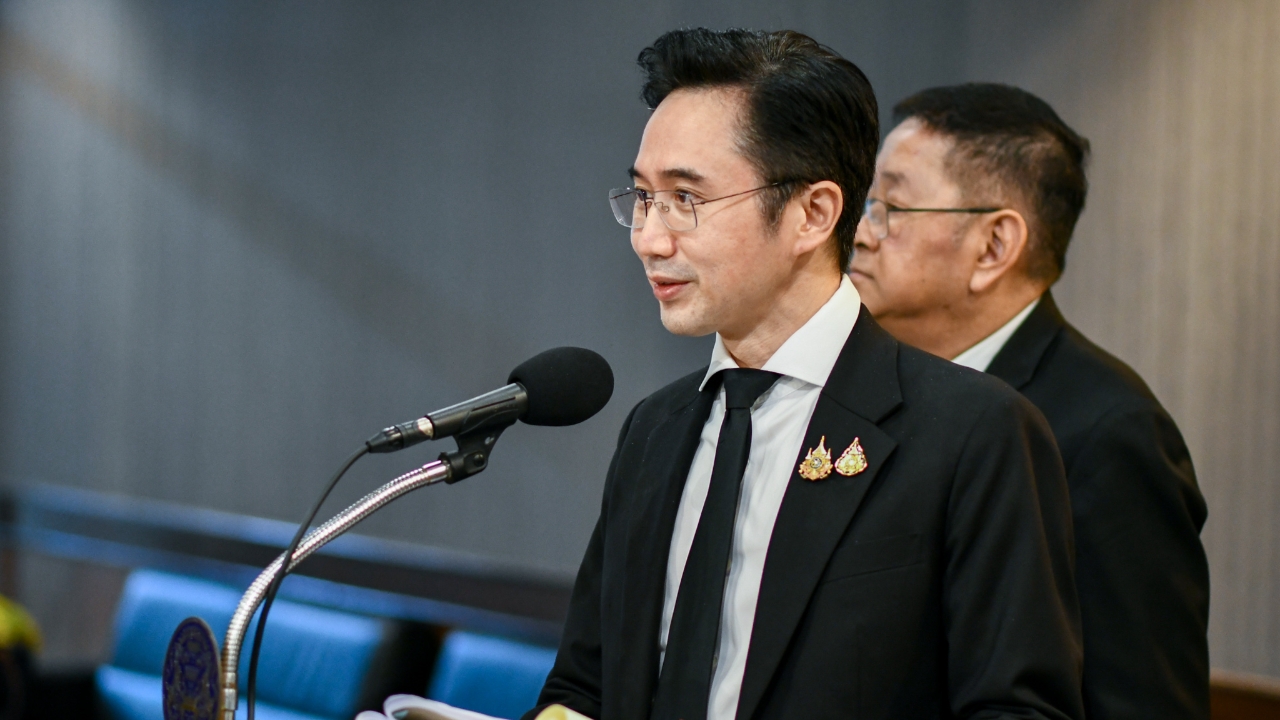
“Yotsanan-Prasert,” two ministers from the Pheu Thai Party, kick off education reform by piloting six policies through the Education Sandbox, promoting the Credit Bank system linked to TCAS and returning teachers to classrooms.,
10 Aug 2026 GMT+7 Mr. Yotsanan Wongsawat, Deputy Prime Minister and Minister of Higher Education, Science, Research and Innovation, , together with Mr. Prasert Chantraruangthong, Minister of Education, revealed at the Government House policy directives to drive Thai education using the mechanism the “Education Sandbox” as a pilot area for practical implementation before expanding successful results nationwide.
Mr. Yotsanan stated that this drive marks a concrete starting point for transforming Thai education, with a systematically planned direction covering six key dimensions as follows:

1. Returning time to teachers through the “central kitchen” system. This aims to reduce administrative burdens related to lunch management and procurement tasks unrelated to teaching. The pilot involves the Office of the Basic Education Commission (OBEC) collaborating with local administrative organizations to establish central kitchens (Cloud Kitchens) managing shared resources among nearby small schools, enabling teachers to fully return to classroom teaching.
2. Revising budget calculation formulas to reduce inequality. This eliminates the average per-student budget allocation and shifts to criteria based on the actual necessary costs for each student group, expected to be completed within 1–2 months. Concurrently, a pilot student transport system will be implemented with local agencies to facilitate access to quality schools without increasing parents’ travel expenses, supporting the plan to consolidate resources of small schools.

3. Updating existing subjects to be world-ready without adding new courses. A competency-based curriculum adjustment (Curriculum & AI Literacy Framework) will be piloted to complete by September, focusing on assessing four main skills aligned with PISA: reading, mathematics and science, communication, and digital/AI skills, by modifying teaching and assessment methods within existing subjects without adding new courses that burden students.
4. Creating flexible education (Thailand Zero Dropout PLUS). Developing a Credit Bank Sandbox system supporting learning outcomes from online, vocational, and community sources, directly linked with the university admission system (TCAS). This opens opportunities for at-risk youth to accumulate credits and competencies for future university admission.

5. Improving laws and management structures. Directing studies on flexible appointments and transfers of school administrators within innovation zones, aligned with Provincial Education Committees’ mechanisms. Also preparing plans to ensure continuity between the Education Sandbox Act’s expiry and the new National Education Act draft.
6. Upgrading schools to safe spaces (Student Safety and Protection Sandbox). Implementing Zero Tolerance measures against all forms of violence, bullying, and harassment by integrating cooperation with the Department of Mental Health for student psychological screening and care. Establishing confidential reporting channels via Traffy Fondue for Education and regularly training teachers in emergency response plans.
At the end, both Mr. Yotsanan and Mr. Prasert emphasized that all involved parties must regularly report progress to the Education Sandbox Policy Committee to assess measurable results before considering scaling this successful model as a national policy.

