

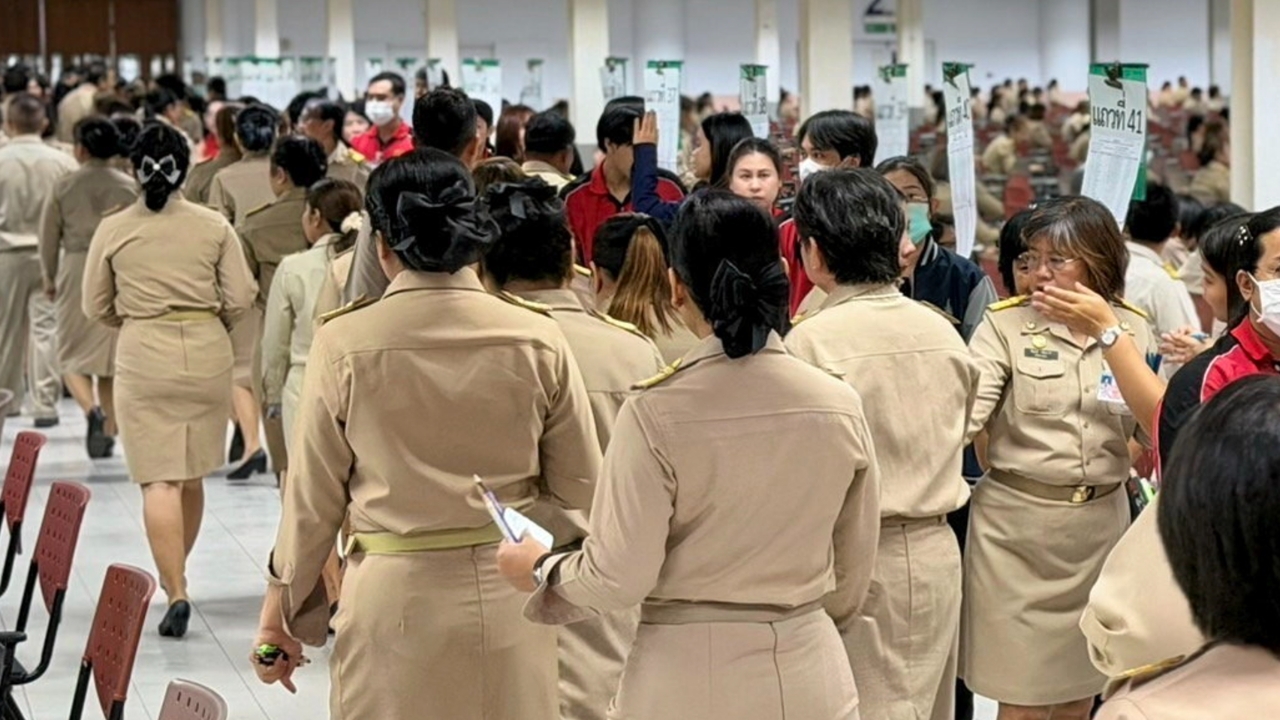
(File photo) "Local government exam corruption investigation results reveal extensive flaws from the TOR stage, over twice the requested positions were filled, exam scores were altered to help failing candidates pass, with proposals for strict prosecution and blacklisting of fraudsters to prevent them from registering for government or other public agency exams again." []
On 12 August 2026, reporters reported that the Office of the Deputy Prime Minister, Pakorn Nilprapunt, issued document Kongno.(Kor6) 0030 / 2569 dated 6 August 2026 regarding the investigation and legal findings on corruption in the 2025 local government civil service examinations, addressed to the Prime Minister. []
According to Prime Minister's Office Order No. 263/2569 dated 6 July 2026 establishing a committee to investigate facts and legal issues concerning corruption in the 2025 local government civil service examinations, the committee was required to report to the Prime Minister within 30 days. The committee has now completed its work and respectfully submits the summary of findings as follows. []
1. The committee investigated every stage, including:
(1) Setting the number of vacancies for recruitment;
(2) Approval to hold the exam;
(3) Preparation of the TOR to contract exam administration;
(4) Selection of contractors;
(5) Contractor's exam administration and result checking;
(6) Preparation and announcement of exam results;
(7) Recruitment and appointment processes;
(8) Actions by related parties after corruption arrests and identification of loopholes facilitating corruption, with indications of potential legal violations at nearly every step.
2. On setting the number of vacancies, it was found that:
A. The central committee approved only 8,548 vacancies as the basis for recruitment, but actually 15,520 were filled. The central committee gave general authority to provincial, municipal, and subdistrict committees to recruit from registered candidate lists without further central approval. This practice conflicts with general agency principles controlling salary and benefits expenses, which should not exceed 40% of local government annual budgets under personnel administration laws. The Ministry of Interior must ensure compliance with the law. 3. Regarding approval to hold the exam, the Civil Service Commission authorized the Department of Local Administration (DLA) to conduct it, but did not consider previous corruption issues that led the Minister of Interior to cancel earlier exams, missing a vital opportunity to establish anti-corruption safeguards.
4. On preparing the TOR for contracting exam administration, the Civil Service Commission delegated this to its secretariat without reviewing the TOR details, despite its responsibility for exam fairness and correctness. This was a clear flaw. Furthermore, the TOR assigned full responsibility for exam questions to the contractor, preventing the Commission from controlling exam quality standards, which should match those of the Office of the Civil Service Commission. The Commission lacked a strict oversight system for the contractor, unlike usual government exam procedures. Although the TOR gave the contractor full civil, criminal, and administrative responsibility, the Commission remains legally accountable. The Ministry of Interior must investigate the Commission and TOR drafters’ responsibilities further.
5. Contractor selection followed procurement procedures.
6. The contractor subcontracted exam result checking, and its staff ordered the subcontractor to make an extra copy of exam results data, creating corruption risks. Because the TOR granted the contractor full authority, the Commission did not rigorously verify the contractor’s work, representing a flaw to be further examined for intent. Regardless, the Commission, legally responsible, cannot deny accountability for resulting issues.
7. On preparation and announcement of exam results, the subcontractor's immediate post-exam checking results differed from the officially announced results. The Commission endorsed the results without detailed review, citing confidentiality, even though it set the confidentiality level and is responsible for exam management and results. It only approved the number of passers presented by the secretariat, a serious flaw. Digital footprints and testimonies reveal multiple instructions and coordination for exam result alterations by Commission staff, including involvement of unauthorized "external persons" in modifying published results—clear, shameless corruption violating laws and regulations. Score changes included converting failing candidates to passers and increasing scores of those already passing, affecting ranking and candidate registration order.
8. Recruitment and appointment proceeded with the inflated vacancies mentioned earlier, requiring further review for legality and compliance with government regulations. If found improper, corrections must be made.
9. Actions by involved parties:
Despite arrests of the corruption ring, the Commission continued appointments, disregarding orders from the Minister of Interior, who oversees the central, civil service, and local administration committees. The Commission cited fear of lawsuits but later ordered appointments without such fears, an abnormal situation. There were delays in fact-finding and verifying the exam management, contrary to normal government urgency in addressing problems, eroding public trust in government (Trust in Government) and severely damaging the entire civil service system. Further in-depth investigation is needed into motivations behind these lapses, especially noncompliance with the Minister’s orders and delayed scandal handling, highlighting problems in the Ministry of Interior's command and control systems. Details are included in the official investigation and legal report on the 2025 local government civil service exam corruption, comprising one volume and eleven appendices submitted herewith. The committee respectfully recommends the following directives.
1. Ministry of Interior (MoI) and Department of Local Administration (DLA):
1.1 Strictly prosecute all individuals listed in section 4.2 (pages 20-36 of the investigation report) in civil, criminal, administrative, and ethical matters.
1.2 Further investigate whether more persons were involved, as this corruption was clearly organized, and immediately prosecute supervisors in all legal and ethical domains.
1.3 Reconsider whether the Civil Service Commission should continue administering exams, given public loss of confidence and the collapse of its exam system. Consider assigning another agency with governance mechanisms for future exams.
2. Department of Local Administration (DLA):
2.1 As secretariat of the Civil Service Commission, reprocess scores and lists of passing candidates for written and practical exams from OMR data, removing those proven to have had their raw scores improperly altered; propose reconsideration of exam result endorsements (sessions 16/2568 and 4/2569) and annul announcements or appointments of ineligible candidates; expedite recovery of salaries and compensation to mitigate government loss, as per the Supreme Administrative Court ruling in case red number Ob.418/2565.
2.2 As contracting party with Srinakharinwirot University (SWU), act per contract and procurement law, since contract personnel were clearly involved in post-exam corruption related to data processing and passing candidate lists.
2.3 Use the Local Human Resources system to record and update vacancy data fully, accurately, and currently as a central database, and impose administrative penalties if local governments neglect their duties.
2.4 As secretariat of provincial, municipal, and subdistrict committees, propose revisions to the 2017 General Standards for Competitive Exams to clearly cover manpower frameworks, authority scope, processes of the Civil Service Commission’s 32 activities, exam quality criteria, use of the Office of the Civil Service Commission’s written exam results, and matching pass lists to the number of approved vacancies.
Propose providing data on those involved in corruption to the Office of the Civil Service Commission to create a central database preventing their future applications for government or other public agency exams. 3. The Office of the Civil Service Commission should be the main agency to develop the central fraud database system for government exam candidates, enabling agencies to screen out fraudsters during application.
4. The Office of the Public Sector Anti-Corruption Commission, Royal Thai Police, and Anti-Money Laundering Office should collaborate seriously to investigate and pursue persons or networks involved in this corruption, supporting the National Anti-Corruption Commission’s ongoing legal inquiries. 5. The Comptroller General’s Department, with related agencies, should establish central standards for TOR preparation for exam contracts, covering all processes, IT system security, data protection, access control, audit logging, and score verification, to be proposed to the Cabinet for mandatory government agency compliance.
6. The Office of the Civil Service Commission, the Public Sector Anti-Corruption Commission, Police, Ministry of Interior, and Office of the Council of State should jointly study, draft, and revise laws to clearly define qualifications, disqualifications, offenses, and penalties related to corruption in government recruitment exams, suitable for current offenses.
The committee respectfully submits this for consideration and, if approved, requests orders as proposed, and that this report be sent to the Ministry of Interior, Office of the Civil Service Commission, Public Sector Anti-Corruption Commission, Police, Ministry of Interior, and Office of the Council of State for appropriate action, with progress reported to the Prime Minister every three months.
Reporters further note that at the end, Prime Minister and Minister of Interior Anutin Charnvirakul signed the document and handwritten noted:
"Approved. Implement as proposed. Report promptly to the Prime Minister. Delegate Deputy Prime Minister Pakorn to supervise, follow up, and report results to the Prime Minister per directives."
Dated 11 August 2026, with an additional directive: "Declassify the report." End of report.