

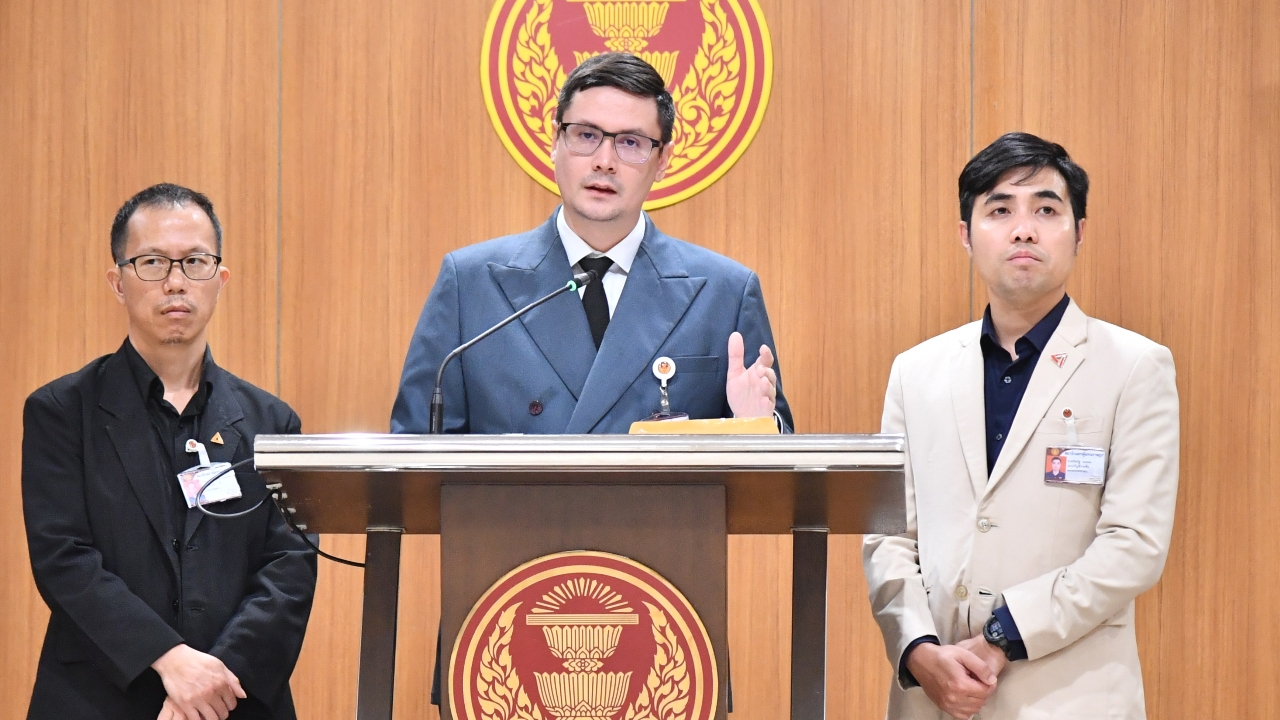
"Rome" highlights that Chaiyanat has been charged with assaulting the Deputy Superintendent of Thung Yai Police Station. If true, legal action must be taken as an example. The People's Party has begun discussions on amending the Firearms Act, criticizing the possession of 30-40 guns as excessive.
At 1:00 p.m. on 13 Aug 2026 GMT+7 at the Parliament, Rangsit Rome, party-list MP and deputy leader of the People's Party, commented on the case of Chaiyanat Dechadecho, party-list MP and deputy leader of the Democrat Party, who was charged with assaulting the Deputy Superintendent of Thung Yai Police Station in Nakhon Si Thammarat. Regarding whether this would affect the image of Parliament or the opposition, he said he has not yet thoroughly examined all facts, but if the reports are true, legal action must be taken seriously to set an example so no one dares to do the same. The key issue is the neutrality of government agencies; officials must remain impartial. Investigations are needed to see if any officials helped one side in the election, such as supporting candidates or political groups, which might be disciplinary violations.
Calls for clarity in solving gun possession issues.
Rangsit discussed concerns over frequent mass shootings, including the recent one in Nakhon Ratchasima. He believes everyone is worried. Thailand ranks among the countries with the highest firearm-to-population ratio globally. Given the tragic incidents, it is clear that current firearm regulations have problems. Without effective safety measures, people will continue to live in fear. So far, no clear solutions have emerged except Prime Minister and Interior Minister Anutin Charnvirakul's statement advising people not to carry guns. To resolve this, policy must clarify whether the state wants citizens to possess firearms at all.
If exceptions exist for officials such as civil servants, police, or military, conditions must be clearly defined. Asked about politicians who own many guns, Rangsit said politicians, police, military, and administrators all have firearms, but the question is whether these weapons are necessary. If the issue of necessity can be addressed, how will their safety be ensured?
"It’s not complicated. Personally, I’m not confident that state officials can protect me. Sometimes, state officials can be more frightening than criminals. So, we need to discuss that if the state wants to reduce firearms, the important question is how it will provide safety for them."
Reveals the People's Party has begun discussions to propose amendments to the Firearms Act.
When asked if the People's Party will propose changes to the Firearms Act, Rangsit said discussions have started. As chairman of the legal commission, he has consulted with advisors and the commission secretary. They see the need to prepare because without solutions, similar incidents could recur. They are gathering data and will consider further steps. Asked about defining the necessity of gun ownership, Rangsit said clear evidence is needed, such as a history of threats with the assailant still at large. This can be subject to discretion or if the occupation genuinely requires it. Health checks should be clear too. He questioned how much gun ownership society should have. If the government wants strict control like Japan, it must have policies such as gun buybacks or amnesty programs to encourage surrendering illegal weapons.
Criticizes politicians owning 30-40 guns as excessive.
Rangsit said if politicians must have guns, it may not apply to all. The decision should be based on facts. Not all are threatened, so occupation alone shouldn’t justify gun ownership. Asked about politicians owning 30-40 firearms, he said that is likely beyond what is necessary for self-defense. Having so many guns as if storing a vehicle warehouse is unnecessary. Personally, he believes firearms should be for self-defense only, and stockpiling weapons is not the answer to protection.