

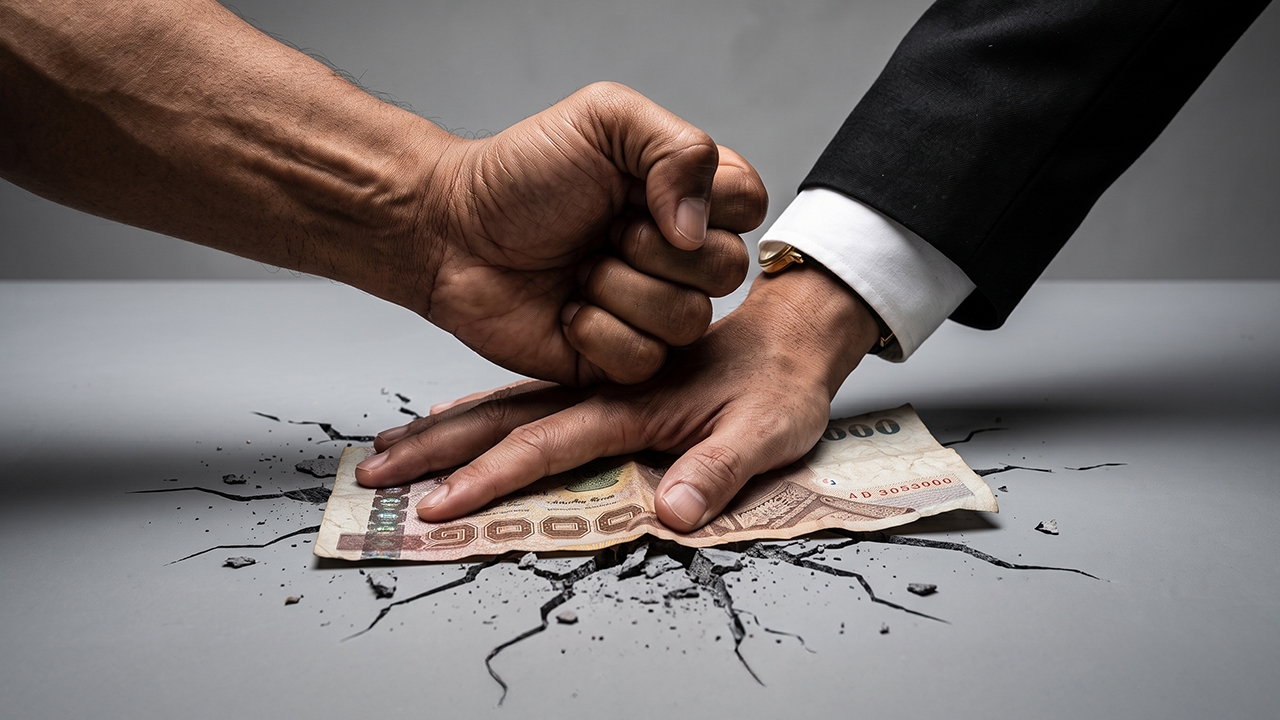
Dr. Suvit Maesincee, former Minister of Higher Education, Science, Research and Innovation, is among those who cannot tolerate the widespread corruption and misconduct, especially as the government has not shown serious resolve to address the problem.
He recently wrote an article reflecting on these issues on his personal Facebook page, titled "Thailand is severely infected by a systemic corruption virus." He stated that if this is not uprooted immediately, we may lose "a state that belongs to the people." forever.
Dr. Suvit sees Thailand in 2025 not as a country held back by lack of talent, but as one being eaten away from within by a corruption virus spreading through politicians, bureaucracy, local governments, police, land officials, and national policies.
This is not a distant issue; it is what causes Thailand to suffer chronic illness—slow economic growth, social conflict, lack of law enforcement, declining ethics, good people retreating, and corrupt individuals thriving—all rooted in a decaying state structure.
1. Overlapping states: a network behind the scenes controlling real state power, managing appointments, transfers, procurement, and permits unseen by the public but widely known to exist. Examples include buying police positions, street and truck extortion, gambling dens, drugs, and migrant labor controlled by actual local owners. Dr. Suvit calls this a shadow state more powerful than the official state.
2. Gray politics, capital, and bureaucracy: not overt bribery but gradual system distortion, such as secret and hidden budgets, legal loopholes benefiting cronies, financial returns to supporting capitalists, and a bureaucracy serving connections rather than citizens. Rules are designed for certain groups, excluding the public.
3. State capture: the worst stage of decay where laws, policies, budgets, and appointments are controlled by a small group, making the state no longer belong to the people but to interest networks. Dr. Suvit identifies this as the gravest disease and why Thailand seems stuck in a loop.
The first is the moral foundation: good people find it harder to work, corrupt individuals grow stronger, and younger generations become disheartened.
The second is state capacity: government work slows and weakens, evidenced by repeated floods, unresolved road accidents, untrustworthy police, stagnant reforms, and even the 20-year national strategy being locked down by hidden powers.
The third is national administration: laws become tools—used to target or silence as desired—leading to public loss of faith in the state. Dr. Suvit calls this a silent internal threat destroying the country from within, not from outside.
Why does old-style politics accelerate the growth of this virus?
Because Thai politics remains a power struggle rather than structural reform. Parties compete over popularity, insults, and handouts but avoid confronting root problems to protect vested interests. As a result, the corruption virus grows stronger.
Dr. Suvit proposes Thailand must change its state model, not just replace politicians, moving toward future-oriented politics—Statecraft Politics—instead of mere power contests.
He outlines six practical measures to uproot corruption simultaneously.
Dr. Suvit says people must shift from asking "Which party offers the most?" to "Which party can truly cleanse the corruption system?" Specifically asking which party dares to challenge gray capital, reform the police, disclose information transparently, and transform power struggles into nation-building politics.
In conclusion, he emphasizes that Thailand must treat the root cause, not just symptoms, because the corruption virus is not merely an economic problem but a disease eating the heart of the Thai state. Without immediate action, the state may be fully captured by gray systems, leaving no people's state for future generations.
Dr. Suvit ends by saying this is a fight for the country, not a partisan political battle. The election must protect the future, not just fix current issues, and it is time for citizens to ask the right questions.
The upcoming election is no longer about party colors but a major war between "gray parties" and "non-gray parties." This war is a matter of national life or death. Whether Thailand survives depends not on politicians but on whether the people choose "a state that belongs to the people." ."