

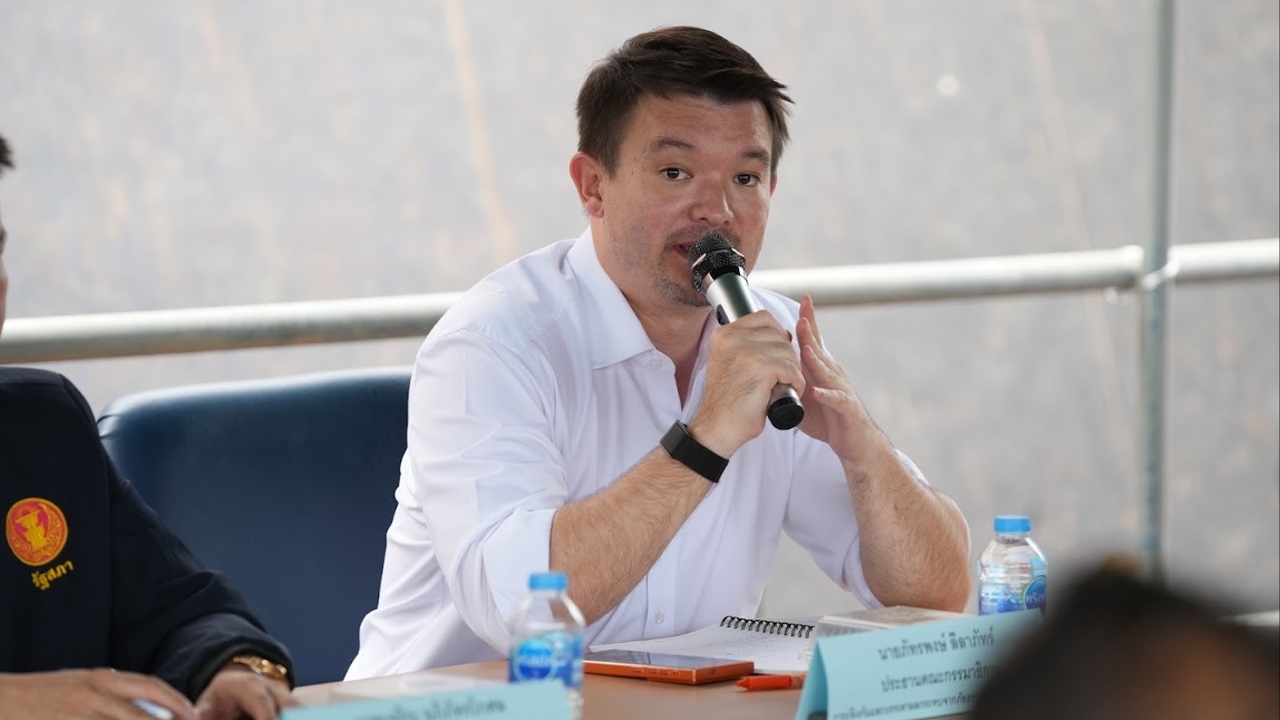
The Disaster Prevention Committee is preparing to ask the National Anti-Corruption Commission (NACC) to investigate state officials who have allowed Saraburi's wastewater problem to persist for 20 years. Documents reveal hazardous waste pits violating the Environmental Impact Assessment (EIA) and exceeding capacity limits. The committee demands the Ministry of Industry order an immediate business shutdown.
On 13 August 2026 at the Parliament, the Committee on Prevention and Mitigation of Natural and Public Disasters, led by Chairman Phattharaphong Leelaphat, convened to review progress on investigating Saraburi Province's water pollution problem ongoing for over 20 years. Phattharaphong said that after field visits and examining additional documents from government agencies, irregularities and critical concerns were found, leading to the conclusion that the case must be referred to the National Anti-Corruption Commission (NACC) to investigate possible wrongdoing by involved state officials.
Phattharaphong explained that government documents highlight two key issues for serious scrutiny. First, the operating area: a 1 July 2026 order from the Department of Industrial Works (DIW) directed Better World Green Company to partially suspend operations, specifying discovery of triangular-shaped pits and large waste leachate ponds located “outside the project area” and absent from the Environmental Impact Assessment (EIA) plans. Moreover, water levels were only 30 centimeters below the embankment, posing a risk of overflow into public waterways. This aligns with the Office of Natural Resources and Environmental Policy and Planning (ONEP) confirming the current site usage does not comply with the EIA report.
The second issue concerns landfill capacity and lifespan. The EIA report set landfill capacity at about 1.13 million cubic meters with a usage period of approximately 9 years and 2 months (starting waste receipt in 2003). However, DIW data show that between 2010 and 2026, over 3.6 million tons of waste were accepted for landfill, including more than 1.38 million tons of hazardous waste—far exceeding the EIA limits. Additionally, no data exist for waste received from 2003 to 2009. This raises major questions about how regulatory agencies could have neglected this issue for over 20 years.
Phattharaphong continued that based on this concrete evidence, the committee concluded the Ministry of Industry must urgently enforce the Factory Act B.E. 2535 (1992), Sections 37 and 39, decisively ordering cessation of violations or a full business suspension. This is necessary due to the severe dangers and impacts caused, consistent with a letter from the Pollution Control Department Director-General indicating heavy metal contamination in natural canals reflects prolonged industrial waste accumulation.
Meanwhile, the committee will exercise constitutional authority to gather evidence and immediately refer the matter to the NACC for investigation. This is not a transboundary pollution issue beyond control—the source is within Thailand, with clear applicable laws. The fact that residents have endured this situation for 20 years means the NACC must determine whether state officials neglected duties or engaged in corruption benefiting business interests.
Phattharaphong concluded that regarding the precise source of pollutants in the canals, the committee has proposed urgent environmental forensic investigations involving the Department of Industrial Works, Pollution Control Department, and Department of Groundwater Resources. The aim is to identify polluters and hold them legally accountable. On 17 August, he along with Phunsak Janjamphai, a party-list MP from the Prachachon Party and waste management expert, will represent the committee in a field inspection with government agencies to closely monitor the issue and restore justice for local residents.