

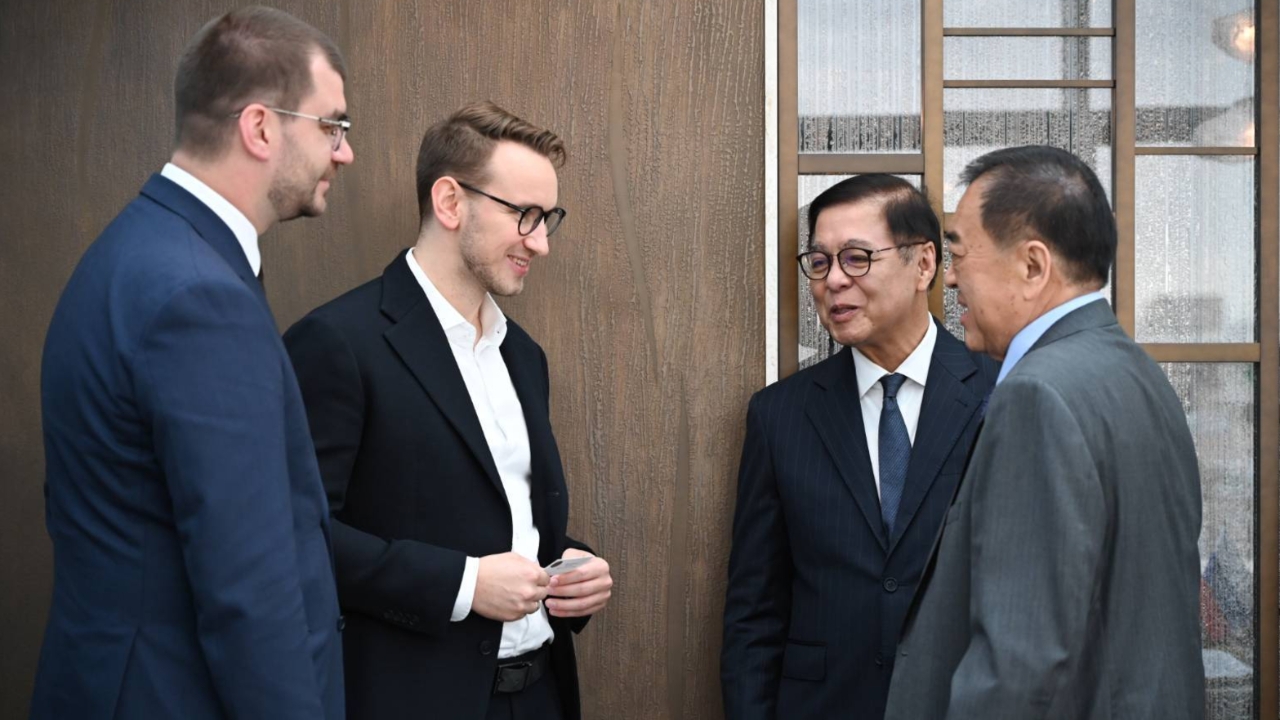
Sihasak held discussions with the Russian Deputy Prime Minister to enhance the economic potential of both countries, actively promoting the Thai-Eurasian Free Trade Agreement (FTA), while addressing issues related to payment systems and trade barriers, thereby opening opportunities for Thai private enterprises to penetrate a market of 180 million people. He expressed confidence that state-to-state coordination would help resolve these problems.
On 14 August 2026 GMT+7, Mr. Sihasak Puangketkaew, Deputy Prime Minister and Minister of Foreign Affairs, met with Mr. Alexander Novak, Deputy Prime Minister of the Russian Federation, at the Government House in Moscow, Russia. Both sides discussed ways to enhance cooperation between Thailand and Russia in trade, investment, agriculture, and energy sectors, as well as to facilitate trade to strengthen the economic capabilities of both countries. Particular emphasis was placed on advancing negotiations for the Thai-Eurasian Economic Union Free Trade Agreement (Thai-EAEU FTA). Russia is Thailand's 36th largest trading partner and the top partner within the Eurasian Economic Union. The two also exchanged views on promoting multilateral economic cooperation frameworks such as BRICS, in which Thailand is a partner country.
Mr. Sihasak commented on his talks with the Russian Deputy Prime Minister responsible for economic affairs, stating that Russia seeks Thailand’s support by recognizing Russia as a key energy source, including oil, gas, and nuclear power, where Russia has abundant resources and advanced technology. However, there are current issues regarding payment and financial transactions. Russia believes these can be conducted without violating sanctions and has methods to do so, which require discussion, especially at the private sector level, to ensure comfort with payment procedures.
Mr. Sihasak said he aims to export Thai agricultural products to Russia. Accompanying him was Mr. Phot Aramwattanon, Chairman of the Thai Chamber of Commerce, who views Russia as a promising market, noting the popularity of Thai restaurants there that require Thai ingredients and food products. The main obstacles are not tariffs but health standards requiring factory inspections, which Russia has already conducted in Thailand. Meanwhile, Russia is interested in exporting beef and pork to Thailand, but Thai authorities have yet to inspect Russian production facilities or complete necessary procedures. Thailand’s Minister of Agriculture and Cooperatives prioritizes this and sent high-level representatives to the 9th Joint Commission on Bilateral Cooperation (JC) meeting.
There are also challenges related to Russian-language documentation, which impede trade. Both sides discussed these issues to facilitate smoother trade and investment and prepare to expand opportunities, which will require ongoing follow-up.
Mr. Sihasak also spoke about his meeting with Mr. Bakytzhan Sagintayev, Chairman of the Eurasian Economic Commission, noting that the Eurasian market comprises 180 million people with a GDP of $1.9 trillion, representing significant potential. Thailand’s Ministry of Foreign Affairs focuses on diplomacy that meets national priorities, especially economic diplomacy. Currently, there are challenges in trade negotiations with the United States, a major market, so Thailand seeks alternatives. He views his foreign ministry missions as opportunities not only to discuss political and security issues but also to promote economic matters.
Mr. Sihasak stated that in talks with Eurasia, a key issue raised was the desire to negotiate a free trade agreement with these countries. Thailand submitted a proposal 10 years ago but saw no progress. Two months ago, he visited Kazakhstan, the chair of Eurasia, which showed strong interest in Thailand, leading to supportive discussions. This visit to Russia revisited the matter, as technical processes and feasibility studies are ongoing to assess benefits. He requested acceleration from the Eurasian secretariat, noting that studies will take over a year, followed by negotiation periods requiring additional time.

He added that there is a joint working group between Thailand and Eurasia discussing various topics including trade and economic cooperation. However, the group has not met for some time. Parallel efforts will push forward the free trade agreement negotiations. Additionally, there is a bilateral investment working group that Eurasia finds attractive because Thailand’s economy is transitioning toward digital and green economies, areas where Eurasian countries could support and invest.
“They view Thailand as a gateway to the ASEAN market. Nowadays, much attention is on ASEAN, especially amid ongoing conflicts in the Middle East whose resolution remains uncertain. Many consider ASEAN geopolitically secure, so this is an opportune time to promote these issues,” Mr. Sihasak said.
Mr. Sihasak said he had lunch with the Russia-Thailand Business Council, which is highly enthusiastic about seeking trade and investment opportunities with Thailand. The council brought businessmen from various sectors such as food, pharmaceuticals, and energy. Meanwhile, Thai private companies are interested in investing in Russia but face difficulties related to payment systems, financial transactions, and regulatory rules that require further discussion.
“I believe that previously there may have been a gap in high-level or political contacts between Thailand and Russia. I am confident that with government-to-government engagement, obstacles will be resolved, opening opportunities for the private sector to conduct business. Ultimately, the government seeks to negotiate rules that benefit economic relations. However, the real driving force is the private sector, which is now actively participating. While I met with government officials, the private sector also met with their Russian counterparts, marking a good start. Going forward, the private sector will continue to expand these efforts, likely leading to joint ventures, trade, and investment,” Mr. Sihasak concluded.
