

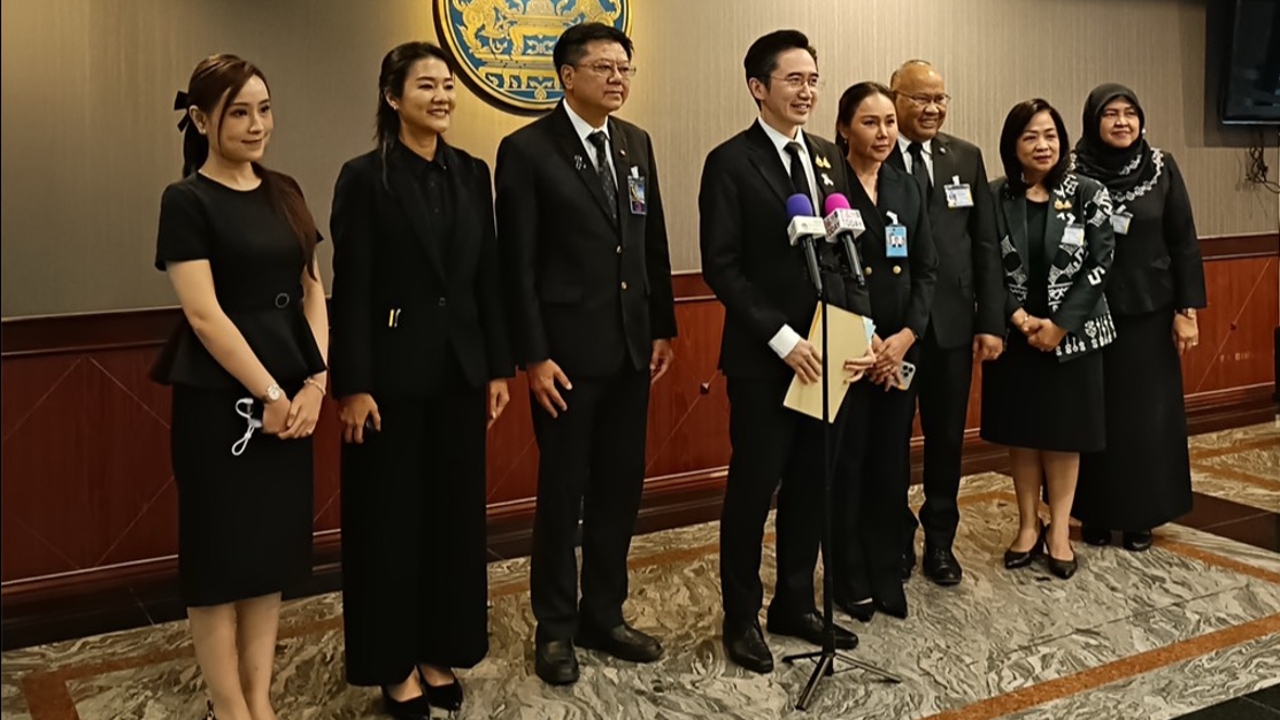
The National Family Committee has approved three measures to promote family leave days, involve communities in caring for all age groups, and prepare the 2026 Family Assembly to address rapid social changes.
On 14 Aug 2026 GMT+7, Lieutenant Colonel Phatdarasmi Thongsaluaykorn, Deputy Spokesperson of the Prime Minister's Office, revealed the outcomes of the National Family Policy and Strategy Committee meeting chaired by Deputy Prime Minister and Minister of Higher Education, Science, Research and Innovation Yotchanan Wongsawat. The meeting approved three key approaches to strengthen Thai family institutions in line with social changes: balancing work and family life, upgrading community-level family care mechanisms, and creating a safe environment for all age groups to prevent problems, build resilience, and empower families to manage new risks appropriately. These include:
Promoting family leave days.
1. “Family Leave Days”—increasing rights and flexibility to enable workers to care for their families.
The meeting agreed on maintaining the current system with clearer guidelines, assigning the Ministry of Social Development and Human Security to coordinate with relevant agencies to revise laws and regulations related to family leave, including civil servant leave rules, wage payment regulations for government employees, and benefits for government officials. It also tasked the Ministry of Labor with reviewing labor protection laws to broaden family leave coverage.
Importantly, there is a plan to improve social security systems to provide financial support for employees taking family leave, encourage agencies to offer counseling services for staff caring for family members, and incorporate technology to support flexible work arrangements such as working from home or offsite, allowing working-age individuals to fulfill job responsibilities while caring for their families.
Turning communities into the frontline.
2. “Community-led Family Development Centers (FDCs)”—transforming communities into frontline caregivers for families across all age groups.
The committee approved upgrading Community Family Development Centers (FDCs) as key mechanisms to build strong families. The Ministry of Social Development and Human Security, through the Department of Women's Affairs and Family Development, together with the Thai Health Promotion Foundation (ThaiHealth), will apply the Social Lab concept as a testing ground to develop working models suited to each community's context.
The goal is to develop "Community-led FDCs: FDCs that create wellbeing and care for all ages," supporting intergenerational families and an aging society, with communities playing a close role in supporting and empowering families.
Highlighting four key agendas from mental health to online threats.
3. “2026 National Family Assembly” emphasizing four key agendas from mental wellbeing to online dangers.
The meeting approved the framework for the 2026 National Family Assembly under the theme “Building Happiness Together in Families,” focusing on four main issues:
• Creating happiness and relationships in families, emphasizing communication, mental health, and spending quality time together.
• Developing family-friendly environments covering homes, communities, schools, workplaces, and public spaces.
• Empowering family economies through job creation, income increase, expense reduction, and economic security.
• Cyber Safe Family—building knowledge and resilience so family members can recognize and stay safe from online threats.
Acknowledgment of the Family Action Plan.
Additionally, the meeting acknowledged the 2023–2027 Family Action Plan progress for 2025, updates on legal reforms regarding domestic violence, the status of Thai and intergenerational families, progress on the “Safe and Violence-Free Thai Families” measures, and reviewed efforts to promote work-life balance and cooperation in advancing FDCs and organizing the 2026 National Family Assembly.
Creating family support systems.
The Deputy Spokesperson of the Prime Minister's Office stated that these three measures reflect a policy shift from reactive problem-solving toward building a “family support system” spanning workplaces, communities, and the national level, especially enabling working-age people to care for their families without having to choose between work duties and caregiving responsibilities.
The National Family Policy Committee aims to implement these key measures concretely within the next quarter by integrating cooperation among government agencies, the private sector, local authorities, communities, schools, and families to establish continuous protection and care systems for all age groups.