

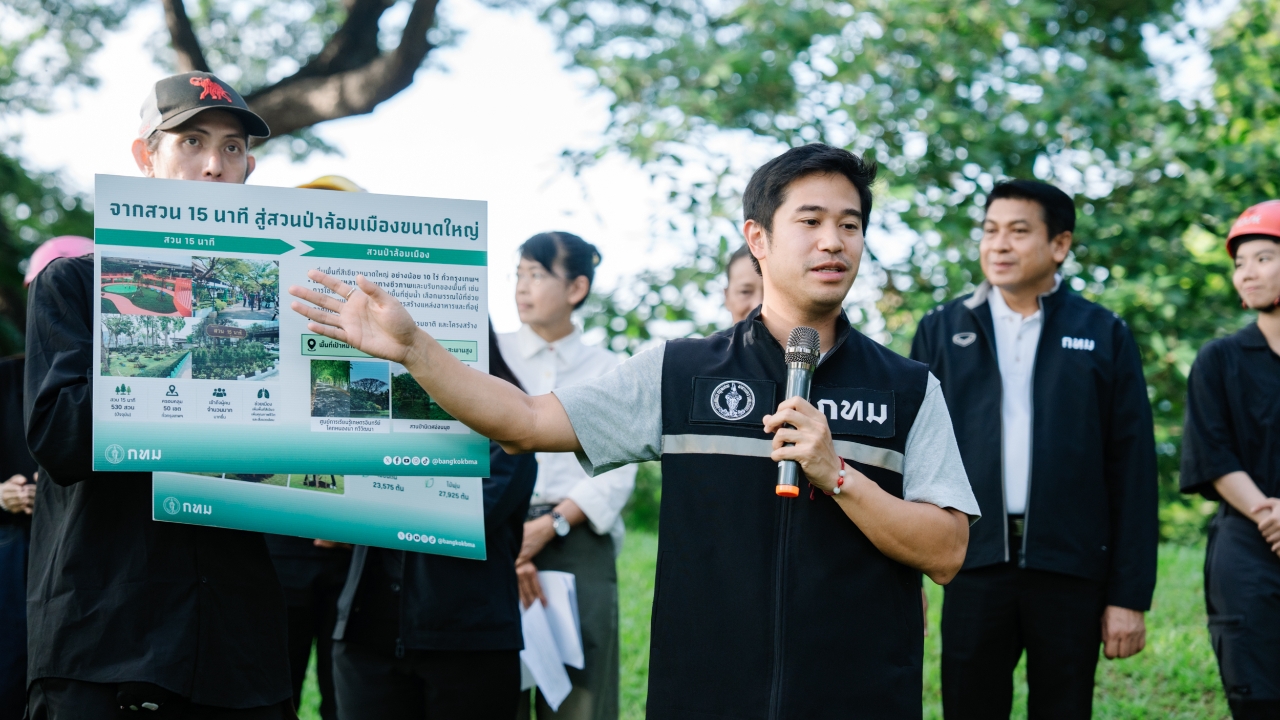
Deputy Governor of Bangkok, Poraprom, invites the public to plant new trees, preserve old ones, and search for heritage trees to establish a “forest garden surrounding the city,” connecting green networks throughout Bangkok.
On 15 Aug 2026 GMT+7,At 07:30, Mr. Poraprom Na.S. Wikitset, Deputy Governor of Bangkok, chaired the activity “Increasing Green Spaces and Searching for Bangkok’s Heritage Trees” at Chamchuri Plaza, Benjakitti Park, Khlong Toei district, to communicate the direction of green space development in Bangkok under the concept “Planting new trees alongside conserving heritage trees to increase urban forest areas.”
Deputy Governor Poraprom said Bangkok is advancing the enhancement of green spaces by not only adding new trees but also increasing the value and preservation of existing resources through the “Bangkok Heritage Trees” project. This involves surveying large trees valuable to the city in terms of shade, environmental benefits, and ecosystem support. The initiative includes systematically creating a database and mapping of trees across public parks, public spaces, roadsides, and suitable areas for long-term conservation and management.
The key is to raise protection standards for registered trees. Any pruning or actions on heritage trees must undergo inspection and obtain permission according to established criteria before proceeding. Arboricultural experts will assess suitability to ensure care follows scientific principles, preserving canopy shape, shade, and tree value, as “trees are assets of the city.”
Currently, Bangkok is developing selection and registration criteria by consulting experts and relevant sectors to establish clear academic standards, apply uniform criteria across all district offices, and reduce discretionary evaluations. Within the first 100 days, Bangkok aims to finalize the criteria and begin surveying trees in every district, then integrate the data into a central database to develop a system for monitoring, care, and systematic conservation planning of heritage trees.
At the same time, the public is invited to submit information on large trees on private properties for Bangkok’s consideration. Guidelines for basic tree health assessment and contact channels to arboricultural experts from both public and private sectors will also be provided. Civil society and the BIG Trees Bangkok group support this knowledge-sharing, ensuring tree conservation is a shared responsibility among all sectors.
Bangkok has set four key criteria for evaluating heritage trees:
1. Physical and Biological Characteristics — Trees with notable size, age, and distinctive features.
Considerations include trunk size, height, canopy shape, and tree age. Trees that are large, have wide crowns providing important shade, or are estimated to be at least 50 years old are essential factors. Trunk size is measured by circumference at a height of at least 1.30 meters above ground, with a circumference between 1.50 and 2.50 meters or more.
2. Historical and Cultural Significance — Trees that are part of the city's narrative.
This considers a tree’s connection to city history, such as those planted during significant periods or events, or located at historical sites. It includes trees reflecting the identity of districts and communities. Some trees serve as important local landmarks or are integral to community life and stories, thus holding value as “memories of the area” worthy of preservation.
3. Rarity and Botanical Importance — Trees with unique traits and educational value.
This includes trees with distinctive botanical characteristics, such as native species original to Bangkok, or those exhibiting unusual but beautiful growth forms with valuable structure. Also considered are trees serving as important study examples or providing learning value about species and urban ecosystems.
4. Urban Ecological and Historical Value — Trees that add value to the city and its people.
Evaluation includes whether a tree contributes to the urban ecosystem by providing shade, serving as habitat or food source for living organisms, and the value arising from its relationship with the area, people, and city history.
