

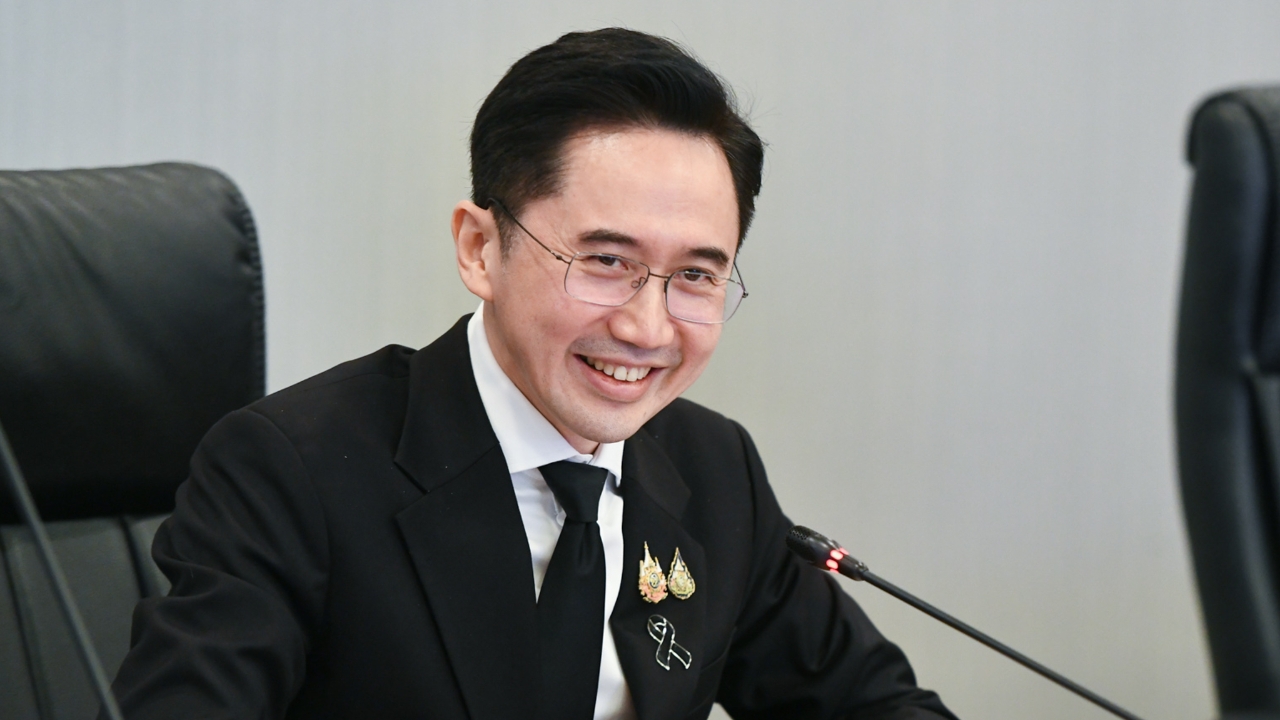
Yotsanan declared he is ready to respond to the opposition without needing special preparation if impeached. He pointed out the issue of US pressure to choose sides on AI, emphasizing that Thailand must build solid data and knowledge foundations, hoping this will be an advantage to select appropriate technological partnerships.
At 09:25 on 17 Aug 2026 GMT+7, Deputy Prime Minister and Minister of Higher Education, Science, Research and Innovation (MHESI) Yotsanan Wongsawat gave an interview at the Government House regarding the opposition's intention to file a no-confidence debate related to the MHESI Ministry and whether he was prepared to explain the matter. He said, "To clarify, we have already set up a committee to oversee this issue and have followed all recommendations and procedures. This is not about confidence or lack thereof because we have always complied with proper processes. There is nothing to worry about regarding this matter."
When asked if this no-confidence debate would be his first, Yotsanan asked back if he was indeed the subject. When further asked if he would need to prepare or be tutored by the Pheu Thai Party, he replied, "As Deputy Prime Minister responsible for this matter, I am fully accountable. I carry out what the country has assigned me to do. This is not a personal issue. Therefore, I am fully prepared, have the data ready, and could respond even today. There is no need for extra preparation or separating politics from ministry affairs."
Yotsanan also commented on the US government's plan to instruct allied countries to pick sides in the AI technology competition with China. He said AI involves various groups, such as semiconductor sectors, with considerable discussions underway. Having attended the AI summit in China at the World Internet Conference (WIC), participation may be necessary but requires consideration from several angles. For Thailand to gain the best advantage, it must maintain neutrality. Thus, discussions with Deputy Prime Minister and Minister of Foreign Affairs Sihasak Phuangketkaew will be held to determine the appropriate stance.
When asked if choosing sides is necessary, Yotsanan said that, ultimately, as he has said before, Thailand is working hard to strengthen essential foundations. They have engaged with countries like France, Japan, and South Korea to bolster Thailand's fundamentals; otherwise, the country will constantly be at a disadvantage in negotiations. Efforts in the past two to three months have focused on establishing our own foundations. Despite some rejections, progress is sufficient and there is no need for worry as the matter is closely monitored. They are also preparing teams domestically and abroad to collaborate on these issues. The priority is establishing these foundations, then deciding what can be conceded or not—it's not about yielding to others but about what truly belongs to Thailand and where it is strong. This will lead to forming plans, some of which have been previously developed and now need urgent strengthening.
, Regarding how Thailand can maintain neutrality and survive amid pressure from major powers, Yotsanan revealed that fundamental knowledge, science, and technology are crucial. Serious investment in these areas is necessary. He stated that infrastructure should not focus solely on AI, which is the top layer, but also on all underlying data. The government cannot act alone; private sectors must participate. The government will take the lead where risks exist, and once business results appear, the private sector will connect accordingly. Therefore, the necessity of data collection and cybersecurity are interconnected and have been ongoing for three months. When discussing AI participation, the real foundation lies in hardware, security, and data. If Thailand has a data base, it will know which AI collaborations are essential and with whom cooperation is possible.
Yotsanan added that with a solid foundation, it becomes easier to decide which partnerships to pursue. Without it, fear arises. He emphasized the need for real investment and joint efforts using connections between government and private sectors through the Joint Public-Private Committee (JPC) to address economic challenges. AI is a subset of technology, and he wants everyone to see this as an opportunity requiring serious attention in Thailand.
When asked how to assure investors, Yotsanan responded by urging confidence, noting that the JPC operates on four pillars: 1. Investment, overseen by Deputy Prime Minister and Finance Minister Aeknithi Nitithanprapas; 2. Trade, overseen by Deputy Prime Minister and Commerce Minister Supachai Sutthamman; 3. People and Technology, under his supervision, linking investment and trade; and 4. Business development and facilitation, overseen by Deputy Prime Minister for Legal Affairs Pakorn Nilprapunt. He affirmed that preparations are clear to build investor confidence, attract investment, and enable technology transfer in Thailand without disadvantaging any country, using regulations and the JPC as driving forces.