

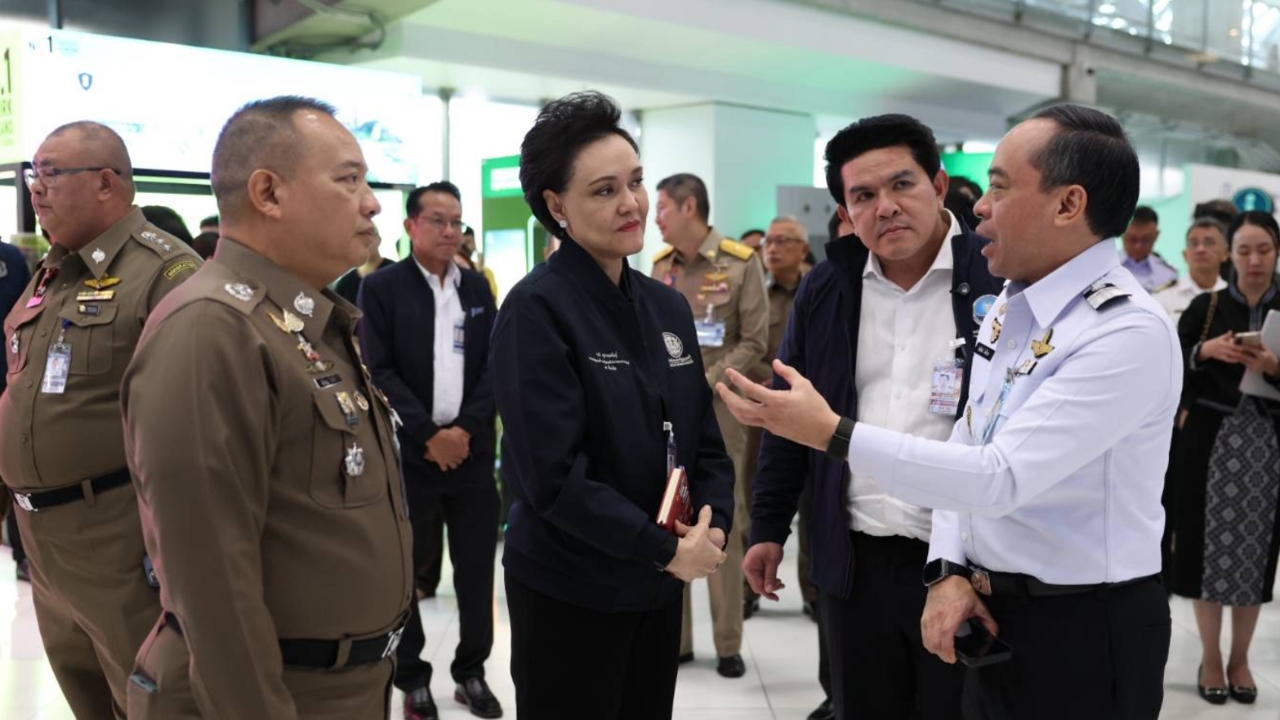
Supachai led a team of three ministers at Suvarnabhumi Airport to urgently resolve immigration bottlenecks by expanding the Auto Gate to serve 33 nationalities, elevating the tourist experience from arrival to destination, stressing that any immediately doable matters must be expedited.
17 Aug 2026 GMT+7 Ms. Supachai Suthammanphun Deputy Prime Minister and Minister of Commerce chaired a meeting to integrate cooperation in enhancing tourist experience and facilitation at Suvarnabhumi Airport, visiting the site together with Mr. Surasak Phanjaroenworakul Minister of Tourism and Sports Mr. Siripong Angkasungkiet and Mr. Patthapong Pattharaprasit Deputy Minister of Transport, along with immigration officials, tourism police, executives from Airports of Thailand Public Company Limited (AOT), and related agencies attending discussions at CIP 1 room, passenger terminal building.
Ms. Supachai said the government wants to see the real issues at the country's frontline because Suvarnabhumi Airport is not just an airport but the first point where travelers experience Thailand. If immigration takes too long or is inconvenient, it will affect impressions, confidence, and overall tourism revenue. Tourism is a significant source of national income, and the government aims to stabilize this revenue by ensuring convenience, safety, immigration processing, baggage claim, airport exit, and waiting experiences are all well managed.
"Today, we are not just looking at how long immigration queues are, but at what can be fixed immediately, what requires budget, what needs legal amendments, and what demands long-term planning. All agencies must work together, not fix problems in isolation."


Regarding short-term measures, the focus is on reducing waiting times, managing staff schedules to match peak flight times, increasing waiting areas, and expanding the number of nationalities eligible for Auto Gate lanes to speed low-risk passengers through immigration queues. They also plan to urgently address the Thailand Digital Arrival Card (TDAC) issue after discovering some tourists were tricked by fake websites charging fees, although the official system is free. Coordination with airlines is needed to inform passengers before check-in and ensure correct scanning of official QR codes. Another key challenge is to prevent waiting time from becoming a negative experience by applying hospitality concepts, such as queue systems that reduce passenger stress or activities showcasing Thai culture during waits to turn bottlenecks into positive impressions.


For the medium term, Mr. Siripong was tasked with coordinating with AOT to study the feasibility of using the Satellite Terminal as an additional immigration checkpoint, including ways to connect passengers who have cleared immigration directly to baggage claim areas to ease pressure in the main terminal's central hall.
As for the long term, the East Terminal development plan must be expedited to increase Suvarnabhumi's capacity to handle growing traveler numbers, and prepare systems ahead of the tourist fee collection policy next year. As Thailand aims to elevate revenue from visitors, service upgrades must go hand in hand.
Meanwhile, Mr. Surasak said the Ministry of Tourism views a tourist's first impression as starting upon entering the airport. When queues build during peak times, managing physical aspects must be paired with caring for passenger feelings by planning with the Tourism Authority of Thailand to introduce traditional Thai performances like Khon, Joe Louis puppet shows, or folk music to create a Thai atmosphere in suitable areas.
Mr. Siripong added the Ministry of Transport will expedite enhancing facilities for arrivals and departures. AOT plans to adjust spaces for early check-in passengers and convert some areas into commercial or activity zones to reduce crowding in the terminal, while pushing forward the East Terminal and studying the opening of immigration at the Satellite Terminal as medium-term plans.

Police Major General Kothathorn Khamthien, Commander of Immigration Division 2, said Immigration plans to expand inbound Auto Gate services for foreigners from the current group to 33 nationalities, beyond the current support for Thai, Singaporean, and Hong Kong nationals. Selection is based on the Henley Passport Index, low denial rates, and low security risk. The expansion is expected to start by this high season.
Currently, in low season, Suvarnabhumi handles an average of 70,000–75,000 inbound passengers daily, with 5,000–6,000 arrivals per hour at immigration during peak hours from 14:00 to 17:00. In high season, this may rise to 85,000–100,000 daily. Staff will be fully assigned to all immigration counters during peak times. Auto Gate processing averages 24–30 seconds per person if no security issues arise. Once fully operational, about 50% of inbound passengers could use automated lanes, while those requiring detailed checks will continue with officers per security standards.
The meeting also discussed optimizing airport surroundings, passenger waiting areas for transfers, inbound retail and food services, regulating public transport, monitoring baggage carousels, joint patrols by tourism police, cracking down on illegal guides, and using CCTV with an intelligent command center to enhance tourist safety.
Ms. Supachai added that following this site visit, responsibilities, timelines, and clear outcomes will be assigned. Any immediate actions must proceed swiftly, while matters requiring infrastructure or budgets will be planned at the government level to ensure Suvarnabhumi becomes a gateway that impresses and truly supports the Visitor Economy.
