

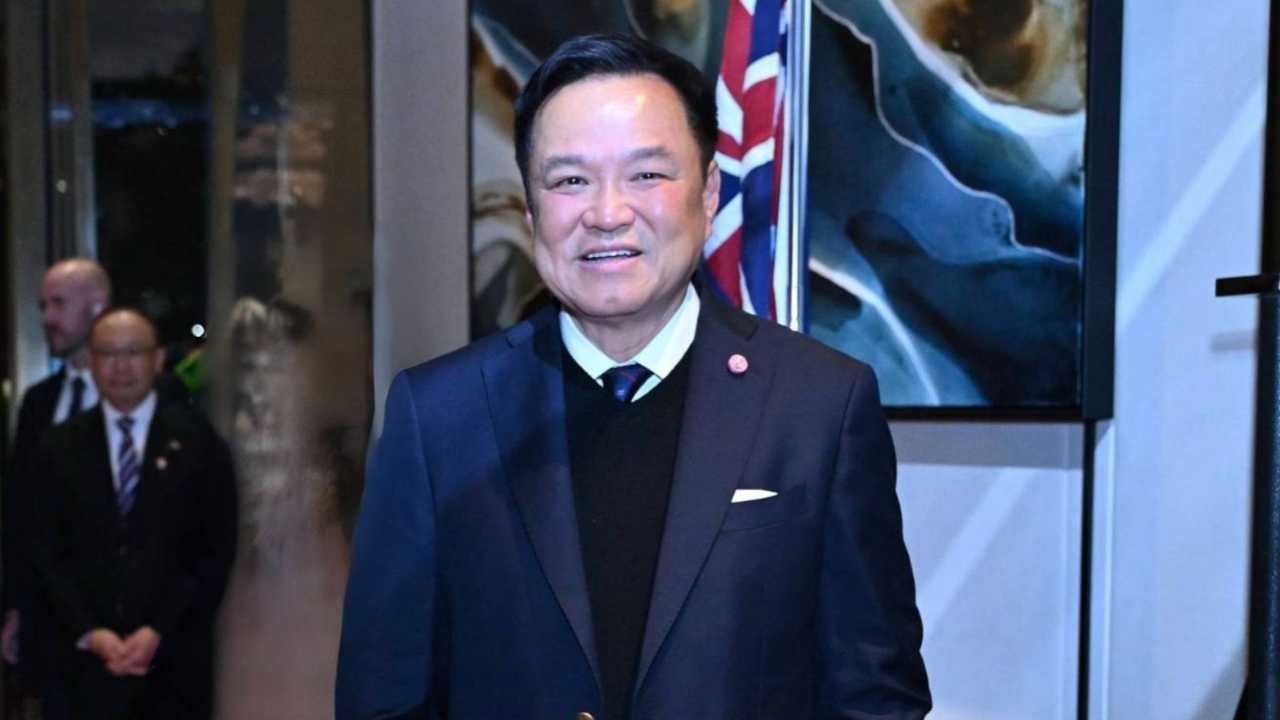
The Prime Minister and Deputy Prime Minister Aekniti, speaking together from Australia, declared that the NESDC's revised GDP growth target of 2.2% for this year remains unsatisfactory. They emphasized that Thailand’s economy must soar to higher growth levels and viewed the government’s injection of 400 billion baht as being on the right path.
On 17 August 2026 at 23:00 local Australian time (3 hours ahead of Thailand) Mr. Anutin Charnvirakul, Prime Minister and Minister of Interior, , and Mr. Aekniti Nitithanprapas, Deputy Prime Minister and Minister of Finance, answered questions from the press regarding the National Economic and Social Development Council's (NESDC) upward revision of this year’s GDP growth forecast from 2% to 2.2%. The Prime Minister stated that the current economic figures cannot be considered satisfactory; they want the economy to grow more. “Regarding the economy now, it’s okay, but there is no such thing as being satisfied with the growth rate. Currently, the figure is at this level. We must ask why the economy isn’t growing by 3%, 4%, 5%, or 6%—why it’s not increasing more and more. There is no satisfaction.”
When asked whether the Prime Minister was satisfied with the Deputy Prime Minister for economic affairs, Anutin responded, “More than satisfied.” When Mr. Aekniti was asked if he was satisfied with this year’s economic growth forecast of about 2%, he said he was not satisfied because there are still issues to push forward, especially investment, which must be accelerated. This is a transitional period for the Thai economy, so increasing investment is essential. The key point regarding investment is that it cannot stop here; it must help transform Thailand and create employment for Thai people within the supply chain.
Mr. Aekniti further explained, Regarding Thailand’s economic situation, GDP growth in the second quarter expanded by 1.9%, which exceeded market expectations of around 1.7%. This confirms that the government’s decision to issue the 2026 Royal Decree authorizing the Ministry of Finance to borrow 400 billion baht to address the energy crisis and drive the country’s energy transition was the right move. The purpose of this borrowing is to support the economy, with the first portion used for the “Thai Help Thai Plus 60:40” program launched in June. This program has been crucial in preventing a deeper economic downturn by helping reduce living costs and boosting public spending.

The Deputy Prime Minister and Minister of Finance added that the GDP figures from the last quarter reflect and underscore that Thailand has clearly faced three waves of crises:
1. The energy crisis, caused by the war driving up oil and natural gas prices, leading to a current account deficit of 17 billion baht (approximately 600 billion baht) in the second quarter. This reveals Thailand’s economic vulnerability due to heavy reliance on imported oil and gas for electricity generation and transportation, underscoring the urgent need for energy structural transition.
2. The cost-of-living crisis, seen in the consumer price index (CPI) rising from negative to positive 2.7% in the second quarter, after being negative in the first quarter. The producer price index (PPI), reflecting costs, surged nearly 9%, increasing expenses for businesses.
3. The purchasing power crisis, evidenced by a slowdown in private consumption growth, which dropped from 3.3% in the first quarter to only 1.9% in the second quarter. The “Thai Help Thai Plus” measures have provided some relief.
“Had we not acted quickly to address these three crisis waves, the impact would have been worse. Today, we still must accelerate the energy transition because the war is ongoing. The large current account deficit reveals how fragile the Thai economy is due to dependence on oil and gas. Without urgent action, Thailand’s dependence and deficit will worsen.”
However, in the second quarter of this year, Thailand’s economy showed positive signs with investment growing by a double-digit 13%, the highest in 13 years, especially in digital and AI industries. For example, a leading global optical transceiver technology company from China expanded investment in Saraburi province, creating 30,000 jobs and collaborating with Suranaree University of Technology on research. This is a concrete example of real investment beyond just data centers.
In conclusion, Mr. Aekniti outlined the future direction for driving Thailand’s economy, focusing on three main points: 1. Sustaining the economy through relief measures to maintain purchasing power and livelihoods; 2. Accelerating the structural transition, especially reducing external dependencies in energy; and 3. Speeding up investment to build the country’s future by reforming economic structures and promoting investment policies through the Board of Investment (BOI), ensuring that foreign investments benefit small and medium enterprises and Thai workers, thereby genuinely reforming the economy to benefit SMEs.