

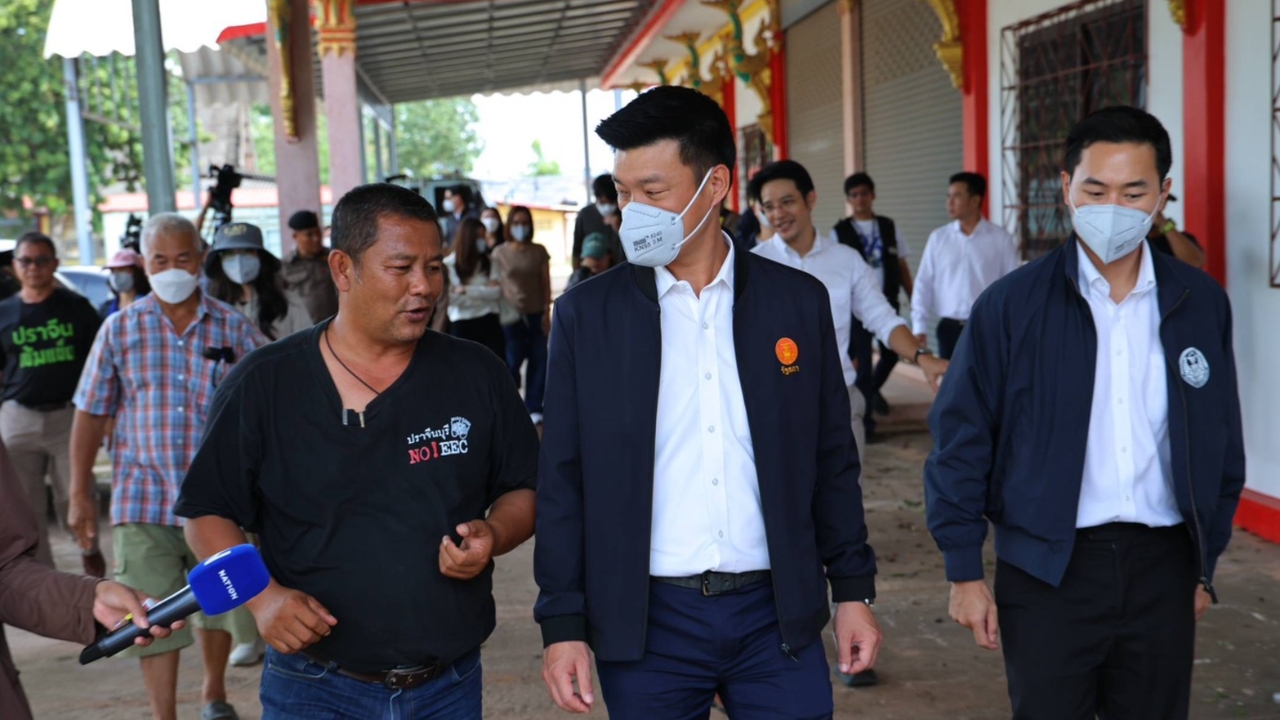
"Teng Natthapong" visited Prachinburi Province to listen to issues related to factories and industrial waste. Villagers reported problems persisting for many years with delayed legal proceedings, offenders showing no fear of the law, and no progress in rehabilitating contaminated areas.,
On 18 Aug 2026 GMT+7, Mr. Natthapong Ruangpanyawut, leader of the People's Party and leader of the opposition in the House of Representatives, along with MPs from the same party, followed up on issues concerning factory operations, illegal industrial waste disposal, and environmental impacts in Prachinburi Province. They also listened to public concerns about regional development direction and the integration of Prachinburi into the Eastern Economic Corridor (EEC).
In the morning, Natthapong and his team held a meeting with relevant agencies and community representatives to follow up and investigate cases of unauthorized factory operations and legal violations, complaints against establishments, licensing processes, regulatory oversight, as well as challenges and limitations in law enforcement.
Mr. Sunthorn Komkha, coordinator of the Prachin Strong Group, provided information that illegal industrial waste dumping in Prachinburi has persisted for many years. Some offenders have been caught, while others remain unidentified. He noted that many cases have proceeded slowly, causing offenders to disregard the law and delaying timely rehabilitation of contaminated areas.
There are also issues with factories operating under licenses but acting beyond permitted activities, and factories operating without any license. This raises questions about regulatory effectiveness, especially since some are large, long-established operations, while community members are often the ones discovering irregularities and reporting them to government agencies.

Mr. Sunthorn further expressed community concerns about three industrial waste-to-energy power plants in Kabin Buri district, located close to each other. Concerns include the consultation process, pollution impact oversight, water use, compliance with conditions, and worries that these plants might increase industrial waste collection and management activities in the area. Accumulated environmental problems contribute significantly to the community’s distrust of integrating Prachinburi into the EEC. The community calls on the government to reconsider this approach.
Mr. Natthapong stated that, as opposition leader, he hopes this forum provides an opportunity for both government agencies and communities to share information openly. The opposition will not tolerate any unethical practices, whether involving private sectors or government officials, and insists on transparent investigation. While most local officials intend to perform their duties, they face constraints from laws, regulations, or organizational structures. If discussions identify laws needing amendment or regulations requiring ministry action, the opposition is ready to advance these through parliamentary mechanisms and committees.

Regarding concerns about the EEC from multiple visits to Prachinburi, Natthapong acknowledged the deep-rooted reasons behind community opposition. He emphasized that the opposition is not against economic development itself but advocates for development that does not sacrifice the environment or community quality of life.
He explained that EEC should not stand solely for Eastern Economic Corridor but also encompass Economic Development alongside Environment protection and Community benefit—ensuring that development gains reach local communities and small-scale people rather than concentrating wealth with investors or factory owners. Meanwhile, locals bear the environmental burdens. This is the community’s demand that government agencies must address.
After the meeting, in the afternoon, Natthapong and his team visited the 304 Buyaibai Industrial Estate in Si Maha Phot district to survey surrounding communities and hear complaints about odors, pollution, and industrial impacts. They then proceeded to the industrial waste-to-energy power plant area in Lat Takhian subdistrict, Kabin Buri district, to gather information and concerns from residents and inspect the surroundings of the facility. During the visits, many residents came forward to report daily hardships, especially related to odors and wastewater.


