

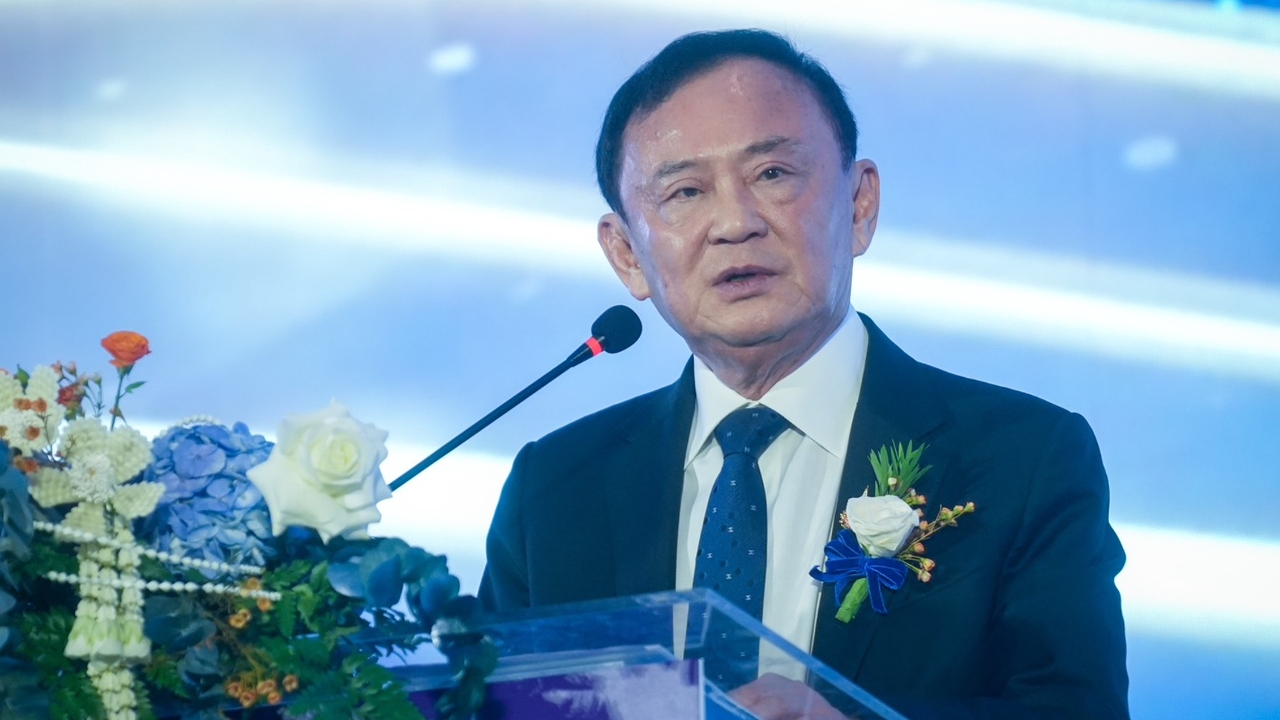
Thaksin has returned, expressing concern that Thailand faces multiple vulnerabilities, trapped by energy monopolies and an excess of laws. He suggests restructuring to confront new types of threats and stresses the importance of restoring public confidence.
On 18 Aug 2026 GMT+7, at the Dusit Thani Hotel, Somapa Information Technology Public Company Limited celebrated its 30th anniversary under the theme “Breaking Through the Global.” Ms. Supamas Isarapakdi, Minister attached to the Prime Minister’s Office, presided over the ceremony. Former Prime Ministers Thaksin Shinawatra and Somchai Wongsawat attended to extend congratulations.
Thaksin delivered a keynote speech on the challenges of security in the modern world, technology, and international cooperation. He stated that threats to Thailand have changed significantly and are no longer limited to military or border security but now include economic factors, technology, cybercrime, energy, employment, and demographic shifts. Therefore, Thailand must prepare to confront new forms of threats, especially by integrating technology into security operations.
"Today, I am concerned about threats facing Thailand in all dimensions because the world has changed greatly, such as conflicts in the Middle East and the situation at the Thai-Cambodian border. Modern threats are more complex, and Thailand must prepare to handle both traditional warfare and modern technological methods," Thaksin said. Thaksin stated.
He added that drone use today is not limited to surveillance or agricultural purposes but can be used for reconnaissance and attacks. Meanwhile, many security operations in Thailand still require large numbers of personnel, although technology could reduce risks and improve operational efficiency.

Thaksin further noted that economic threats from AI will rapidly change work structures and labor markets, especially entry-level jobs, which AI can increasingly replace. Skilled and specialized workers will become more important and use AI as "capable employees" assisting in various departments. Without adaptation, this will pose a significant threat to Thai occupations, work, and employment. Thailand must prepare its workforce for the modern labor market by developing skills aligned with market demands.
He also emphasized the importance of cybersecurity, stating that Thailand must prioritize protecting critical infrastructure systems vital to daily life, such as electricity, water supply, oil, and communications. Cyberattacks on these systems would broadly impact the population. Currently, Thailand’s cybersecurity is inadequate, so it is time to raise awareness on this issue.
Regarding changes in younger generations and education, Thaksin observed that the future world values lifelong learning more, with AI becoming an essential tool for learning and skill development. Thus, the education system must shift focus from degrees toward building applicable knowledge and skills.
Although there is criticism in Thailand that younger generations, especially Gen Z, lack patience and change jobs often, Thaksin pointed out that this generation has a strong desire to become entrepreneurs and start their own businesses. Therefore, economic and educational systems should be designed to harness the potential of young people to drive the country's economy.
Thaksin also viewed longevity as a major future challenge. Advances in biomedical technology and science may greatly extend human lifespan, impacting pension systems, employment, housing, and family structures. If these changes occur, questions arise about how people will live, pension sustainability, and housing systems. Thailand must begin considering these impacts now.
Another issue is communication technology. Thaksin noted that future mobile communications will increasingly connect with satellite systems and develop new network generations, drastically changing communication infrastructure. Thailand must keep pace with technology and plan communication security accordingly. Regarding energy security, he criticized Thailand’s state monopoly and refusal to adopt Smart Meter or Digital Grid technologies, which limits people’s freedom to choose cheaper energy sources. High electricity costs discourage industrial investment.
He emphasized that Thailand needs a flexible electricity system capable of supporting diverse energy sources, including renewables and new technologies. Energy costs, especially electricity prices, are critical to the country's competitiveness. Electricity must become more affordable; otherwise, no one will build industrial factories in Thailand.
Thaksin stated that Thailand’s structural problems include a weak economy, bureaucracy, and excessive laws—over 100,000—which hinder development. Thailand’s civil service has grown to 3 million employees. The most critical crises are the rule of law and public trust. A major economic restructuring is needed, including reducing bureaucracy by replacing roles with AI, and seriously restoring strategic cooperation with foreign countries so Thailand can effectively address new global threats.
He highlighted the importance of trust and rule of law in building national confidence, especially in a capitalist economy. Without credibility, investors will hesitate to invest. The core of capitalism involves trust and good governance under the rule of law. Therefore, Thailand must restore credibility and develop personnel ready for the modern world.
Thaksin concluded that future threats will cover border security, economy, society, technology, bureaucracy, energy, and cybersecurity. Thus, Thailand must accelerate internal adaptations and build strategic partnerships with other countries to cope with the rapidly changing world.

