

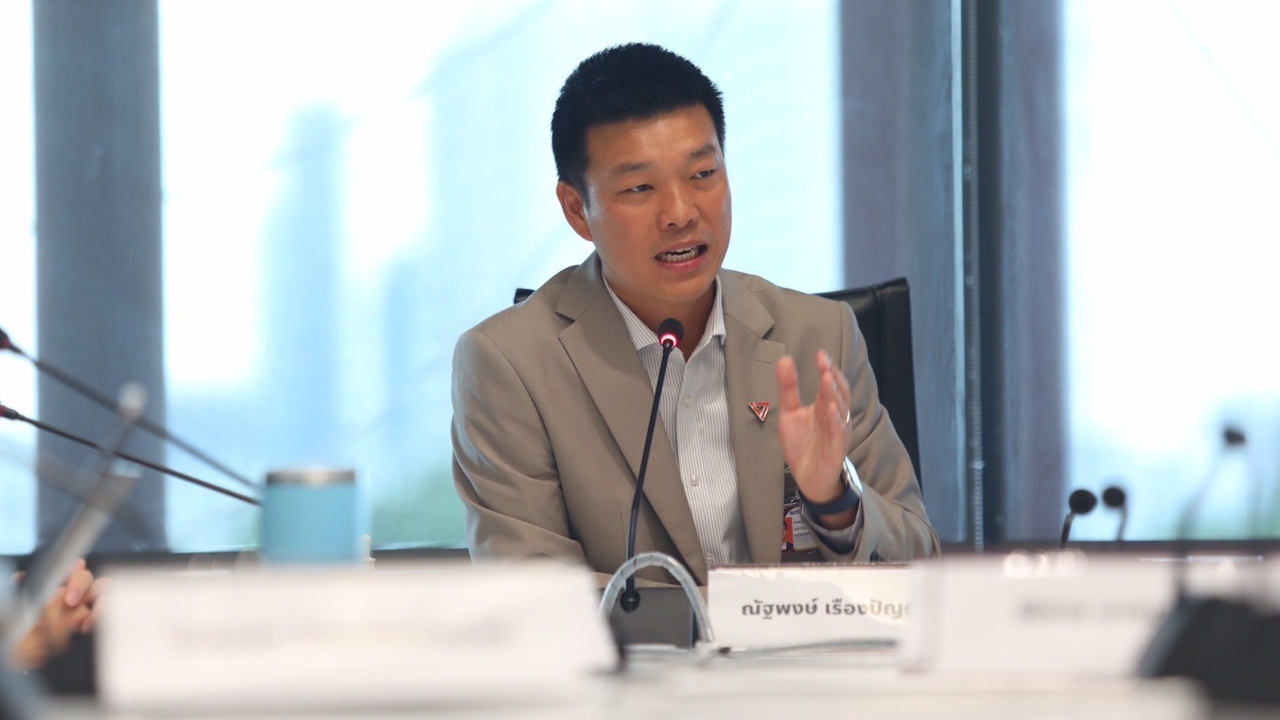
Nattapong urged the government to promptly solve the industrial waste problem in Prachinburi, pointing out that under the 'Blue Regime' and 'Gray Capital,' the issue intensifies. Meanwhile, Karunpon recounted opening a car door to a strong foul odor that even an N95 mask could not block.
On 19 Aug 2026 GMT+7 at the parliament, Mr. Nattapong Ruangpanyawut, opposition leader and head of the People's Party, along with MPs Mr. Karunpon Thiansuwan and Mr. Poonsak Janjamphai, briefed on their recent field follow-up of illegal industrial waste dumping in Prachinburi province. They also shared public concerns about efforts to include the province in the Eastern Economic Corridor (EEC). Their visit to Sri Maha Phot and Kabin Buri districts uncovered severe illegal factory operations and industrial waste dumping. Residents who complained faced death threats, while officials lacked safety during enforcement, reflecting a failure of oversight and patronage systems in the area.
Mr. Karunpon said that upon arriving at Tha Toom Subdistrict Administrative Organization, there was no need for scientific instruments to detect the foul stench; simply opening the car door revealed strong odors of sourness, garbage, rotting wood, and alcohol that shifted with the wind direction. Even wearing an N95 mask with a carbon filter was insufficient to block these smells. Local residents reported multiple government inspections, but after officials left, the problem recurred with no genuine resolution.
Further in-depth investigation found five industrial factories in the area: four foreign-invested and only one Thai-owned. This raised suspicion of the use of money and influence by large foreign capital groups to silence or interfere with state officials, preventing legal action or problem resolution for the community.
A clear contrast was observed between factories outside industrial estates and those within the High-Tech Industrial Estate. Factories inside the estate are regulated by laws and officials in an organized manner, causing no impact on nearby communities. In contrast, those outside lack oversight, forcing Prachinburi residents to live in fear and face threats if they protest or file complaints.

Mr. Karunpon added that local police explained attempts to set up checkpoints and block truck movements, but offenders often smuggled waste at night, using old clay pits dug by villagers for topsoil sales as hidden dumping sites for industrial waste.
He emphasized that Prachinburi is an important agricultural and fruit-growing region in the country. Dumping toxic waste into the soil causes harmful chemicals to seep into groundwater and land, contaminating agricultural products, animal feed corn, and drinking water. Ultimately, this poses a toxic residue risk to consumers and future generations across Thailand. If the government remains passive and fails to act against foreign capital and influential actors or to rehabilitate toxic waste areas in Prachinburi, the problem will spread nationwide.
Mr. Nattapong proposed a systemic solution by integrating satellite imagery data from GISTDA with factory licensing records to identify factories constructed without authorization, enhancing officials’ ability to inspect and take action.
He stated that the Prachinburi issue clearly reflects the 'Blue Regime,' where 'gray capital' groups collude with local political networks, leading to state officials being threatened and sued by 'gray capital' lawyers to silence investigations. He noted that as bribery and extortion occur in Prachinburi, a province with intense local political dynamics linked to dominant political families, the stronger the blue political presence, the more severe the industrial waste management problems become.
Mr. Nattapong also called on Mr. Suchart Chomklin, Minister of Natural Resources and Environment, to heed public and opposition voices by urgently addressing factories illegally polluting and transporting industrial waste into the area. He urged the minister to clarify whether there are plans to include Prachinburi in the EEC and how to ensure the community benefits from development without harming the environment or residents’ quality of life.