

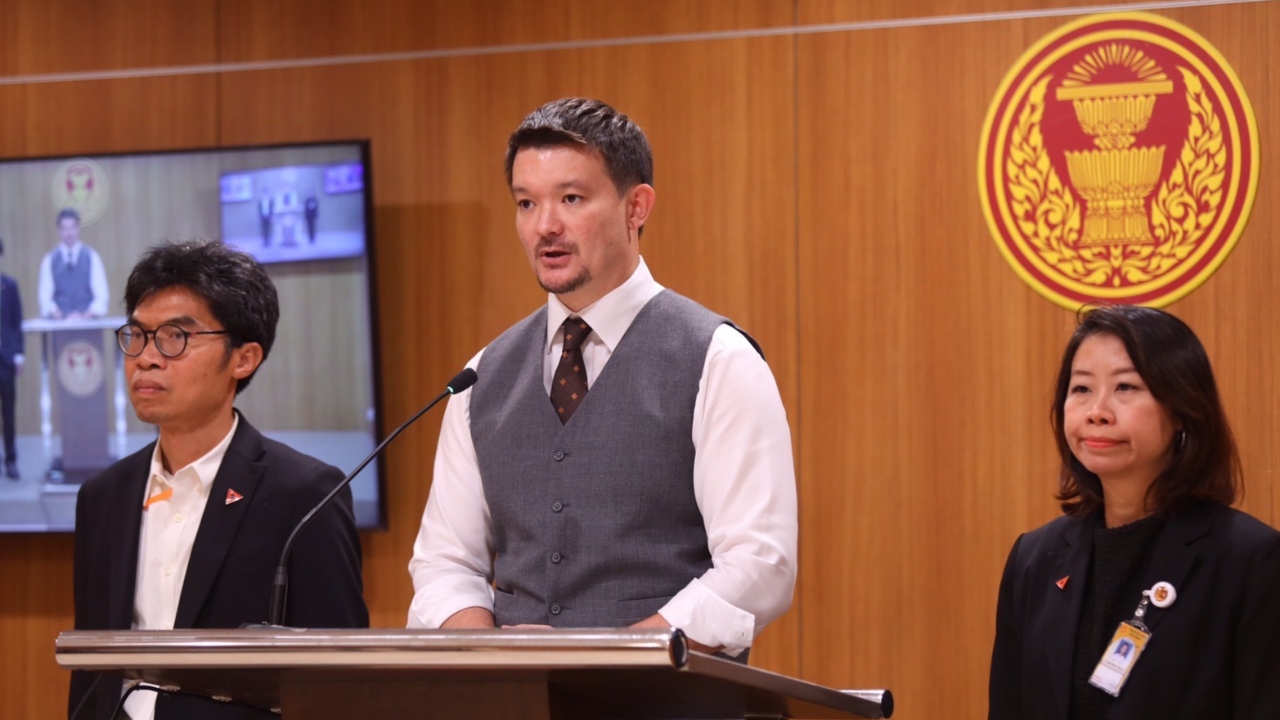
Pattarapong urged Suchart not to avoid the parliamentary committee and to urgently explain the details of the Thai-Myanmar TOR concerning transboundary water pollution, after arsenic levels in agricultural areas reached a critical level. He also called on the media to help raise awareness of this issue.
On 19 Aug 2026 GMT+7 at the Parliament, Mr. Pattarapong Leelaphat, MP for Chiang Mai District 8 from the People's Party and chairman of the Subcommittee on Transboundary Water Pollution, announced the results of today's meeting. The subcommittee reviewed the draft Terms of Reference (TOR) for the joint working group on water quality management of border and international rivers between Thailand and Myanmar. There are concerns about clauses prohibiting disclosure of information without written consent from both parties, including the requirement for mutual approval before any press release.
Mr. Pattarapong said this issue has sparked ongoing debate and concern among academics, civil society, and the People's Party. He has been closely following the matter but has yet to receive a response from the Ministry of Natural Resources and Environment. Today, he invited Mr. Suchart Chomklin, Minister of Natural Resources and Environment, to join the meeting to discuss these concerns and inquire about the origins of these provisions.
Mr. Pattarapong pointed out that the TOR's clauses on confidentiality and non-disclosure actually originated from the Thai side, with the Pollution Control Department as the primary responsible agency. He expressed hope that the minister would be open to hearing information and recommendations from the subcommittee, noting that the subcommittee has demonstrated tangible results and taken this matter more seriously than the government thus far.
However, Mr. Suchart informed that he could not attend the meeting due to other commitments. The subcommittee had anticipated this possibility and has requested the Ministry of Natural Resources and Environment to promptly provide a date and time when the minister can attend, so that preparations can be made accordingly.
Mr. Pattarapong called on the media and the public to pressure the minister to schedule a meeting soon, emphasizing that this issue is serious and extends beyond water contamination. It now affects soil sediment and farmland soil used for rice and other crops, with contamination levels exceeding standards by multiple times.
The standard limit for arsenic in cultivated land is no more than 25 milligrams per kilogram, but tests by the Land Development Department found that soils in the Kok River basin currently contain arsenic levels as high as 164 milligrams per kilogram. Similarly, many areas in the Sai River basin also exceed arsenic standards.
Satellite images confirm that these areas continue to be used for growing rice, animal feed corn, and other crops, despite government agencies having contamination data in hand but lacking clear management measures. As a result, farmers are left to face and cope with these problems on their own.
Mr. Pattarapong added that the Ministry of Natural Resources and Environment, which is directly responsible for the country's environmental issues, has shown neglect and refuses to hear the detailed facts studied by the subcommittee, as well as recommendations from civil society and expert academics.
"The subcommittee invites the media and the public to raise their voices about the pollution in the Kok, Sai, Ruak, Mekong, Kraburi, and Salawin rivers, which are contaminated by toxic substances from mining activities in neighboring countries. This pressure is necessary to urge the government to urgently recognize the importance of this problem and to use parliamentary mechanisms to solve it, protecting the quality of life for the Thai people," Mr. Pattarapong concluded.