

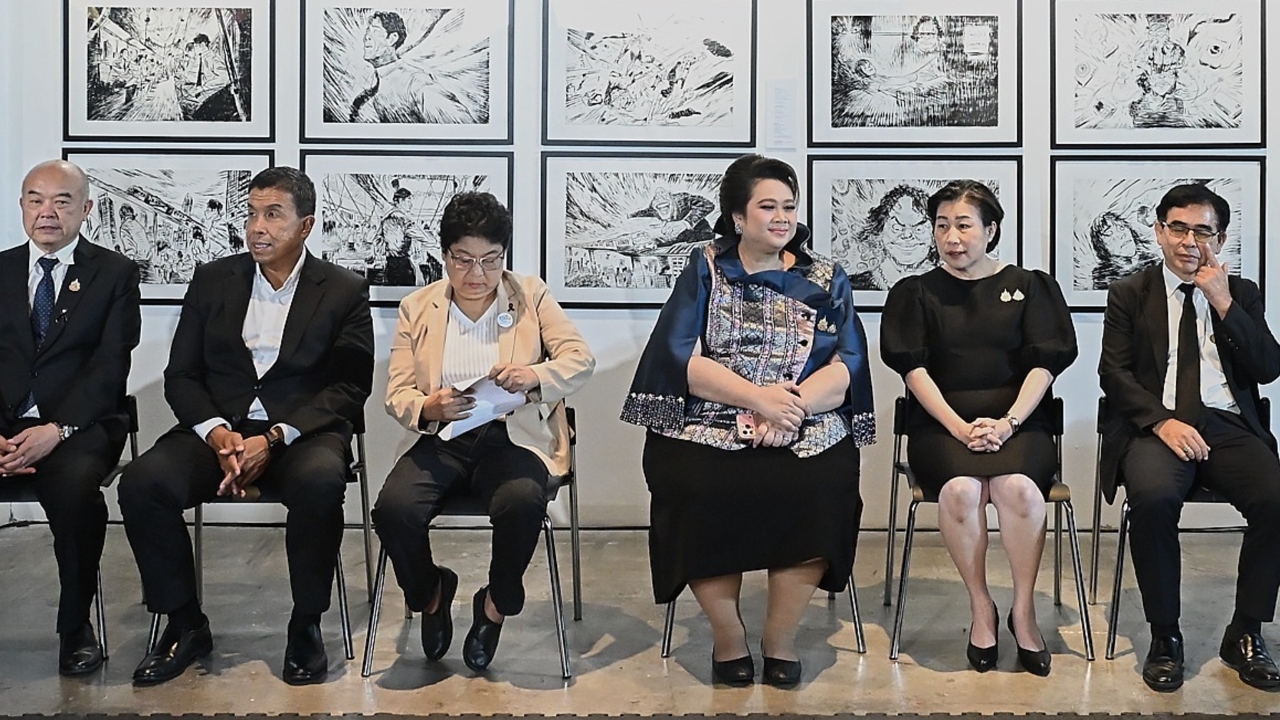
“Supamas” launched a consumer protection exhibition promoting self-rights defense and revealed that the “Lemon Law” legislation is nearly finalized, set to enter parliament for its 2nd and 3rd readings after the session opens, with enactment expected within one year.
On 20 Aug 2026 at 14:30 GMT+7, Ms. Supamas Isarapakdi, Minister attached to the Prime Minister's Office overseeing the Office of the Consumer Protection Board (OCPB), chaired the opening of the art exhibition “SPEAK UP: Reflecting Consumer Issues through Art — We Must Not Submit,” organized by the Consumer Organizations Council, with support from the Bangkok Art and Culture Centre and the Public Broadcasting Service of Thailand (Thai PBS).
The opening ceremony was honored by the presence of Ms. Supamas Isarapakdi, Minister attached to the Prime Minister's Office, as chair. The Office of the Consumer Protection Board (OCPB) participated as a partner organization at the Bangkok Art and Culture Centre to raise public awareness and encourage people to stand up for their rights.
Ms. Supamas stated that consumer issues closely affect the public, and the government has a duty to protect citizens from exploitation and improve their quality of life. Previously, over half of consumers tended to accept exploitation due to perceiving it as complicated or feeling embarrassed to assert their rights.
“Today, we want to awaken the public’s spirit: do not be ashamed. Your one voice is a heavenly voice capable of changing the nation.”
A notable aspect of this event is its break from traditional advocacy formats like forums or complaint displays. Instead, it uses art as a medium, featuring two renowned artists who created works that serve as a universal language to prompt reflection and deepen understanding of consumer problems. The artworks include storyboard sketches with charcoal illustrations reflecting issues drawn from interviews with over 100 actual victims.
The exhibition emphasized four main problems facing Thai consumers: online threats causing widespread harm; tangled communication cables creating visual and safety hazards; public transport issues in provinces, with the Consumer Organizations Council pushing provincial administrations (PAOs) to provide EV buses; and unfair apartment lease contracts, especially landlords charging excessive water and electricity fees. The Minister clearly stated that landlords may charge only rent for the space and are not allowed to resell electricity for profit, which constitutes illegal conduct.
Later, Ms. Supamas explained that as Minister attached to the Prime Minister’s Office overseeing the OCPB, she has continuously worked with the Consumer Council. Consumers often accept problems quietly due to shame or reluctance to cause trouble. This exhibition aims to awaken those exploited to unite their voices for change. Moreover, it is an exciting and novel approach compared to conventional forums or document presentations, using art as a universal language understandable even beyond Thailand. Visitors will learn about the Consumer Council’s role as organizer and may be encouraged to demand their rights more actively in the future.
Additionally, on behalf of the government and together with the Consumer Council, efforts have been made to advance the draft Product Liability Act B.E. .... or “Lemon Law” bill. Regarding the bill’s progress, Ms. Supamas stated it is currently under review by the House of Representatives’ committee, with only minor details remaining. It will then be submitted to the House for its 2nd and 3rd readings and subsequently forwarded to the Senate. It is expected to be among the first bills considered when the parliamentary session opens on 26 Aug 2026, with enactment anticipated within one year from now.