

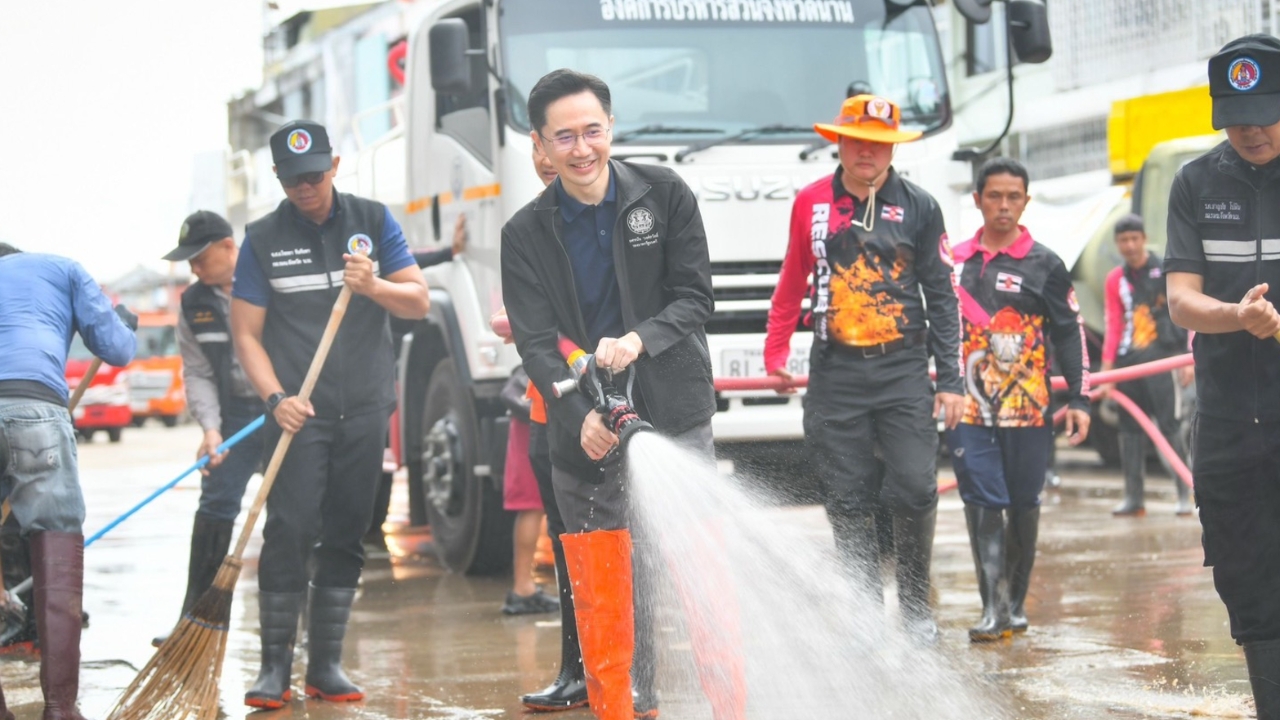
“Yotsanan” enforces Single Command, ordering 17 northern provinces to remain on 24-hour standby to handle floods. He leads volunteer teams in a major clean-up and restoration of Nan Municipality after waters recede, accelerating compensation efforts with a proposal to the Prime Minister this week. The text implies 'ยศชนัน' is a person named Yotsanan; the exact government title is clarified in later parts.
On 21 Aug 2026 at 08:30, Prof. Dr. Yotsanan Wongsawat, Deputy Prime Minister and Minister of Higher Education, Science, Research and Innovation, serving as Chair of the Committee on Flood and Drought Prevention and Resolution in Northern Thailand, visited Nan Municipality (Sumanthawarat Road in front of Kad Sri Kham) to oversee city recovery efforts. He participated in cleaning streets and homes and encouraged volunteers and civil society members supporting restoration activities in the area.
Prof. Dr. Yotsanan personally operated a high-pressure water hose to wash away stubborn mud and cleaned the streets alongside officials and volunteer workers in a friendly manner. The Mayor of Nan Municipality thanked government representatives for establishing a command post beside the people of Nan throughout the past 3-4 days up to the recovery phase.
Prof. Dr. Yotsanan then provided an update on assistance efforts, revealing that earlier, Prime Minister Anutin Charnvirakul called to inquire about the situation with concern. They discussed operational plans; currently, the focus remains on area recovery. Going forward, the government will accelerate relief and compensation payments to flood victims. Although flooding lasted only a few days, the mud deposited caused significant damage, necessitating comprehensive support measures for farmers and residents needing home repairs, requiring cooperation across several ministries.
Prof. Dr. Yotsanan added that the Prime Minister intends to visit Nan Province this weekend specifically to oversee relief efforts. If relevant agencies such as the Ministry of Finance and Comptroller General’s Department can coordinate systematically, it will reduce paperwork and processing time, enabling the public to receive relief quickly and comprehensively, allowing them to resume normal life and economic recovery as soon as possible.
When asked about long-term flood prevention plans for Nan’s economic area, Prof. Dr. Yotsanan stated that the Royal Irrigation Department and the province have proposed contingency plans. The key principle is to establish water retention areas at various points to hold runoff from higher elevations, such as retention ponds, monkey cheeks (flood detention areas), or small weirs, before the water reaches the city.
Furthermore, he emphasized adopting technology in warning systems by upgrading from GIS to Digital Twin technology, collaborating with the private sector to analyze data from telemetry stations across locations. This enhances the accuracy of water-level warnings via applications, allowing residents to view specific data for each area’s varying elevations and prepare promptly for flood situations.
Subsequently, reporters reported that Yotsanan, as Chair of the Committee on Flood and Drought Prevention and Resolution in Northern Thailand, issued an urgent letter (Ref: M.T. 0608/W 14601) to governors of 17 northern provinces, stressing all agencies must prepare to respond to and prevent flooding with unified and urgent measures to minimize loss of life and property.
The directive highlighted six key operational measures: enforce Single Command to ensure all local command, orders, and communication align; prepare equipment and personnel including boats, rescue vehicles, and water pumps to assist victims immediately; prioritize evacuation of vulnerable groups such as bedridden patients, elderly, and those in risky areas; and secure safe parking spaces for residents' vehicles.
Suppress fake news by monitoring social media to prevent misinformation, provide clarifications through the Public Relations Department, report emergencies immediately to the committee chair and the Department of Disaster Prevention and Mitigation (DDPM). In severe crises, governors, police, military, and local administrative organizations must operate continuously 24/7 until normalcy returns.


