

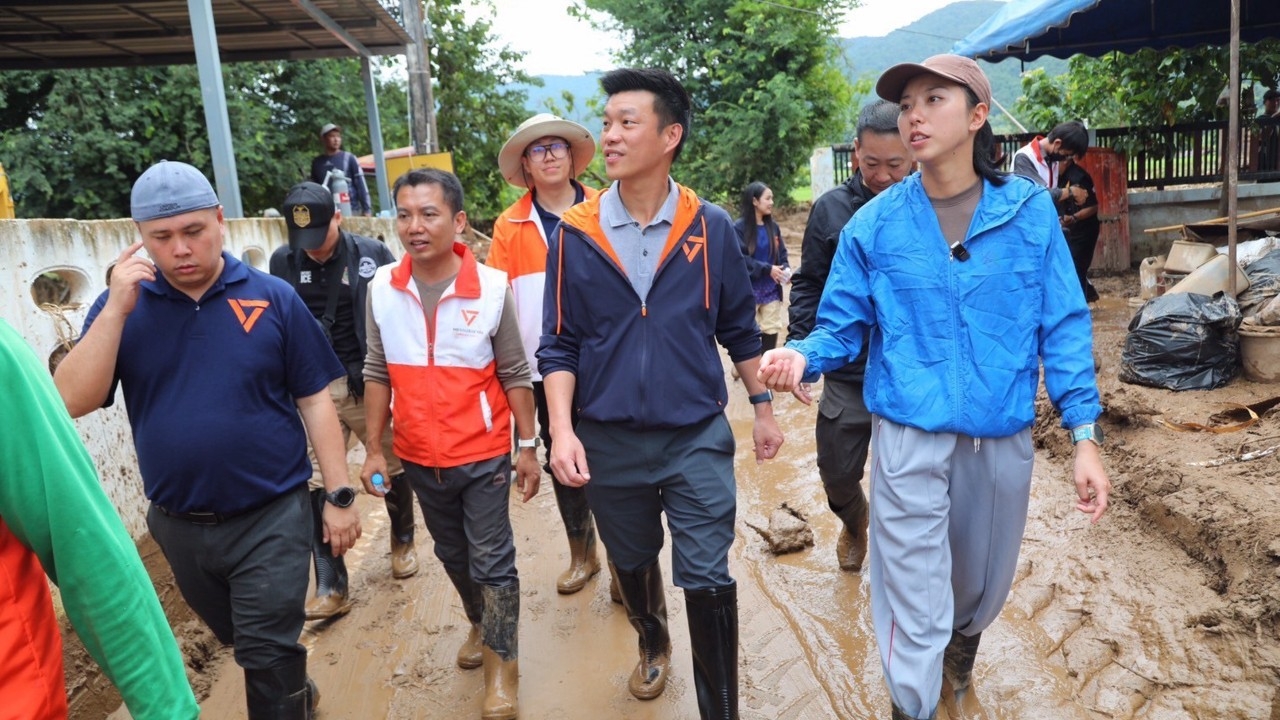
“Teng Nattapong” visited Pua District, Nan Province, where locals urged for expedited relief efforts. He noted that while ministers staying overnight in the area to monitor the situation is positive, many areas still lack timely warnings, forcing village heads to ring bells to alert residents.
On 22 Aug 2026 GMT+7, at Ban Hia and Ban Kret, Sila Laeng Subdistrict, Pua District, Nan Province, Nattapong Ruangpanyawut, party-list MP and leader of the Prachachon Party, along with MPs Chaowich Innoy and Charoen Apiphatkosol from Nan province and local leaders, visited to assess flood recovery and relief efforts. Nattapong said the urgent priority is to assist affected residents and thanked all agencies from other areas helping out. He spoke with the Mirror Foundation, which has established a center in Pua. They reported lacking equipment like boots, water squeegees, cleaning tools, and heavy machinery to remove mud from homes. This is an urgent need. Talking with villagers, everyone requested relief support and expressed a desire for long-term solutions. He urged the government to consider continuous budget allocation and proper planning to meet these needs.

Regarding whether the deputy prime minister and ministers staying overnight to monitor the area represents improved problem-solving, Nattapong said it is positive that executives see the issues firsthand, which helps them understand local conditions better. However, many residents understand they must adapt to environmental and weather conditions. What they truly want is long-term problem resolution.
Asked if these issues should be declared a national agenda with a specific resolution model, Nattapong said the current problem is a lack of clear direction and continuity in government actions, which has been ongoing. Legally, there is the Water Act and the establishment of the National Water Resources Office (NWRO). Each province must prepare water plans alongside urban plans. However, the NWRO lacks authority to allocate budgets on behalf of other agencies. What is needed is clear guidance from the executive branch focusing on provinces or watershed areas. With clear plans, continuous implementation can proceed.

Asked if he had further suggestions for government improvements, especially regarding Cell Broadcast warnings that many areas did not receive or received late, Nattapong said locals in Pua reported no advance warnings on the night before the flood. Instead, village heads or community leaders had to ring bells to warn that water was coming. This is understandable given that Pua experienced a rain bomb event in a valley area with water converging into the Khun River. Thus, warning agencies lacked data to forecast the event. To prevent this, simulation models or comprehensive monitoring equipment covering all areas are needed.


