

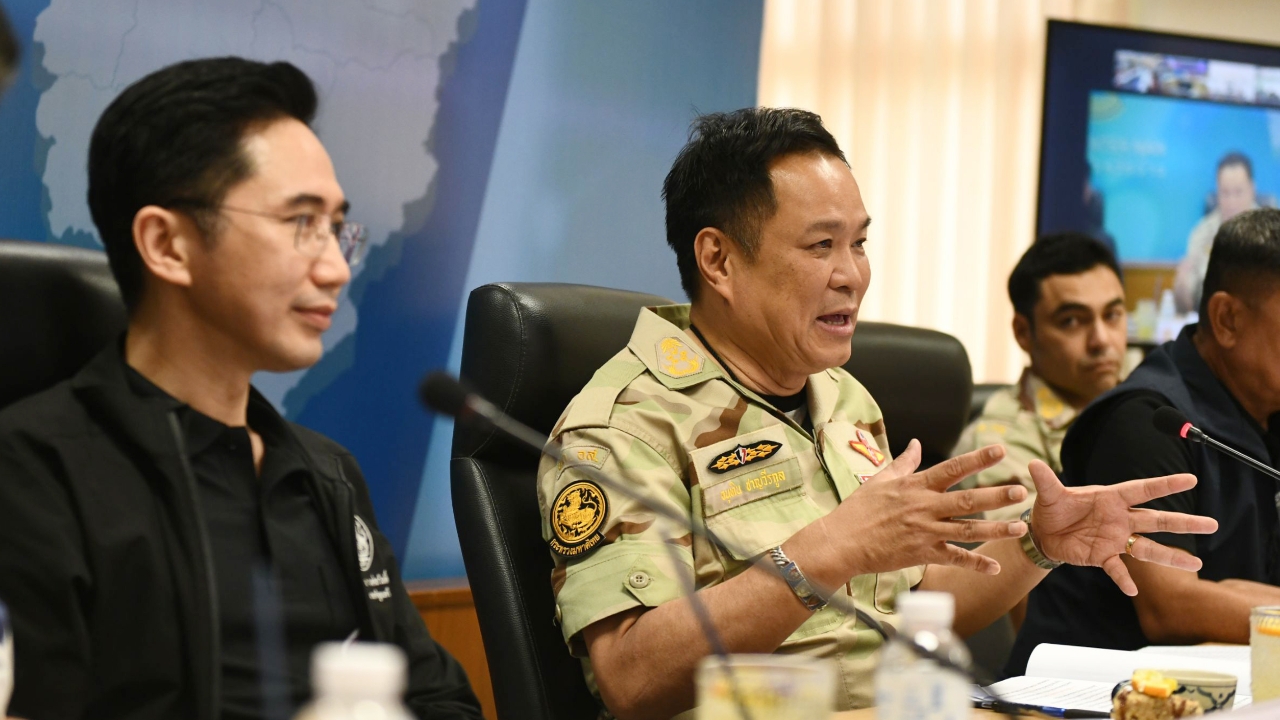
The Prime Minister held a meeting to monitor the flood situation in northern and northeastern Thailand, expressed condolences to families of the deceased, ordered vigilance and accelerated recovery efforts, emphasized the need to issue warnings before floodwaters arrive, and thanked Deputy Prime Minister Yotsanan for immediately visiting the affected areas.
At 11:05 a.m. on 23 August 2026 GMT+7 Prime Minister and Minister of Interior Anutin Charnvirakul presided over a command center meeting to monitor the flood situation in the northern and northeastern regions at the Phra Chao Sri Suriya Phong Phritdet conference room, Nan Provincial Hall. Attending were Deputy Prime Minister and Minister of Higher Education, Science, Research and Innovation Yotsanan Wongsawat, in his role as Chair of the Committee for Flood and Drought Prevention and Mitigation in the North; Minister of Defense Lieutenant General Adul Boonthamcharoen; Minister of Agriculture and Cooperatives Suriya Juangroongruangkit; Deputy Minister of Interior Jesada Thaises; Deputy Minister of Transport Phattharaphong Phattharapisit,
as well as Army Commander General Pana Klaewplodtuk, Army Chief of Staff General Chaipruk Duangprapat, Director-General of the Department of Disaster Prevention and Mitigation (DDPM) Theeraphat Kachamat, Nan Governor Chainarong Wongyai, and other government agencies. The meeting also included governors from 37 northern and northeastern provinces via videoconference, with reports from Nan, Sukhothai, and Nakhon Phanom provinces.


The Prime Minister then opened the meeting, stating that his delegation, including local administration and the army commander, had traveled to Nan Province to monitor the flood situation. First and foremost, he expressed deep condolences for the recent flood-related fatalities. He extended sympathies to the families and relatives of those who lost their lives, emphasizing that such losses are unwanted by anyone. He urged relevant agencies to provide full care and assistance to the bereaved families and all flood victims.
The Prime Minister added that prior to the situation, he had assigned deputy prime ministers in his cabinet to oversee specific regions: Yotsanan for the North, Phiphat Ratchakitprakarn (Deputy Prime Minister and Minister of Transport) for the South, Akiniti (Deputy Prime Minister and Minister of Finance) for the Central region, and Songsak Thongsri for the Northeast. Each has full authority to command and manage responses to floods and natural disasters, including policy and relief measures.
In this case, he expressed special thanks to Deputy Prime Minister Yotsanan, who promptly went to the affected areas when the situation arose. While the Prime Minister was on official duty abroad, they maintained constant communication, with Yotsanan providing regular updates. The Prime Minister was confident that Yotsanan could effectively oversee and control the situation.
He also thanked the other ministers involved for fully supporting Yotsanan in the field. Although the overall flood situation has eased, vigilance remains necessary due to the ongoing rainy season and risks of heavy rain, flash floods, and landslides. Some areas are experiencing water recession and entering recovery, but resources must remain deployed for close monitoring.


At the meeting, the Prime Minister instructed the Department of Disaster Prevention and Mitigation to expedite damage assessments and accelerate relief and rehabilitation efforts in affected areas. Pumping equipment should be deployed in flooded and low-lying zones to drain water quickly. As water recedes, restoration of homes, roads, bridges, electricity, water supply, healthcare facilities, and agricultural areas must proceed immediately. Damage surveys and aid distribution should be conducted promptly, following established relief protocols.
He requested the Meteorological Department, the Office of the National Water Resources (ONWR), and the Geo-Informatics and Space Technology Development Agency (Public Organization) to continuously monitor and forecast rainfall in high-risk provinces, especially in northern and upstream regions. They should analyze and identify areas prone to heavy rain, create flood maps and forecasts, and disseminate information to relevant agencies for timely preparedness.
Additionally, ONWR, the Royal Irrigation Department, and the Geo-Informatics Agency are to collaborate in ongoing water situation monitoring and assessment. They should integrate rainfall and runoff data to estimate the volume and timing of water flows entering key areas, particularly economic zones, major districts, and downstream locations, updating data regularly. This information will support provincial and agency decision-making for public warnings.
“I emphasize that once it is known where floodwaters will arrive, the public must be informed immediately, not after the water has come. This allows people time to prepare, move belongings, relocate vehicles, and—most importantly—evacuate vulnerable groups from their homes and risk areas swiftly. Equipment and pumps should be mobilized and ready to respond instantly should conditions change,” the Prime Minister said.


He also urged continued monitoring of landslide risks by the Department of Mineral Resources in cooperation with various networks to watch vulnerable areas and alert the public for timely preparation and evacuation. For infrastructure restoration, the Ministry of Transport was tasked with assessing and inspecting bridges and structures potentially affected by water currents, mobilizing machinery to clear and reopen routes safely and quickly. The Royal Irrigation Department stands ready with emergency equipment such as bearing bridges to assist in case roads are cut off by floods, aiming to minimize transport disruptions.
“From experience with last year's events, I am confident that this year’s readiness is better. I have already instructed the electricity and water supply agencies accordingly, and I believe the situation will be manageable,” he added.
Regarding long-term plans, the Prime Minister said he would have ONWR submit flood mitigation proposals. Today’s gathering aimed to brainstorm and receive policies to develop comprehensive flood prevention measures to minimize economic and tourism impacts.
For monitoring, governors were urged to coordinate closely with the DDPM, focusing mainly on continuous updates and warnings. The DDPM was asked to ensure availability of new applications to provide the most current data and to expedite implementation. Information dissemination should be linked to governors, who are encouraged to build communication networks down to sub-district and village levels for preparedness and ongoing coordination with local authorities. All units must integrate efforts, prioritizing the safety of people and property, providing full relief and rehabilitation to restore normal life quickly.
In areas where floodwaters have receded, rapid recovery is requested. For high-risk zones, surveillance and warnings should remain at the highest level. Downstream areas expected to be affected must prepare to minimize damage. Any obstacles or issues beyond capacity should be reported up the chain. The Prime Minister pledged full support and urged immediate implementation of these directives.
