

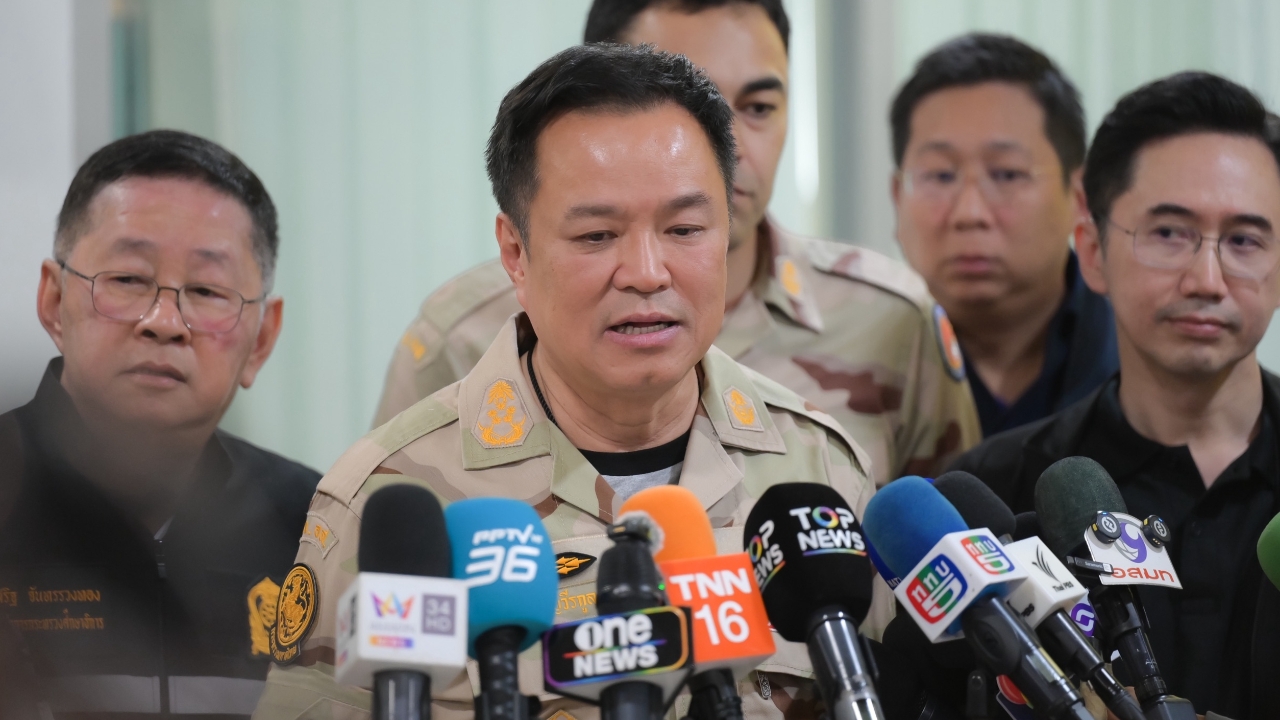
Prime Minister "Nhu" emphasized that authorities have already been ordered regarding the southern border violence. He has not yet responded on whether he will visit the area personally. He instructed the Southern Border Provinces Administrative Center (SBPAC) to establish an operations center and send teams to oversee the southern border area, and launched hotline 1880 to track every case without omission.
At 12:20 p.m. on 23 Aug 2026 GMT+7 Prime Minister and Minister of Interior Anutin Charnvirakul gave an interview at the Nan Provincial Hall concerning the violent incidents in the three southern border provinces after attending a security agency meeting prior to traveling to monitor flood situations and solutions in Nan Province. The Prime Minister nodded and said he was aware of the situation, had discussed it, and already issued directives.
Regarding the question on whether he would personally visit the area, the Prime Minister replied only, "Actions have already been taken." Reporters then asked if he was concerned about the situation, but the Prime Minister did not respond and immediately entered his vehicle to leave. He was scheduled to continue his trip to Ubon Ratchathani Province to visit soldiers injured by landmines.


Meanwhile, Ms. Ratchada Thanadirek, spokesperson for the Prime Minister's Office, revealed that after the Prime Minister monitored and issued security directives concerning the violence in the southern border provinces, he emphasized ongoing care for affected citizens by assigning the Southern Border Provinces Administrative Center (SBPAC) to expedite assistance and compensation for all cases, ensuring citizens can access their legal rights quickly and comprehensively, covering direct victims, families, vulnerable groups, and those suffering economic losses.
Recently, SBPAC established a communication and legal aid operations center using a Case Management system throughout the process, with Case Managers overseeing both overall and individual cases. They work as one team with provincial authorities—from field visits to gather information on victims, verify rights, monitor aid access, to identifying obstacles, responsible parties, and deadlines for resolution.
Currently, three provincial Rapid Response teams have deployed across the three provinces to gather real-time information on situations and issues, coordinating closely with aid officials and provincial staff. The approach emphasizes proactive outreach, with officials visiting affected individuals instead of waiting for citizens to initiate contact or coordinate among multiple agencies themselves.


Additionally, SBPAC has launched the "SBPAC Hotline 1880" to provide information and answer questions directly about rights and aid. Affected individuals and families can call immediately to inquire and coordinate assistance, with data integrated into the Case Management system to track each case until aid is delivered.
Moreover, a real-time Dashboard has been created to monitor the status of aid per case, divided into four levels:
This system allows immediate visibility of each case’s stage, obstacles, and areas requiring urgent attention. Progress data will be continuously communicated publicly so citizens can track and verify status.

The Prime Minister emphasized that those suffering should not have to seek out government agencies; rather, the government must reach out to the people. Assistance must clearly identify how each family is affected, what compensation rights they have, the process stage, obstacles, responsible officials, and when resolution will occur to ensure aid reaches people promptly and effectively.
Care will cover medical treatment and rehabilitation for the injured, support for families and mental health—especially the elderly, children, women, and vulnerable groups—as well as damage to homes, property, businesses, and livelihoods.