

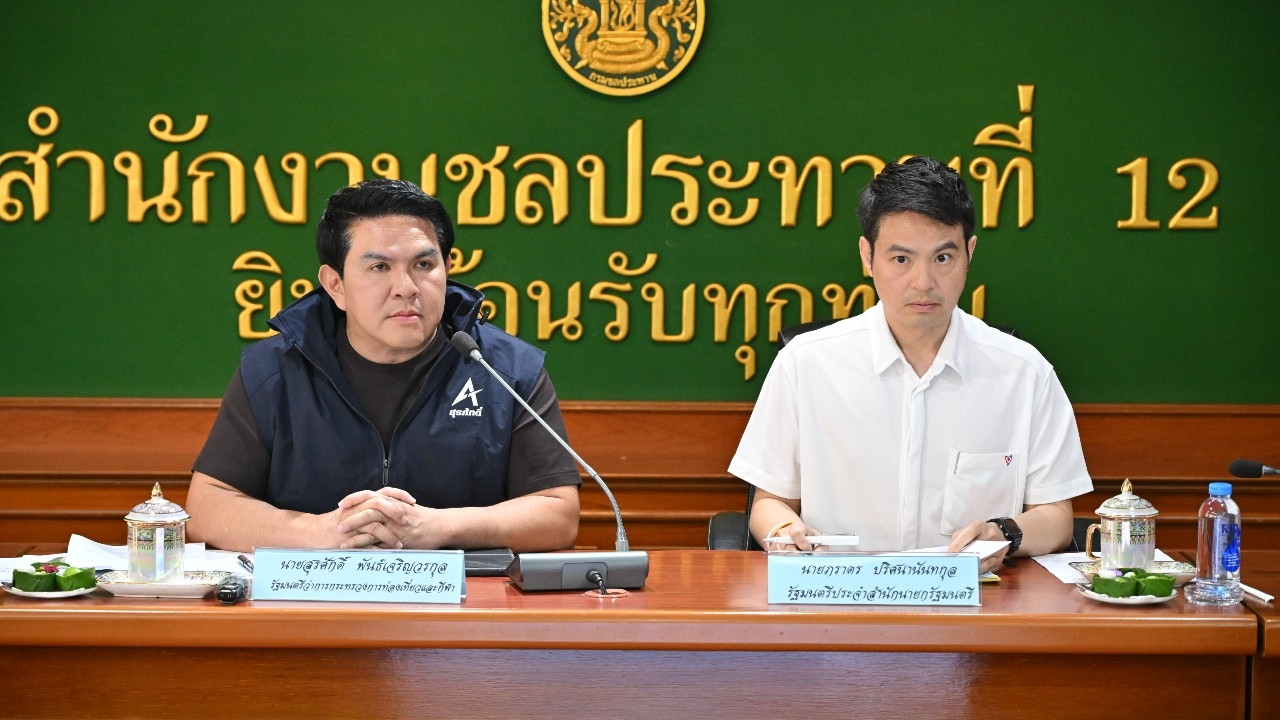
Two ministers, Surasak and Pradorn, led a meeting on flood and drought prevention in the Chao Phraya basin, ordering six strict measures and heightened monitoring of the Pasak dam due to the risk of overflow late in the rainy season, while revising plans to respond to La Niña.
23 Aug 2026 GMT+7 Mr. Surasak Pancharoenworakul Minister of Tourism and Sports chaired the subcommittee meeting on flood and drought prevention for the Chao Phraya basin, session 1/2026, accompanied by Mr. Pradorn Prissanantakul Minister attached to the Prime Minister's Office and advisor to the subcommittee, at the Royal Irrigation Department Office 12 conference room, Sapphaya district, Chai Nat province, and via electronic media, to set policy frameworks and closely monitor water conditions in the Chao Phraya basin.
The meeting assessed the overall 2026 water situation as below normal, with central Thailand receiving 20% less rainfall than average. Meanwhile, key dams like Bhumibol and Sirikit hold 68% and 73% capacity respectively, still able to accommodate more water.
“Short-term risk evaluation shows that Pasak Cholsit dam has a high chance of exceeding its capacity at the end of the rainy season, potentially impacting water levels along riverbanks in Saraburi and Phra Nakhon Si Ayutthaya provinces.”


The meeting also discussed strategic goals to prepare for 2027, when models predict a full La Niña event likely to cause severe flooding. To prepare, Minister Surasak assigned six policy directives to relevant agencies to expedite action:
1. Use real-time risk assessment technology Agencies including GISTDA, the Hydro-Informatics Institute, the National Water Resources Office, the Meteorological Department, the Royal Irrigation Department, and the Department of Disaster Prevention and Mitigation will collaborate to produce real-time hazard maps and develop rapid early warning systems.
2. Develop provincial operational checklists The National Water Resources Office and the Department of Disaster Prevention and Mitigation will create operational manuals for provincial governors to systematically inspect water barriers and drainage systems.
3. Integrate provincial command centers Provincial governors will coordinate military, police, and civilian units, with the Ministry of Social Development preparing shelters and prioritizing aid for vulnerable groups first.


4. Prepare medical readiness Health agencies must prepare personnel and medical supplies to provide 24-hour care for the population.
5. Implement proactive agricultural planning The Royal Irrigation Department and Department of Agricultural Extension will plan dry-season rice cultivation for 2026 in line with water availability, to avoid impacting water usage in 2027.
6. Streamline and ensure transparency in compensation Expedite fair damage surveys and compensation disbursement by using GISTDA satellite imagery to reduce paperwork and prevent fraud.
Meanwhile, Minister Pradorn suggested a key strategy shift in water management from a “vertical” approach (releasing floodwater through main river channels) to a “crosswise/forest belt” approach, systematically diverting floodwaters into irrigation canals and agricultural areas to lessen impact on riverside residents. He emphasized that relevant agencies must engage with local communities transparently in advance. .
