

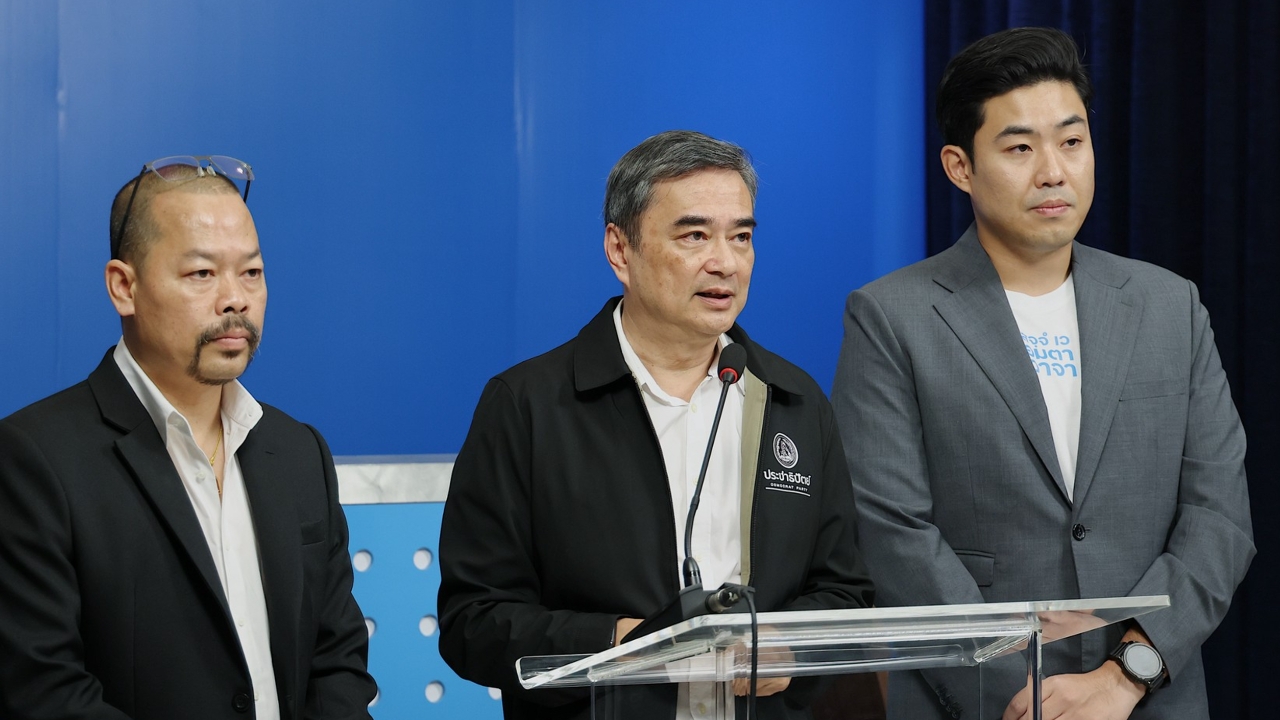
“Abhisit” praises ministers for quickly visiting flood-affected areas in Nan province. He reveals the Democrat Party will submit a complaint to the National Anti-Corruption Commission (NACC) on 24 August, urging the introduction of witness protection measures in the local exam fraud case. He emphasizes that opposition parties will definitely submit a no-confidence motion.
At 14:00 on 23 August 2026 GMT+7, Abhisit Vejjajiva, party-list MP and leader of the Democrat Party, commented on the flood situation in Nan province, saying that party members and mechanisms in the northern region have been assisting the public, continuously reporting the situation, expressing condolences to victims and those affected, and offering support to officials in their work.
He praised the ministers who quickly went to the affected areas, helping to boost confidence and morale locally, and noted that the response had been highly unified. He expressed hope that these efforts would continue, as recovery processes are ongoing. He also noted the possibility of future disasters elsewhere, suggesting this experience could serve as a lesson and model for future responses.
Later, Abhisit announced that the Democrat Party is preparing to submit a complaint to the NACC concerning corruption in local government exams. The case involves a large-scale operation with masterminds who are powerful and have extensive networks. There is concern about whether investigators can reach the true masterminds or if the process will be cut short to protect those in power. Those who paid for the exams have key information about brokers and contacts involved and want to provide facts to identify the masterminds but worry about facing prosecution themselves.

The party notes that Section 135 of the NACC Act allows such individuals to be protected as witnesses if they are not key perpetrators and provide useful information to identify major culprits. The NACC can protect witnesses without prosecuting them and implement witness protection measures. However, there is currently no confidence in this, as it remains at the NACC’s discretion whether to grant witness protection, and there is no clear law on witness protection in police proceedings.
. Therefore,
on 24 August, the Democrat Party will submit a letter to the NACC requesting clear policies and announcements on how witness protection measures will be implemented. The party is ready to coordinate bringing these individuals forward to provide information to the NACC, as this issue undermines morale, integrity, and ethics within local government and administration.
When asked about the number of witnesses, Abhisit said it is not yet possible to specify the exact number, but some have contacted the party directly. He said the NACC should promptly clarify this and prioritize rights for the earliest informants. Regarding whether the protected witnesses’ information will reach ministerial levels, Abhisit said it depends on how the NACC can assure confidence. Unless the NACC claims it is fully prepared, this remains uncertain. As a political party with an oversight role, they want to help ensure the process is effective and meets its goals.

Reaffirming the opposition’s plan to submit a no-confidence motion against the government despite unlikely success, he said it would still cause political damage.
The Democrat leader also discussed preparations for work after the parliamentary session opens. On 25 August, the party will submit important bills to the House, including the Palm Oil Act, and expedite drafts related to national education, social security, and local governance.
On 26 August, they will debate the 400-billion-baht loan decree, highlighting government economic management issues. The government’s large borrowing has pushed public debt close to the ceiling, leaving only one installment of funds to assist the public by early September. Problems like rising prices and energy costs remain, despite government promises to restructure. In practice, the government has not fully acted on these promises.
If the government had followed the party’s initial approach focusing on cost reduction, the current situation could have been avoided. They will cite Constitutional Court rulings where experts agreed with the opposition that the government’s actions do not meet economic security criteria. On 27 August, they plan to submit questions or join the opposition to propose motions addressing violence in the southern region.
On 28-29 August, the party will meet with opposition parties on three major issues: the rigging of senator elections to show the Election Commission (EC) has no reason not to forward the case to the Supreme Court before its late-month decision; constitutional amendments revealing divergent political party views during drafting, with urgent fixes needed on senator selection to prevent repeating past methods, and on the parliamentary speaker’s power to refer cases of NACC misconduct to an independent investigation committee. The party will demand the speaker disclose the screening committee members’ names and a clear timeline for completion.

Regarding the no-confidence debate, opposition leaders will meet at the end of August to plan strategies and schedules. After parliament opens, debates will cover the loan decree and, within two weeks, the 2027 budget in second and third readings. Asked if specific issues are prioritized for the no-confidence debate, Abhisit said several MPs are preparing information but consultations with opposition parties are pending. He confirmed the Democrat Party will definitely participate in the no-confidence debate.
When asked about the People’s Party (Popon) preparing to focus on senator vote-rigging and corruption, Abhisit said, investigations are everyone’s duty. Regarding senator vote-rigging, he noted that since the prime minister election, ministers involved have been charged in the EC’s 26th investigation committee. The People’s Party’s staged disclosures match the party’s information. The initial task is to urge the EC to forward the case to the court, enabling the EC to uncover the full facts.
“If we recall, the EC previously sent a case where two senator candidates exchanged votes via Line chats to the court, which ruled it illegal. So, given the facts revealed in the past 2-3 months, there is no reason for the EC not to forward this case to the court. The court’s judgment in that case is final.”
Regarding a NIDA Poll suggesting the government may not last long due to mounting problems, Abhisit said some polls predict survival but with some damage. The important task is oversight. They see failures in administration and corruption that the public has the right to know. While this may not affect parliamentary votes, it is their duty to help society pressure the government to improve. As he stated before, they acknowledge government successes but must highlight shortcomings, hoping the government will address issues, such as the unprofitable land bridge project.