

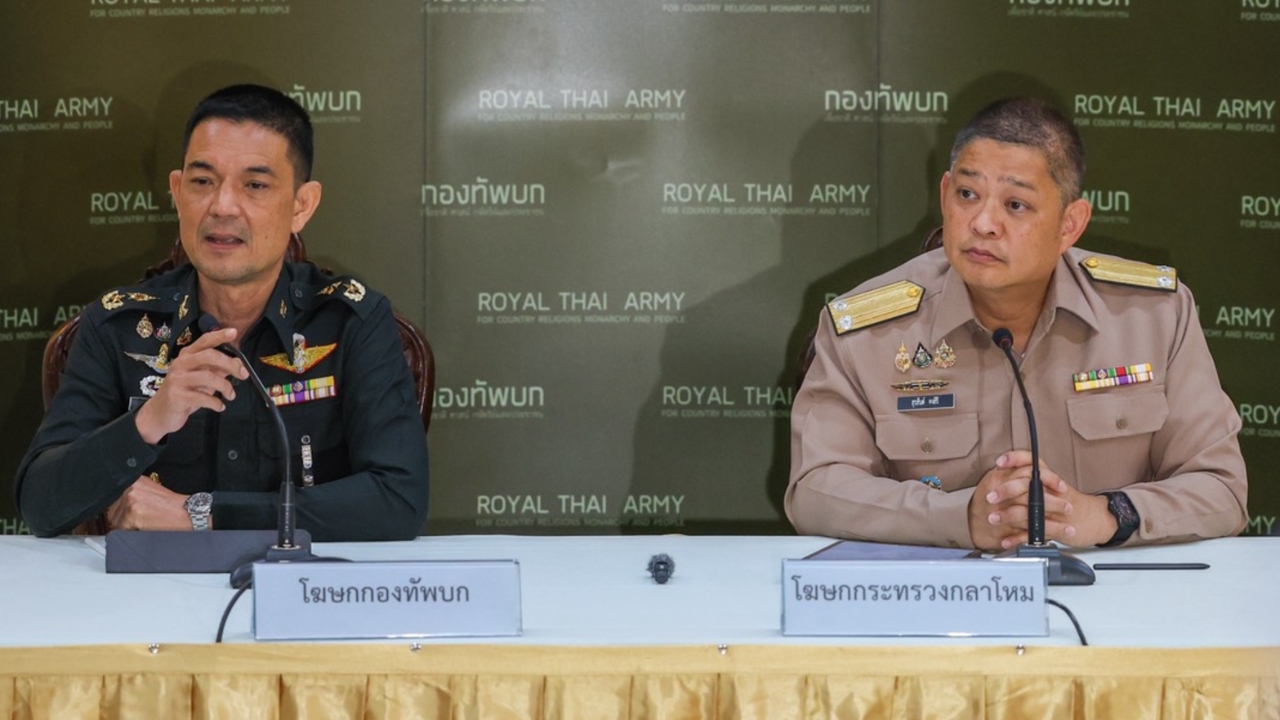
The Defense Minister instructed the Army to promptly correct misinformation about helicopters firing on civilians. Winthai pointed out that the unrest in the southern border was a deliberate provocation and affirmed that intelligence has not failed. The Army Chief emphasized the need for improvements and revealed the incidents are connected to the BRN.
On 24 August 2026, in the morning at the Army Headquarters (HQ). Lieutenant General Adul Boonthamcharoen, the Minister of Defense, visited the Army Headquarters. He was accompanied by General Phana Klaewplaodtook, the Army Commander-in-Chief, along with senior commanders and commanders of various army regions, except the Fourth Army Region Commander, who was represented by the deputy commander.
Later, at 12:10 p.m., Rear Admiral Surasan Kongsiri, the Defense Ministry spokesperson, held a press briefing after Lieutenant General Adul's visit to the Army Headquarters regarding the unrest in the three southern border provinces. He stated that the Defense Minister has been closely monitoring the situation and instructed investigations into misinformation to correct the public record promptly. This includes false claims that the army used weapons from helicopters to shoot civilians, which the Fourth Army Region Commander has already clarified. The Defense Ministry will support the regional armies accordingly.


Winthai acknowledged misinformation campaigns harming officials' reputations.
Meanwhile, Army spokesperson Major General Winthai Suwaree added that the southern border provinces have long been targeted by misinformation campaigns intended to damage the image of security personnel. Recently, the Internal Security Operations Command Region 4 Front (ISOC Region 4 Front) has adjusted its communication strategy, which addresses the simultaneous incidents at over 51 locations. These coordinated actions across multiple areas were not violent or aimed at harming civilians but intended as psychological operations using communication tactics. In the three southern border provinces, there is ongoing conflict involving law enforcement and information warfare. It is acknowledged that during the incidents, the situation was chaotic with many people moving about, while some officials were actively responding. Differences in perspectives may arise, often fueled by unverified information such as statements from political figures.

Emphasizing deliberate provocation and quantity of incidents.
Major General Winthai stressed that helicopters are not designed for such targets due to their speed and nighttime operations with limited visibility. Unlike in movies, helicopters are typically used for group targets such as escorts, which is not tactically appropriate here. Additionally, army personnel support for ISOC missions is within established rules and international norms. The use of weapons is rare except in self-defense. Tracking perpetrators is ongoing, with significant progress.
The Army spokesperson further explained that concerns about where officials were during the 51 incidents stem from comparing personnel numbers to vast operational areas. ISOC’s general principles require coordination with intelligence work, which remains functional but needs efficiency improvements. Most incidents occur outside community centers and high-surveillance zones. Tactical plans by military, police, and administrative authorities designate varying levels of area focus.
However, such incidents tend to be provocations focused on increasing the number of occurrences to affect morale among youth, emphasizing property damage rather than lives, aiming to create symbolic impacts. These acts are not difficult given the large number of locations, areas lacking official presence, and places not closely monitored, such as widespread destruction of electrical poles, which number in the hundreds of thousands.

Army Chief stresses improving intelligence capabilities.
Regarding concerns about intelligence performance, Major General Winthai explained intelligence operates at multiple levels, including local and systemic. For such incidents, intelligence on smaller-scale events may need enhancement. Intelligence units coordinate closely, forming an integrated intelligence community. He believes the system is not fractured but operates collectively.
He also addressed skepticism about intelligence accuracy, noting that perpetrators intend daily attacks but often succeed only sporadically, possibly due to readiness issues. It is challenging for intelligence to fully anticipate all incidents given the many districts and areas per province. Narathiwat province experiences the highest number of incidents. He admitted personnel shortages, especially at night.
Major General Winthai reaffirmed that these incidents do not undermine public confidence in officials and insisted intelligence work has not failed. Perpetrators intentionally raise such questions to pressure authorities, influencing public opinion and complicating problem-solving. Overall, statistics show improvements in reducing loss of life and property compared to the past. Meanwhile, General Phana continuously monitors the situation, emphasizing intelligence enhancements and stronger safety measures.

Incidents linked to BRN.
In conclusion, Major General Winthai stated that most incidents in the southern border are related to the BRN insurgency. Rear Admiral Surasan added that these events involved coordinated actions by insurgent groups, occurring simultaneously with concealed objectives not aimed at civilians’ lives. The exact motives remain unclear, but the operations are organized, and investigations must delve deeper into the root causes driving these attacks.