

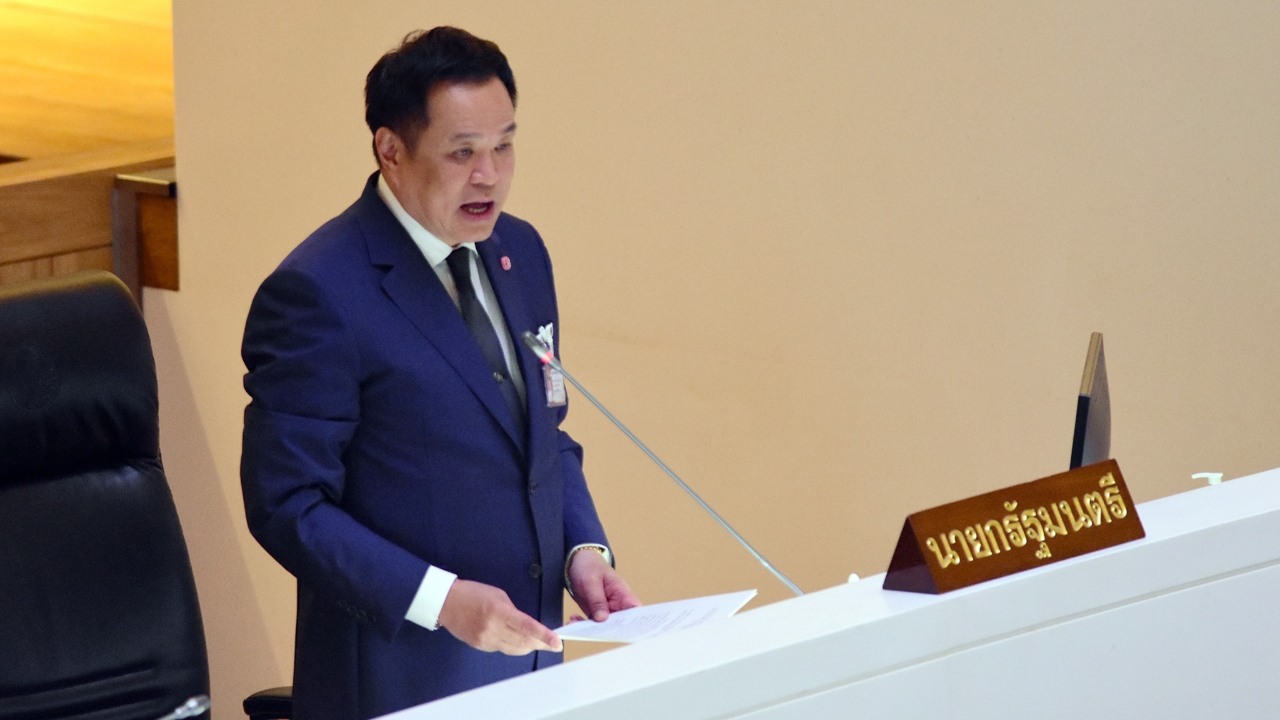
The Prime Minister addressed Parliament, pointing out the unavoidable urgent necessity to issue a royal decree authorizing a 400 billion baht loan to manage the energy crisis, reduce living costs, accelerate energy transition, and safeguard the nation's economic stability.
At 09:35 on 26 August 2026, Anutin Charnvirakul, Prime Minister and Minister of Interior, presented to the House of Representatives regarding the royal decree empowering the Ministry of Finance to borrow funds to address impacts from the energy crisis and promote the country’s energy transition for 2026, with a credit limit of 400 billion baht. He stated that on 5 May, the Cabinet approved the issuance of this royal decree, which took effect on 9 May, and the Constitutional Court ruled it constitutional under Article 172, paragraph one, as necessary to preserve economic stability amid an unavoidable emergency. During the parliamentary session, the government was to present the reasons, necessity, and key provisions of the 400 billion baht decree.
The Prime Minister explained the reasons and necessity: 1. The Middle East conflict is an unprecedented crisis; historically, OPEC bans on oil exports caused global shortages. Recent armed conflicts between Russia and Ukraine, and in the Middle East in 2026, involving destruction of gas wells, oil pipelines, storage facilities, ports, and closure of shipping routes such as the Strait of Hormuz, have disrupted oil production from this key region. Meanwhile, global oil demand remains unchanged, alternative sources cannot compensate, and current weather conditions remain uncertain.
2. Thailand imports nearly 50 percent of its oil from the Middle East, making it inevitably vulnerable. The country’s production structures in manufacturing, transport, and agriculture still rely heavily on petroleum. Transition to alternative energy remains low. This situation affects prices of goods, transportation, services, agriculture, and citizens. The impact has come in waves: initial panic, rising energy prices, increased food and service costs, higher living expenses, and reduced household income with rising production costs. Without intervention, this will cause economic slowdown amid high inflation, recession, and difficult recovery.
The Prime Minister stated that no one can predict when the Middle East situation will resolve; it may take years for oil production and exports to normalize, or it may never fully recover. Without structural reforms, risks will persist. This layered economic crisis requires managing multiple waves while limiting broad future impacts. Thus, this royal decree is essential for economic security since the current fiscal budget framework cannot sufficiently address the crisis in time, and existing budget tools are inadequate for prompt action.
He emphasized that the previous emergency budget was capped at 99 billion baht, which the Cabinet allocated to flood and disaster relief, and unrest along the Thai-Cambodian border. Consequently, the central and 2026 annual budgets are insufficient, with an additional 140 billion baht in necessary expenditures lacking coverage. The remaining central budget plus a 50 billion baht contingency fund under Section 45 are still insufficient to meet expenses.
The Prime Minister added that over 72 percent of the 2026 budget has been spent in the first two quarters, leaving limited funds for the third and fourth quarters. The budget transfer law process takes at least two months, which may be too slow to address the crisis. Revenue collection remains highly uncertain, and public debt management has only 17 billion baht of borrowing capacity left for budget deficit compensation, insufficient to support measures aiding those impacted by the energy crisis. Using the 2027 budget to cover the crisis is too late, as it becomes effective in October. Furthermore, the 2027 budget of 3.788 trillion baht must also support national development, climate adaptation, and other priorities. Requests from energy agencies are also insufficient to support the transition to renewable and alternative energy technologies to replace fossil fuels.
The Prime Minister acknowledged that although the government has implemented various relief and fiscal measures, these have not fully resolved the problems and may cause difficult-to-repair damage later. Without timely promulgation of this decree, the crisis will prolong and increase economic risks. Therefore, the decree is necessary to maintain economic stability and to establish energy price security and diversified production options as soon as possible to reduce energy import dependence, alongside developing citizens’ skills.
Regarding the future energy transition, the Prime Minister summarized that the decree aims to achieve three objectives: 1. To preserve national economic security as an unavoidable emergency, providing support to farmers, citizens, and businesses while reducing fossil fuel use and increasing alternative energy and domestic production; 2. To reduce fossil fuel consumption as rapidly and extensively as possible by using domestically produced alternative energy; and 3. To develop citizens’ skills and innovation to support restructuring the energy sector toward renewable and alternative energy.
The Prime Minister stated that in issuing this 400 billion baht loan decree, the government recognizes concerns about maintaining fiscal discipline, cost-effectiveness, and transparency. Therefore, it has established financial discipline frameworks: 1. The Ministry of Finance may borrow up to 400 billion baht in baht, foreign currencies, or debt instruments, with agreements signed by 30 September 2027; 2. Loan expenditures must follow the decree’s annex to assist citizens, farmers, and businesses affected by the energy crisis, with 200 billion baht allocated for relief and another 200 billion baht to promote the transition from fossil fuels to renewable and alternative energy technologies and skills. Since early 2026, the government has exhausted all legal funding avenues, making this 400 billion baht loan decree the last resort, as ordinary budgets and existing borrowing laws are insufficient. The government assures that combined borrowing under this decree and others will not breach the public debt-to-GDP ceiling of 70 percent mandated by fiscal discipline laws.
Regarding debt repayment, the Prime Minister noted that the Ministry of Finance has planned systematic domestic borrowing and repayment to spread risk and maintain appropriate cost levels, ensuring principal and interest can be serviced. He expressed confidence that debt levels will remain manageable within fiscal discipline frameworks. To ensure the loan’s cost-effectiveness, transparency, and auditability, the government prioritizes project vetting strictly according to the decree’s annex, focusing on urgent needs without overlap with regular budgets. Projects will be assigned to agencies ready to implement them immediately to maximize benefits for the Thai people.
In closing, the Prime Minister emphasized that the energy crisis is severe. After consideration, the government views this loan decree as essential and unavoidable to safeguard national economic stability. He requested Parliament to deliberate and approve granting the Ministry of Finance borrowing authority to resolve and transition Thailand’s energy crisis.
Additional reports noted that before the agenda, Sopon Sarum, Speaker of the House of Representatives, asked members present to stand in silent tribute for one minute to Mr. Rang Thurapol, former Udon Thani MP from the Bhumjaithai Party, who passed away on 20 July 2026. Consequently, the current active MPs number 499.
For today’s schedule, the opposition received 8 hours, the Cabinet 3 hours, coalition parties 1 hour, and the Speaker 1 hour, totaling 13 hours from 09:00 to 22:00.