

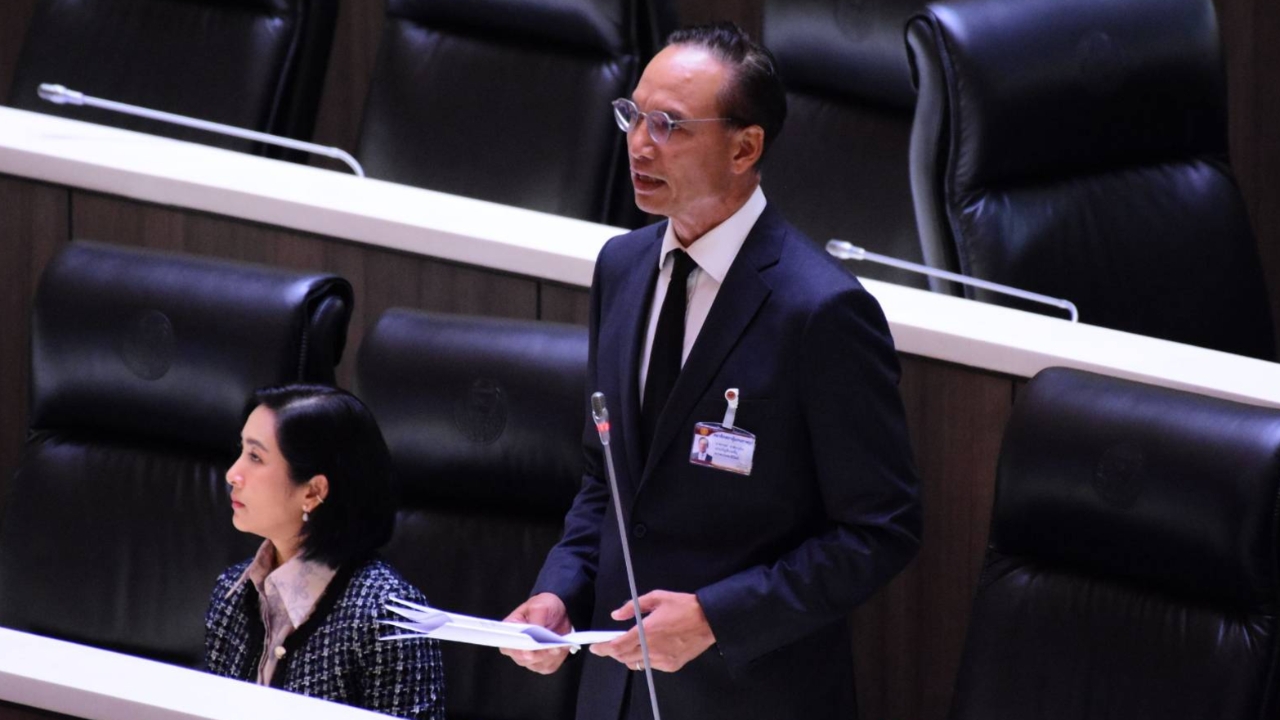
Korn stresses he will definitely oppose the 400 billion baht loan decree, pointing out there is no real urgent need. He cites the government's goal to support installing solar rooftops on one million households as unachievable within a single year. Borrowing large sums to distribute funds could impact the public debt ceiling.
At 10:20 a.m. on 26 Aug 2026 at the parliament, Korn Chatikavanij, party-list MP and deputy leader of the Democrat Party, spoke during the parliamentary session reviewing the 400 billion baht loan decree. He stated the country's main problems are fourfold: slow economic growth, structural issues including a growing current account deficit, declining household incomes, and continuously rising prices of consumer goods. He agreed with the government's explanation that rising oil prices are a cause and noted the Constitutional Court affirmed the government's authority to issue the decree. However, he questioned whether spending under this decree would truly solve these problems, viewing the borrowing and distribution of money as only causing a temporary economic boost without resolving citizens' issues. Regarding the transition from fossil fuels to renewable energy such as solar power via a fund supporting solar rooftop installations, the government has set a target of 500,000 to 1 million households using the loan from this decree. He asked whether the government could realistically achieve this, noting that in 2025 only 100,000 households installed solar rooftops nationwide, with an estimated 140,000 more in 2026. He projected 200,000 installations in 2027, which is less than half the government's minimum target and only one-fifth of the highest target of 1 million households. Therefore, he concluded the government would need five years to reach its announced goal of supporting one million households installing solar rooftops.
"These facts show that it takes time; therefore, there is no urgent necessity to rush borrowing. Furthermore, the decree's condition requires borrowing to be completed by 30 September 2027, just over a year from now. Thus, what the government should not and cannot do is borrow a large sum and hold it unused, as this would incur additional interest costs the government must bear. This reflects the reality that there is no urgent need to borrow the entire amount," Korn said.
Korn continued in his debate that this borrowing would affect the country's fiscal security and financial status, adding to the debt burden of citizens. Currently, Thailand's public debt-to-GDP ratio stands at 67%, with ongoing borrowing to cover the 2026 budget deficit and an additional 800 billion baht needed for the 2027 budget. Combined with this 400 billion baht loan decree, Thailand's public debt could rise by 1.8 to 1.9 trillion baht, or 10% of GDP, within just one year. This threatens to breach the 70% debt ceiling, reaching the maximum borrowing limit. He believes that when preparing the 2028 budget, the government will again face problems, lacking sufficient loans for the legally required 20% investment budget. At that point, the government will inevitably need to issue another loan decree, but will be unable to due to the debt ceiling already being reached. Therefore, regardless of any fiscal reasons, decisions should be based not on legal permissibility but on what is best suited to solve the cost of living issues and the slower economic growth compared to neighboring countries. His clear answer is that this loan decree is not the solution. He and Democrat MPs, along with opposition MPs, thus oppose issuing this 400 billion baht loan decree.